Judge gives nod to Philly in declaring NYC stop-and-frisk illegal
A federal judge in New York lamented that Mayor Bloomberg didnt follow the Philadelphia model in crafting a stop-and-firsk policy.
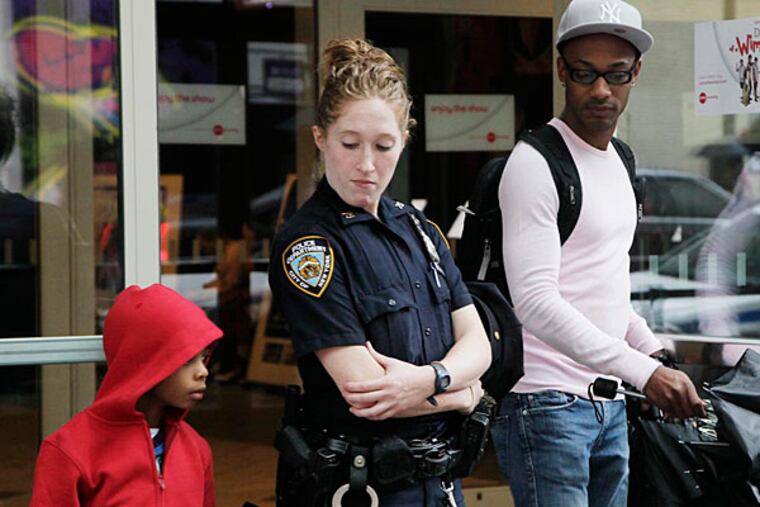
SIGH. New York City, why couldn't you be more like your little sister to the south, Philadelphia?
That's what a federal judge suggested yesterday in finding that the New York City Police Department's stop-and-frisk practices systematically violated the constitutional rights of scores of blacks and Latinos.
U.S. District Court Judge Shira Scheindlin, sitting in Manhattan, lamented that NYPD leaders hadn't followed Philly's lead and reached a settlement agreement to reform stop-and-frisk, rather than engaging in a drawn-out legal battle. It was a bit of a rib shot to Mayor Michael Bloomberg, who last year vowed not to cave - like Philadelphia - to civil-rights lawyers.
"I note that the city's refusal to engage in a joint attempt to craft remedies contrasts with many municipalities that have reached settlement agreements or consent decrees when confronted with evidence of police misconduct," Scheindlin wrote, referencing a June 2011 consent decree in Philadelphia that grew out of a class-action lawsuit brought by eight black and Latino men who alleged that police officers had illegally targeted them for stops and frisks.
In a 39-page "Remedies Opinion," the judge ordered the NYPD to adopt a stop-and-frisk form - similar to one currently used by Philadelphia police officers - to better document and detail the reason for a stop. She also mandated an independent monitor to oversee policy changes. As part of Philadelphia's agreement, JoAnne Epps, dean of Temple University's Beasley School of Law, has been supervising stop-and-frisk reforms for the past two years.
"It's in everybody's best interest that any stop that the police make is done within constitutional guidelines," Police Commissioner Charles Ramsey said yesterday during a telephone interview when asked why he and other city leaders chose to work with civil-rights lawyers who filed the federal lawsuit in 2010.
Civil-rights lawyer David Rudovsky yesterday credited Ramsey and Mayor Nutter for "dealing with the problem up front."
But, Rudovsky noted, the police department still has "a long way to go" in reforming what he called a "long-standing culture in which there were simply too many impermissible stops."
In recent months, Ramsey said he has taken several steps to root out problems. He recently assigned an inspector whose full-time job is to review stop-and-frisk forms. He also banned officers from using the term "loitering" as a reason for a stop, calling the word too general.
"There's always more work to be done. I'm never going to say, in any aspect of our operation, that you can't monitor and improve," Ramsey said. "We have to constantly monitor. It never ends. I think it's important to stay on top of it, and make sure training is sufficient and that we correct any behavior that is inconsistent with the department's policy around this issue."