Bravely rowing against the current of sexism
In the wake of thousands of collegiate student athletes converging on the Schuylkill last weekend for the 2016 Dad Vail Regatta, consider the story of the Philadelphia Girls' Rowing Club, the oldest organization of its kind in the country.
In the wake of thousands of collegiate student athletes converging on the Schuylkill last weekend for the 2016 Dad Vail Regatta, consider the story of the Philadelphia Girls' Rowing Club, the oldest organization of its kind in the country.
The development of American athletics is intimately connected to the history of competitive rowing. It was not on a diamond, court, or gridiron that the first intercollegiate sport was contested. Instead, it was on the nation's (calmer) rivers, and Philadelphia's connections to rowing are fathoms deep.
"As an occupation, rowing dates back to the 17th century when oarsmen would scull (with two oars) or row (with one oar) people across the Schuylkill before bridges were built across the river," observes historian Elizabeth Milroy. "Ferry 'men' were not always men - if someone arrived at a ferry needing to cross the river, oftentimes the person plying the oars was the wife or daughter."
However, for competitive rowing, it was not until the 1821 completion of the Fairmount Dam that the Schuylkill became suitable for racing, with intercity races quickly becoming a popular spectacle.
During a race against visiting New Yorkers, "the huzzas went up from such a goodly number of throats, that the verdure on the picturesque hills round about, seemed to quiver in the voice of gratulation," ran the purple description in an 1837 edition of the Spirit of the Times.
While women did row competitively in the 19th century - "oarswomen" are cited in an 1869 New York Herald Tribune, with a race held the following year between two women on the Monongahela River - they were certainly the exception.
Founded in 1938, the Philadelphia Girls' Rowing Club sought to reverse this.
The original organizers of the club were Ruth Adams Robinhold, Gladys Hauser Lux, Lovey Farrell, and Ernestine Bayer - whose husband, Olympic rower Ernest Bayer, became the club's first coach. Members were not posh daughters of Old Philadelphia families, but rather the city's secretaries, nurses, saleswomen, and typists.
In trying to establish women's competitive rowing, the club struggled against strong currents of sexism.
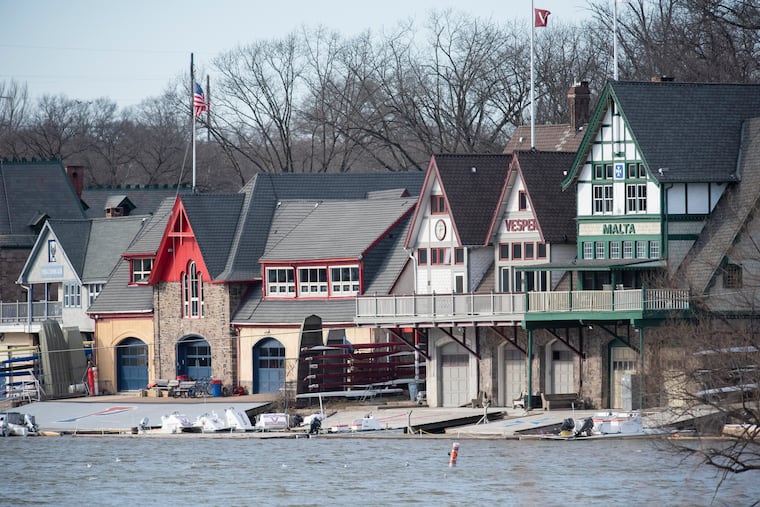
Many considered rowing a male-only sport, with several clubs along Boathouse Row outright barring women from joining as members.
"The most striking feature of the PGRC collection was the contrast between how the women viewed themselves and how the press and other rowers viewed them, especially during the early years of the club," said Megan Sheffer Evans, archivist for the Historical Society of Pennsylvania, who recently processed the club's records.
"The letters and minutes depict a group of highly driven and competitive women who were serious about their athleticism, but press clippings found in members' scrapbooks reduced them to a 'marriage club' only trying to attract husbands."
Condescending newspaper accounts lingered over the novelty of women rowing in their shorts.
"As long as they're only practicing, the girls can stop to 'powder up.' There'll probably be a rule against it once they get their own slip, which men along the 'Row' have promised to help them build," jeered the Philadelphia Record in 1938. "This picture may convince the girls that there's something to those jackets and blouses with lastex ribbing at the bottom. Or maybe they'll adopt overalls as their official costume."
This caddishness did not wash up onto every man lining the Schuylkill's banks. Olympian Tom Curran and renowned coach Rusty Callow were early supporters, as well as 89-year-old professional rower Fred Plaisted - who donated the club's first two boats.
Far from out of its depth, the PGRC soon impressed itself upon the Record's more enlightened male reporters.
"An admiring throng of would-be helpful men lined the shore at Boat House Row and offered encouragement to the feminine oarsmen," the now-shuttered newspaper reported in 1940. "The women disdained the advice and went right on with their first workout on a rough, windswept river."
In July 1939, the Schuylkill Navy agreed to host the first women's competition, a half-mile "exhibition race," which continued through the late 1950s. However, PGRC members struggled to find other female competitors or races.
This changed with the founding of the National Women's Rowing Association - in which PGRC member Joanne Iverson took part - and its successful campaign for women's rowing to be admitted as an Olympic sport.
The Women's Eight from the PGRC won the first National Women's Rowing Championships in 1966 and again the following year. The PGRC was also the first women's club to represent the United States in a European race, for which the club earned a key to the city from a proud Philadelphia.
Even the Schuylkill Navy came around, allowing the PGRC to join in the 1960s.
"As the years went by, some male rowers likely were discomfited by female rowers passing them at a faster rate on the river," Milroy added.
That this is no longer a shocking sight on the Schuylkill is a testament to the PGRC's tenacity.
Today, as one of the Schuylkill Navy's clubs, the PGRC continues to foster the spirit of women's competitive rowing.
Join Elizabeth Milroy, author of "The Grid and the River: Philadelphia's Green Spaces, 1682-1876," on June 15 for "Counting Trees: The Search for Fairmount Park," as part of the Historical Society of Pennsylvania's free #SummerBookChats. Visit hsp.org/Calendar to register.