Pardon me, Mr. President! | Editorial
Once used sparingly to temper justice with mercy, the presidential pardon has become a get-out-of-jail-free card for Trump supporters, no matter how corrupt or violent.
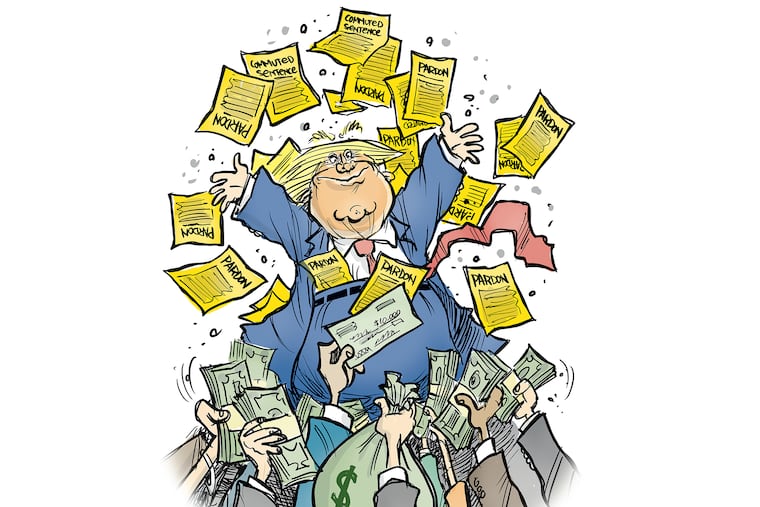
Donald Trump has abused his power in many ways, but one of the most grotesque is through his perversion of presidential pardons.
At the same time Trump has misused the U.S. Department of Justice to prosecute perceived political enemies, he has turned presidential pardons into a cottage industry, focused on freeing donors and business allies.
This abuse of power rewards cronyism and distorts the idea that everyone is equal under the law.
In Trump’s warped view, any allies with the right connections who got convicted or pleaded guilty were victims of a “witch hunt.” Conversely, anyone who refuses to do his bidding, or places their constitutional oath first, must be punished or prosecuted.
Ironically, Trump is the one waging the lawfare he frequently decries.
During the campaign, Trump promised retribution. The list of vindictive prosecutions shows that he has kept his word.
See: former FBI Director James Comey, Comey’s daughter, Maurene, E. Jean Carroll, former Federal Reserve Chairman Jerome Powell, Federal Reserve Governor Lisa Cook, New York Attorney General Letitia James, former CIA Director John Brennan, former FBI Deputy Director Andrew McCabe, the Southern Poverty Law Center, and many others.
At the same time, Trump has pardoned a number of disgraced politicians who were supportive of him, just as he pardoned a host of his loyal hatchet men at the end of his first term, including Steve Bannon, Michael Flynn, Paul Manafort, and Roger Stone.
The blatant abuse on both sides of the legal scale by a sitting president is noxious and undermines the rule of law.
Trump’s abuse of power rewards cronyism and distorts the idea that everyone is equal under the law.
Presidential pardons were meant to safeguard justice or demonstrate mercy. They were not meant to be dangled as rewards to cronies or violent supporters.
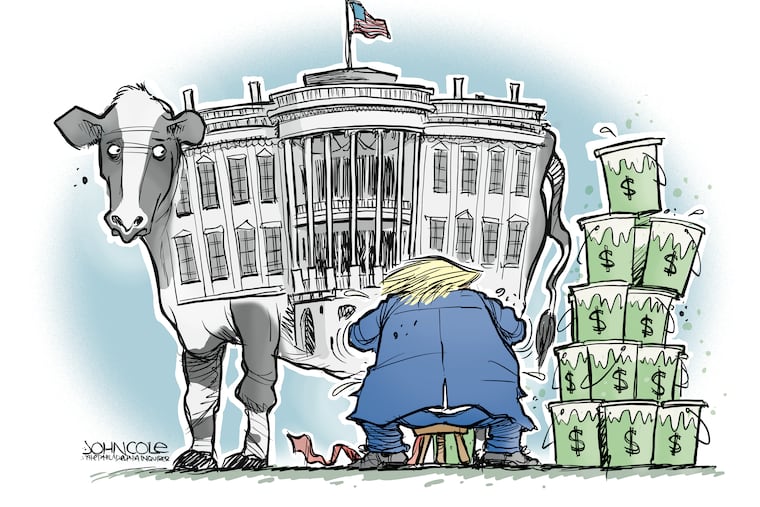
Trump’s pardon abuse also benefits him. He secures loyalty, buys silence, and signals that future lawbreakers who act on his behalf will be protected. In some cases, he receives benefits via campaign donations or sweetheart business deals.
The entire scheme is part of Trump’s broader Art of the Steal as he turns the power of the presidency into an instrument for personal gain.
To be sure, other presidents have issued controversial pardons to political friends and family.
Gerald Ford’s pardon of Richard Nixon, who resigned in disgrace to avoid impeachment, is probably the most notorious. More recently, Joe Biden pardoned his son, Hunter.
Bill Clinton pardoned Marc Rich, a wealthy donor. George H.W. Bush pardoned six Reagan administration officials entangled in the Iran-Contra affair, including former Defense Secretary Caspar Weinberger.
But Trump supercharged the pardon power in ways that make a mockery of the rule of law.
On his first day back in office, Trump issued sweeping pardons and commutations to approximately 1,500 defendants charged or convicted for their role in the Jan. 6, 2021, insurrection — which a bipartisan House committee and federal prosecutors found he incited.
The Jan. 6 insurrectionists ransacked the U.S. Capitol, attacked police officers, called for hanging then-Vice President Mike Pence, and hunted for then-House Speaker Nancy Pelosi. Nearly 100 of the Jan. 6 rioters Trump pardoned have gone on to commit new crimes.
Trump said the Jan. 6 pardons were justified, and that the Constitution gives him the absolute power to “do whatever I want.”
He has continued to issue pardons with that mindset. He preemptively pardoned political allies including Rudy Giuliani, Mark Meadows, and Sydney Powell last year, even though none of them faced any federal charges.
Trump super-charged the pardon power in ways that make a mockery of the rule of law.
In the first year of his second term, Trump granted 166 pardons, not including the mass pardons for the Jan. 6 insurrectionists. By comparison, during his entire four-year term, former President Biden issued 80 pardons.
Trump, who was found liable in a civil fraud case related to his businesses, seems partial to freeing white-collar fraudsters. In all, he has extended clemency to more than 70 allies, donors, and others convicted of fraud.
Trump’s abuse of the pardon system includes ignoring basic checks on the system.
Justice Department guidelines call for people seeking pardons to wait five years after release from prison, show remorse, provide evidence of rehabilitation, and file a petition through the Office of the Pardon Attorney.
That process has been obliterated. In its place, Trump essentially selects and issues pardons whenever and to whomever he wants.
Supporters and business associates are often at the top of the list.
Disgraced former U.S. Rep. George Santos (R., N.Y.) was freed after serving just three months of a seven-year term. In commuting the sentence, Trump cited the former lawmaker’s political support.
Trump pardoned former Illinois Gov. Rod Blagojevich, who campaigned for the president and appeared on his reality TV show Celebrity Apprentice.
Trump pardoned Changpeng Zhao, the billionaire founder of Binance, the world’s largest cryptocurrency exchange. Months later, the Trump family’s crypto company entered an alliance with Binance, a move that benefited World Liberty, the Trumps’ fledgling firm.
Some of those who have been granted clemency have received added benefits beyond their freedom.
Trump, who was found liable in a civil fraud case related to his businesses, seems partial to freeing white-collar fraudsters.
At the end of his first term, Trump pardoned his son-in-law’s father, Charles Kushner, who pleaded guilty to tax evasion and making illegal campaign contributions.
After returning to the White House, Trump handed Kushner the plum assignment of ambassador to France — a role in which he quickly proved to be unfit.
Other pardons have cost taxpayers millions.
Trump pardoned Trevor Milton, who was convicted of securities fraud, after he and his wife donated $1.8 million to Trump’s presidential campaign. The pardon eliminated $660 million in restitution obligations.
Trump pardoned a tax cheat weeks after his mother attended a $1 million-per-person fundraising dinner at Mar-a-Lago. The deal also eliminated $4 million in restitution Paul Walczak, a nursing home executive convicted of tax evasion, was supposed to repay to taxpayers.
In all, Trump’s pardons and commutations have wiped away nearly $2 billion that the offenders had been ordered to pay as part of their sentences.
He told advisers he plans to issue mass pardons on his way out the door, according to the Wall Street Journal. No wonder Trump’s henchmen continue to act with impunity.
“I’ll pardon everyone who has come within 200 feet of the Oval [Office],” Trump reportedly said during one meeting, generating laughs.
Sadly, the joke is on the American people.