Phils' Lidge works on holding runners on first
CLEARWATER, Fla. - Even before Johnny Damon helped point the 2009 World Series irrevocably toward a Yankees victory with his "Did that really just happen?" steal of two bases on one pitch in Game 4, Brad Lidge recognized the flaw in his own game. An inability to hold runners on base was one of many side effects caused by knee pain last season, and Damon's memorable heists reinforced the need to address it.
CLEARWATER, Fla. - Even before Johnny Damon helped point the 2009 World Series irrevocably toward a Yankees victory with his "Did that really just happen?" steal of two bases on one pitch in Game 4, Brad Lidge recognized the flaw in his own game. An inability to hold runners on base was one of many side effects caused by knee pain last season, and Damon's memorable heists reinforced the need to address it.
"That was the icing on the cake," said Lidge, who had allowed 11 of the 12 attempted base-stealers to succeed last year before that play. "The cake had been built all year long. It was a big cake. That was just putting the sprinkles on it. That slapped me in the face and made us very aware of what we had to do."
The signature play of the Series, Damon's steals provided a moment rich enough so that even now, more than four months later, there are still relevant layers to peel. Of primary importance to the 2010 Phillies, it solidified Lidge's belief that he needed to focus during spring training on paying greater attention to runners on first.
The right-knee issues plagued Lidge for most of the season, and caused him to alter his delivery. When healthy, the closer began his windup by shifting all his weight onto the knee and driving off it. In order to minimize pain last year, he took to twisting the knee at the beginning of his motion, which relieved some of the pressure but slowed the pitch's arrival at home plate.
"I had to twist, but that gave the runner extra time, about 0.4 [seconds]," Lidge said. "All of a sudden it becomes almost impossible for [catcher] Carlos [Ruiz] to throw a guy out, because of what I had to do just so I could pitch."
After undergoing January surgery, Lidge is much more comfortable than he was last year, and will revert to his former delivery.
"One thing that comes from the surgery is feeling more agile and not worrying that when you spin off the mound to make a pickoff throw, your knee is going to get caught," Lidge said. "When I did turn around and throw it to first, you were looking at a pretty stiff-bodied guy doing that."
Lidge, who plans to pitch in a minor-league game tomorrow for his first competitive action of the spring, will also work on small adjustments aimed to help him hold runners.
"I don't want to reveal too much about it, but let's say I have to make sure he knows I'm more aware of him," Lidge said. "Whether it's Johnny Damon or Michael Bourn, or someone like Carlos Lee, who is not fast but is smart - all those guys were stealing on me because I couldn't hold them."
Because Lidge's troubles were well-known by October, Damon surprised no one that night when, after singling to end a nine-pitch struggle with two out in the ninth, he attempted to steal second. At the time, the Yankees were up two games to one, and Pedro Feliz had just tied the game with an eighth-inning home run.
That was where the game shifted from memorable to classic. Switch-hitter Mark Teixeira followed Damon, batting lefthanded against the righty Lidge - and because of that, the infield shifted toward right field. Shortstop Jimmy Rollins became the temporary second baseman, and third baseman Feliz became the shortstop.
Standing on first, Damon considered waiting one pitch before trying to steal.
"I was like, 'OK, do I go on the first pitch or do I wait a pitch and see how quick Lidge is going to be to the plate?' Then I said, 'The heck with it, it's time to go,'" Damon said yesterday at Bright House Field, where his new team, the Detroit Tigers, played the Phils.
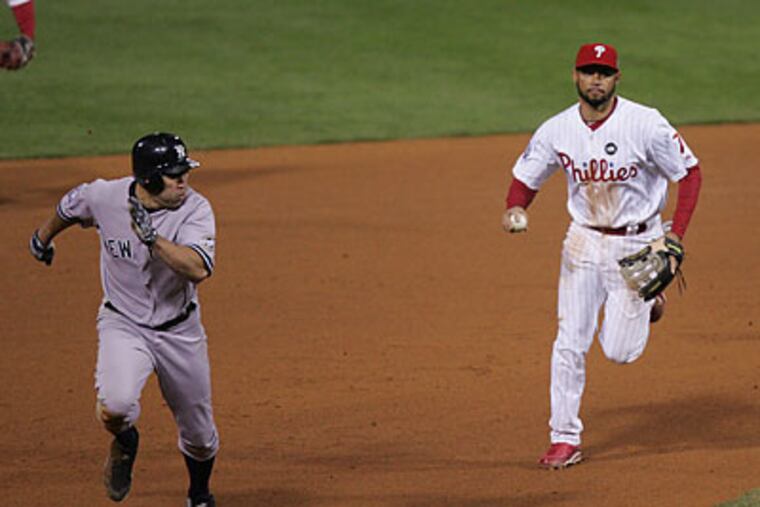
Lidge threw a slider in the dirt, leaving Ruiz able only to execute a weak throw to second. Feliz fielded it to the left of the base, and Damon looked toward third: No one covering, and no one close. Lidge was on the mound, Rollins and Feliz near second, Ruiz a few steps from home plate. Damon continued and was safe; Lidge then hit Teixeira and allowed a game-deciding double to Alex Rodriguez.
Manager Charlie Manuel said after the game that Ruiz should have covered third. Rollins blamed himself for failing to signal to Feliz that he needed to do it. Lidge said he had no idea whose responsibility it was. General manager Ruben Amaro Jr. said this spring that "it was the third baseman's job" to cover.
So who was Damon expecting to see on third?
"When teams put the shift on, the shortstop is sometimes the one who is called upon to cover the bag," he said. "But it depends on how much of a shift they're playing. You're asking the catcher a lot to throw the ball and start running, and you're asking the pitcher a lot to throw the ball, duck, and keep his eye on all that."
Basically, Damon did not expect anyone to cover third effectively, because he had watched the Phils' shift earlier in the Series and determined they were out of position to defend a double steal. Once he saw Feliz on second, he knew that third was his.
Though that play remains infinitely interesting to dissect, it is a distasteful memory for Lidge. Whoever was to blame for Damon's taking third base, the pitcher wishes he had not felt entitled to second.
"[I want to] make that runner very aware that he can't just take second base at will," Lidge said. "That's what they were doing last year."