Members of Congress tour EMR in Camden, push for oversight of fire-causing lithium-ion batteries
“We want to fix the problem before it turns into a fire,” U.S. Rep. Donald Norcross said.
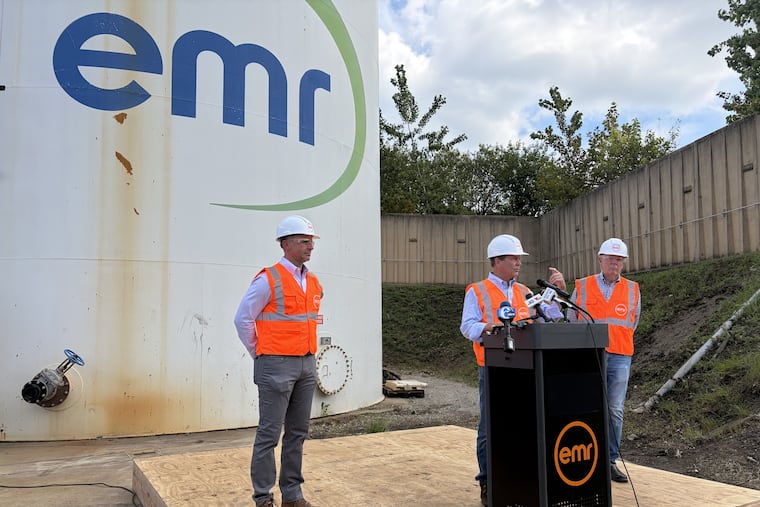
Two New Jersey Congress members appeared alongside EMR’s CEO on Thursday to call for more oversight on lithium-ion batteries, which the company blames for causing fires at its Camden scrap metal site.
U.S. Rep. Donald Norcross, a Camden Democrat, introduced the Battery Fire Prevention Act nearly a year ago, inspired by fires at the Camden facility. But it hasn’t made progress in the Republican-dominated Congress. He toured the EMR site Thursday with U.S. Rep. Frank Pallone Jr., of Monmouth County, the top Democrat on the House Energy and Commerce Committee.
“Today it’s Camden. Yesterday was North Carolina and Minnesota. It’s literally all 50 states and quite frankly, a global problem,” Norcross said of lithium-ion battery fires.
“The United States Congress has failed in this,” he added. “When we understand that China is more progressive in finding batteries in their waste streams, you know we have a big problem.”
Standing in front of gigantic piles of old household appliances, damaged cars, and other kinds of scrap metal with a view of the Philadelphia skyline, Norcross said his bill will advance once Pallone becomes committee chair in the coming months — if Democrats win back the House in this year’s midterm elections.
The bill would create a 30% tax credit for waste and recycling companies to purchase technology to help identify lithium-ion batteries and a 5% tax on the sale of lithium-ion batteries. It would also direct the Department of Energy and the Environmental Protection Agency to develop a battery buyback program. Using money from the battery tax, the program would award grants to facilities — like schools, local governments, or recycling plants — to collect batteries from consumers, who would get paid for returning their batteries. Those batteries would then be properly disposed of or recycled.
EMR’s machinery separates and shreds large pieces of metal and spits them out into new piles of knuckle-sized scrap. Lithium-ion batteries, which are found in everyday technology like phones, watches, and e-bikes, aren’t supposed to land at the site but end up in the waste streams anyway.
Joe Balzano, the CEO of EMR Metal Recycling USA, said that the company has mechanisms to detect batteries that are about to burst, but the technology that identifies the batteries in the first place that he could apply at his site hasn’t been invented yet. Instead, employees sort through objects and set aside items that could have the batteries, which are prone to catching on fire if they become damaged or overheated. Those fires can spew out of control when hidden in a giant pile of metal.
Norcross said research to solve this problem is currently underway.
“Necessity is the mother of invention, so I’m hoping that invention comes quick,” Balzano said in an interview.
While suppliers and workers have gotten better at detecting items with the batteries, “things that didn’t have a battery yesterday have a battery today,” he said.
Part of the issue is there isn’t an obvious way for consumers to easily dispose of these batteries, so they end up in the trash or on the curbs, he said.
“They get picked up by peddler scrappers, or they enter into the municipality waste streams, and then they make themselves through the recycling process, and they come here,” Balzano said.
Frustrated residents who have suffered the impacts of repeated fires at the site have called for the closing of EMR in Camden. The facility temporarily shuttered earlier this summer and the company entered a legal battle with the city before a judge allowed the site to reopen.
Norcross, who appeared alongside Balzano on Thursday, said shutting down EMR in Camden won’t solve the core problem.
“If this disappears tomorrow, it goes to the next community, and then they’ll be fighting the same thing,” Norcross said in an interview. “So we want to fix the problem before it turns into a fire.”
Pallone said another bill in his committee that would create federal waste rules for recycling lithium-ion batteries has bipartisan support. He said seeing the site firsthand helped him understand the issue.
“The batteries come here, they’re essentially coming in secret,” he said.
Norcross pointed a finger at the corporations that manufacture the batteries for not taking a proactive role in preventing improper disposal.
“The manufacturers of batteries can’t walk away from the problem of just selling their product, and it ends up wherever it does, causing fires,” the lawmaker said.