‘It was like we had won the Super Bowl’: 20 years ago, Philadelphians raised $68 million in 45 days to keep an iconic painting from being sold
“It was done in Philadelphia by Philadelphians for Philadelphia,” major donor Joe Neubauer said about keeping Thomas Eakins’ “The Gross Clinic” in the city the artist and the art called home.
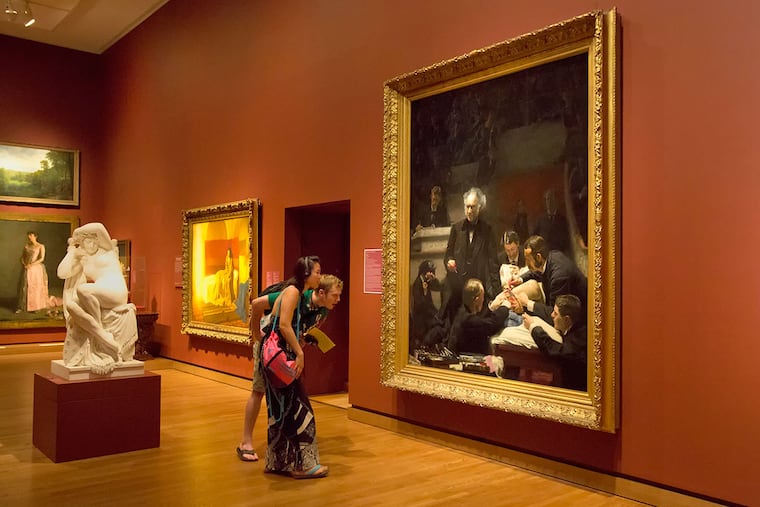
One painting stands out among the stately portraits, vast landscapes, and elaborate tableaux of figures in the Philadelphia Museum of Art’s early American art galleries.
And not just for its size.
In the 8-by-6.5-foot oil painting, a stern-looking man with fluffy gray hair stands next to an operating table. A crowded amphitheater watches him and a group of doctors operate on a boy’s leg. The wound, their hands, and their scalpels are covered in bright red blood.
This is Philadelphia native Thomas Eakins’ The Gross Clinic, painted in 1875 and depicting Samuel D. Gross teaching surgery at Jefferson Medical College at Thomas Jefferson University.
The painting is currently owned jointly by the PMA and the Pennsylvania Academy of the Fine Arts (PAFA), where Eakins studied.
But the story of the journey to that ownership is not a simple one.
In 2006, after 128 years of displaying the painting at Jefferson, the university sold it in a surprise deal. Local institutions had 45 days to match the price: $68 million.
PMA and PAFA started a public fundraiser, and Philadelphians took swift action — no one was going to take their painting away from them.
Twenty years ago, Philadelphia almost lost The Gross Clinic forever. Almost.
The slow burn of ‘The Gross Clinic’
Eakins was incredibly passionate about the medical profession. So much so that while studying at PAFA, he also enrolled in anatomy and dissection courses at Jefferson, where Gross was teaching.
“He was very obsessed with the accuracy of the body because as a painter, knowing the human body and depicting it is the highest skill level to attain,” said Reisa Mukamal, a PMA museum guide.
In The Gross Clinic, Gross is operating on an adolescent boy with osteomyelitis, a bone infection that had previously been treated with amputation. The painting depicts the doctors performing a newer procedure for the disease involving removing the damaged bone tissue rather than cutting off the limb — a stunning medical advancement.
“The light is shining off Dr. Gross’ head and it’s almost like your eye goes there. It’s a dark painting, and then your eye goes to his forehead, sort of symbolizing his intellect. … This is a live surgery, which was a brand new thing to paint,” said Mukamal.
Eakins was excited to show off The Gross Clinic at the 1876 World’s Fair in Fairmount Park, which doubled as a Centennial celebration and exhibition.
Unfortunately for the young artist, it was perceived as too disturbing for the art jury. The painting was moved to the fair’s U.S. Army field hospital exhibition due to its medical nature. Jefferson alumni gifted it to the university two years later.
‘It belonged here’
But 128 years after receiving that gift, Jefferson made a shocking announcement. On Nov. 11, 2006, university officials said The Gross Clinic was to be sold to a museum partnership between the National Gallery in Washington and the Crystal Bridges Museum of American Art in Arkansas, for $68 million.
The money from the sale would help finance an ambitious expansion plan for the medical school.
“This is a big undertaking, a transformational undertaking, and it requires a redirection of our assets,” said Robert L. Barchi, Jefferson’s president, in a November 2006 interview with The Inquirer’s Stephan Salisbury.
“We’re not a museum. We’re not in the business of art education,” he added.
Jefferson’s chairman of the board, Brian Harrison, said, “Our first obligation as trustees of the university, if we are going to release an asset like this, is to maximize value.” He acknowledged the “importance of the painting” to Philadelphia and noted that “the [Jefferson] alumni revered” it.
» READ MORE: Thomas Eakins turned Philadelphia’s medical history into high art. Philadelphians weren’t ready for it.
Once the deal brokered by the auction house Christie’s was struck, an additional clause was added to the agreement. It allowed Philadelphia to keep the painting if it could match the sale price. Jefferson gave the city 45 days to do so — a month and a half to raise the largest amount ever paid for a pre-World War II American painting up until that point.
“There’s no museum, in fact I can think of no nonprofit in the U.S., that can raise $68 million in 45 days,” said Kathleen Foster, senior curator and director of the Center for American Art at the Philadelphia Museum of Art. “There wasn’t really time to twiddle our thumbs, we had to just dive in.”
Anne d’Harnoncourt, the director and CEO of PMA at the time, “was never ever dissuaded,” Foster said. She started a fundraising campaign and immediately put the museum staff on phones calling government officials. She had them giving talks to the public, updating them on the campaign, and she suggested partnering with PAFA.
The museums met with bankers and coordinated to receive donations from Philadelphia-based philanthropists. The Annenberg Foundation, Gerry Lenfest, Pew Charitable Trusts, Nicholas and Athena Karabots, and Joe Neubauer all pledged donations in the millions, making up about a third of the funds raised.
Neubauer, formerly CEO of Aramark, has supported several institutions through his family foundation, including the Pew Research Center, Brandeis University, the Jewish Theological Seminary, and Calder Gardens.
“I like challenges. This seemed to me to be in the essence of Philadelphia,” said Neubauer, who donated $3 million to the cause. “An artist, who was the greatest artist in Philadelphia in his period, this was his greatest piece that he had ever done. It’s been in Philadelphia from the beginning. He lived in Philadelphia, worked in Philadelphia, went to art school in Philadelphia, went to Central High School. It belonged here and to take it out seemed to be just not fair.”
A few Eakinses for an Eakins
Both the PMA and PAFA parted ways with several of Eakins’ other paintings they owned via a process called deaccessioning — selling work from the collection and using those funds to keep The Gross Clinic.
Among Eakins’ paintings that the PMA sold was one of a cowboy playing the banjo. Several Dakota landscape paintings went to a Western art collection in Denver. PAFA had to sell a more beloved Eakins piece, called The Cello Player, to a private collector.
“That was sort of a necessary tragedy. Because it’s a private collector, they could come up with money fast, and the academy could get the money quickly,” said Foster. “For the museum it was a happier ending because the paintings [it deaccessioned] went on view to the public. For the academy it was sadder because the painting has basically disappeared, gone underground.”
As PMA and PAFA acquired big-name donors and sold beloved artwork, the story of the campaign reached the public. Civic outrage ensued.
‘Hopping mad’ Philadelphians
Steven Conn, a history professor at Miami University of Ohio, was invited to discuss the matter on a local AM talk radio show, then known as The Big Talker, after he criticized the sale of the painting on NPR.
“I had expected to defend the idea that we should care at all about the sale of this painting and was caught off-guard when I realized that not only the host but several of the callers were hopping mad about it too,” Conn wrote in the 2012 essay “Local Hero: The Gross Clinic and Our Sense of Civic Identity.”
Kathleen Foster recalls that even Conn’s taxi driver, who picked him up at the airport, became “incensed” when Conn brought up the possible sale of The Gross Clinic. The public was angry, and so were public officials.
“I had to give this talk and in the front row, there was Ed Rendell leaning forward in his chair, drinking up every word I was saying. Who knows whether he had any idea who Thomas Eakins was before he got this pep talk,” said Foster.
Rendell was governor of Pennsylvania at the time, and had previously served as the mayor of Philadelphia.
“He called up the director of the National Gallery and screamed at him,” said Foster. “He just said, ‘How dare you take this away from Pennsylvania? For shame!’ I heard the director had to hold the phone away because he was being yelled at by the governor of Pennsylvania. That kind of energy I think is pride that this is a gem for our city and for the state.”
But more important than how angry they were was how willing people were to donate. Before Reisa Mukamal was a PMA guide, she was living in Swarthmore, raising four children and working as a synagogue teacher and writing tutor. When she heard about the campaign, she knew she had to donate.
“I must’ve read about it in the news,” she said. “I didn’t contribute a lot, it was a modest amount of money. But there was no way I was going pass that up and it seemed like a once-in-a-lifetime story.”
‘Why would we want to let a cherished piece of art leave the community?’
Foster’s favorite story is of a little boy who donated $2.46 (his piggy bank savings) to the cause after watching his grandfather become infuriated after hearing about the story on television.
“It’s that kind of anecdote that just was so heartwarming that we just had Philadelphians at home in their living rooms listening to the television, maybe reading stuff from Stephan Salisbury in The Inquirer, and being outraged. We had this torrent of small gifts that were so adorable. Students, people with no money, and then there were the Annenbergs of the world giving a million dollars. We had this amazing spectrum of people.”
In Salisbury’s original coverage in The Inquirer, he reported that “a woman in Wyoming sent in $25 because her daughter, who lives in Philadelphia, said she wanted a ‘donation to this fund’ as a Christmas present” and “a woman from Philadelphia sent in $100 and noted that she had taken her whole family to see The Gross Clinic over the Thanksgiving holiday.”
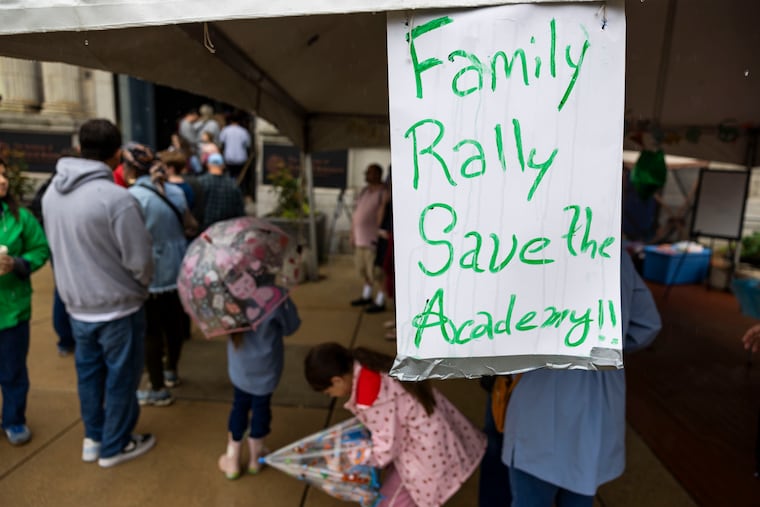
Faculty members at PAFA started selling buttons at the foot of the Rocky steps for a dollar; they said “Keep ‘Gross’ in Philadelphia.” From time to time, they’d bring their jar of dollars into the PMA to donate toward the fundraiser.
“It’s amazing to me that people hear about things in the news, whether they read it or watch it somewhere, and all of a sudden, $10, $15 dollars, $5, $1,” said Neubauer. “Contributions now are much more easily made than writing a check and putting it in an envelope and putting a stamp on it. It caught the spirit of the people. Philadelphians are proud of their city, and this was a pride in the city. Why would we want to let a cherished piece of art leave the community?”
The PMA and PAFA say the campaign received money from between 3,400 and 3,600 donors from across the nation.
“I hope people appreciate that it’s not contemporary art, it’s 19th-century art. When I was younger I always marveled at cave drawings. Why did people draw in the caves? Because it was important to them to show what nature was,” said Neubauer.
The PMA and PAFA raised enough money by the Dec. 26 deadline to keep The Gross Clinic at their institutions indefinitely.
“I think it’s very important for people in Philadelphia to go see it and understand that it was done in Philadelphia by Philadelphians for Philadelphia,” said Neubauer.
Supporters packed into the PMA’s Great Stair Hall to cheer on this victory for the Philadelphia art world.
“Ed Rendell came to the microphone, put his arms up like Rocky, and just bellowed in triumph over the acquisition of this painting,” said Foster. “This cheer goes up from the room, I thought the roof was going to lift. It was like we had won the Super Bowl.”
“The Gross Clinic” is currently on display in the Historic Landmark Building at the Pennsylvania Academy of the Fine Arts, 118-128 N. Broad St., Philadelphia, Pa. 19102.
[Editor’s note: Morgan Ritter is The Inquirer’s first recipient of the Stephan Salisbury Internship for Arts Journalism. Salisbury died in 2024, after a long career as an arts and culture reporter for The Inquirer — including his reporting on the proposed sale of “The Gross Clinic.” ]