Grappling with past, present, and the patriarchy, while sometimes in the nude: ‘Liberation’ at Philadelphia Theatre Company
The riveting Philly premiere of the Tony-winning drama is one of two recent plays to explore the complexities and constraints of women's lives
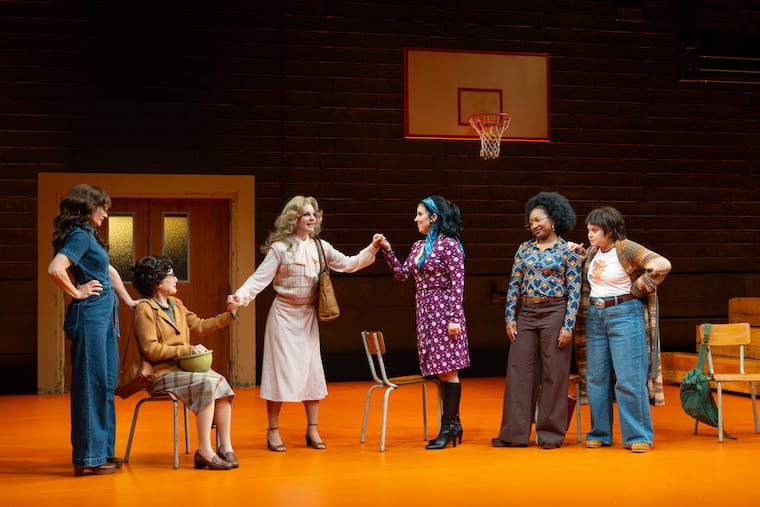
Both Bess Wohl’s Liberation and David Auburn’s Summer, 1976 examine women’s choices, relationships, and regrets through the scrim of memory and against the backdrop of second-wave feminism. And both happen to be set primarily in 1970s Ohio, a middle American bastion being assaulted by changes whose effects are still being felt.
The Lantern Theater Company’s poignant Philadelphia premiere of Summer, 1976, directed by Kate Galvin, closed Oct. 11. But you can, and should, see the Philadelphia Theatre Company’s Liberation, which opened Wednesday night and runs through Oct. 25. Also a Philadelphia premiere, it is the Pulitzer Prize and Tony Award-winning show’s first regional production since its 2025-26 Broadway run.
The two memory plays view women’s concerns through a contemporary lens, toying with theatrical conventions, decentering men, and moving almost seamlessly between eras. At critical moments, each also riffs on an imagined, and more expansive, future before returning with a thud to the compromised present.
In Summer, 1976, Auburn (best known for Proof, a drama about a female mathematical genius) sketches an unlikely friendship between two women in Columbus, Ohio, at a key juncture in their lives. It’s an exquisitely well-crafted piece that seems, in the end, almost as evanescent as the relationship it portrays.
Alice (played appealingly at Lantern by Grace Gonglewski) is a graduate school dropout, the tradwife of an economics professor at Ohio State University but also something of a free spirit. Diana (McKenna Kerrigan) is a tougher character — a single mother, artist and art teacher. Their young daughters become friends, catapulting the women into an initially uneasy intimacy.
The setting is the Bicentennial summer, evocative of our own Semiquincentennial celebrations. Fireworks illuminate the night skies, and the metaphor of independence undergirds the slight plot.
Diana lives stoically on her own, and in the world of her imagination. Alice rebelliously subverts her husband’s model babysitting co-op. Together they admire a hunky graduate student, share joints, feast on Diana’s cooking, buy a Bauhaus desk, and realize with a start that “people aren’t just one thing.” It’s the most modest of revelations. When Diana leaves Columbus, they recede from each other’s lives and move toward their different, still circumscribed fates.
In Liberation, too, we are poised between memory and fantasy, stasis and change. While the protagonists of Summer, 1976, alternate narrative duties, Wohl’s play has a single, modern-day narrator, Lizzie (the engaging Julianna Zinkel), a stand-in for the playwright herself.
Trying to recover — or imagine — her mother’s feminist past, she wonders: How could an instigator of a consciousness-raising group and onetime Ms. magazine editor have ended up in such a traditional marriage?
Lizzie’s question opens up a broader interrogation, about how and why the revolutionary fervor of the 1970s women’s movement ran aground. And about how exactly contemporary women should respond.
The central theatrical conceit is that Zinkel/Lizzie also plays Lizzie’s mother — except in pivotal instances when she doesn’t. (One of her stand-ins, Noelle Diane Johnson’s Joanne, articulates the objections of a working-class Black woman to the movement’s presumptive class and racial tilt.)
Under Taibi Magar’s direction, the PTC production (in association with Baltimore Center Stage) hits all the play’s comic beats. Magar, PTC’s co-artistic director, has assembled a stellar ensemble to embody the half-dozen women who spar and spur one another on in the basement basketball court of a recreation center. The realistic set is by Sasha Jin Schwartz; costume designer LeVonne Lindsay dresses the women variously in print shirtdresses, bell-bottoms, overalls and pastel suits.
Dora (Campbell O’Hare, fabulous in a showy role) stumbles into the group thinking it is a knitting circle; over time, she finds her voice and her vocation. Margie (Susan Rome) is the oldest, with a retired husband who still leaves a long litany of household tasks to her. Her ambiguous win will be getting him to do the dishes, badly, twice a week.
Susan (Anna Faye Lieberman) is broke and living in a car with her bird — until invited to move in with Celeste (Ciera Gardner), a Black Radcliffe graduate caring for her dying mother. Lee Minora’s Isadora, an Italian immigrant with a sketchy accent and a green card marriage, is self-righteous, radical, and desperate for concrete action.
All of them appear in the nude for a CR session devoted to assessing their own bodies. The scene is daring, overlong, somewhat gratuitous, and the reason that audience members are obliged to stash their phones in locked pouches for the show’s duration.
On Broadway, the Tony-nominated Betsy Aidem did a star turn as Margie, anchoring an intense, tragicomic reunion. Collapsing past and present, the climactic encounter exposes the limits of both memory and invention and offers a hint of resolution. The PTC production, for all its polish, can’t quite scale the requisite emotional heights.
Liberation supplies no road map for women to escape the trap of their own conflicting desires. It doesn’t pretend to, deliberately leaving the answers to us. But it remains a riveting evening of theater, likely to spark lively conversations about where feminism has succeeded, and where it has fallen short.
“Liberation” runs through Oct. 25 at the Philadelphia Theatre Company’s Suzanne Roberts Theatre, 480 S. Broad St. 215-985-0420 or philadelphiatheatrecompany.org