There would be no US Navy without Philadelphia
The decision to create the Continental Navy and Marines was part of an offensive strategy that helped the the colonists win the Revolutionary War. It was taken in Independence Hall.
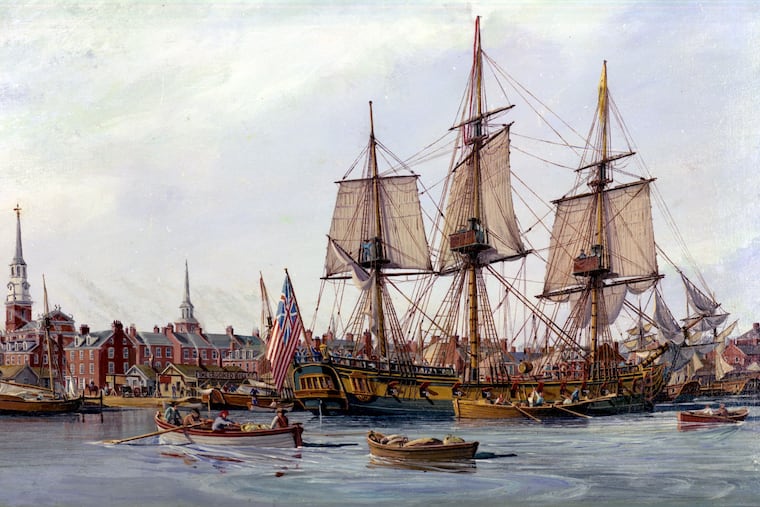
It was the summer of 1775 and Rhode Island’s delegates were concerned.
The colonists had been at war with Britain for four months and the battles were heating up. Bounded by the Narragansett Bay, a tributary of the Atlantic Ocean, Rhode Island was particularly vulnerable to a surprise British ambush by sea.
The New World’s tiniest colony knew they needed the fire power of fellow colonies to hold off the world’s largest navy in a sea battle. So in August, Rhode Island sent delegates to the Second Continental Congress in Philadelphia’s Independence Hall to request a “fleet of sufficient force for the protection of these colonies [to] be established.”
On Oct. 13, Congress voted to grant Connecticut and Rhode Island merchant vessels to patrol the North in a search-and-destroy mission of British ships. The Congress also voted in favor of supplying General George Washington with an armed schooner and sloop to seize British supplies.
With the authorization of the military to protect its interests on water, the Second Continental Congress created the U.S. Navy.
The U.S. Navy’s beginning will be remembered Saturday at the Arch Street Meeting House firstival, part of the Philadelphia Historic District’s yearlong weekly celebration honoring important American institutions that trace its beginnings to Philadelphia.
“The creation of an American naval force was a key strategy to winning the war,” said Sean Connolly, executive director of the Arch Street Meeting House Preservation Trust. “It also proved to other European nations like the French, the Dutch, and the Spanish that we were to be taken seriously, that we were just like other world powers.”
Guarding the seas was just one part of the colonists’ military strategy. When the ships arrived at their destination they needed to employ guerrilla fighters and marines to match up to the might of the British Royal Marines.
The Continental Congress established two batallions of the Continental Marines on Nov. 10. Later that month, on Nov. 28, Massachusetts delegate John Hancock appointed Philadelphia Quaker Samuel Nicholas as the Marines’ first commissioned officer.
In March of 1776, Nicholas took a ship outfitted by another Philadelphia Quaker Joshua Humphreys to New Providence, the capital of the British-controlled Bahamas where he commanded the United States to raid a British ship and steal its weapons and gunpowder.
It was a strategic mission, Connolly said, to capture and destroy ships used to fight the colonists on American soil.
“It was a way of weakening the British forces by diverting their attention from America to their colonies in the Caribbean,” Connolly said. “We needed ammunition. So we decided to raid their forts of gunpowder and cannons and take it back to America. We were very successful, capturing 88 cannons, 15 mortars, and a huge amount of gunpowder.”
Most importantly, the Americans would no longer be underestimated. This show of military power, Connelly said, is why France joined the colonists.
After the Treaty of Versailles was signed in 1783, Congress disbanded the Colonial Navy and Marines. The Continental Army was a mere shell of itself.
“The Founding Fathers didn’t think we need a permanent military force anymore,” Connolly said. “They believed an armed militia could potentially be used against the government.”
But the need for defense proved necessary.
In August 1789, Washington (who was now president) created at he U.S. Department of War, appointing Henry Knox as its first secretary. On Sept. 29, 1789, Washington reestablished the U.S. Army under the Constitution.
During his second term as president on March 27, 1794, Congress created the Navy as we know it today to protect American ships from pirates on the Mediterranean Sea. Humphreys was called on to build the first six U.S. Navy frigates.
One of the ships Humphreys designed, the USS Constitution, is still in active service as a training vessel for the Navy, Connolly said.
On July 11, 1798, President John Adams signed the act establishing and organizing the U.S. Marine Corps as a part of the Department of the Navy.
“The Quakers were pacifists, yes,” Connolly said. “But we cannot forget their military contributions to helping America become America.”
This week’s Firstival is Saturday, Oct. 17, from 11 a.m.-1 p.m., at the Arch Street Meeting House, 320 Arch Street.
Each week, The Inquirer is highlighting a “first” from the Philadelphia Historic District’s 52 Weeks of Firsts. A “52 Weeks of Firsts” podcast, produced by All That’s Good Productions, drops every Tuesday.