A rural transgender story of love and acceptance unfolds on the Avenue of the Arts
The world premier play seeks to disprove the myth that trans people can only find happiness in cities.
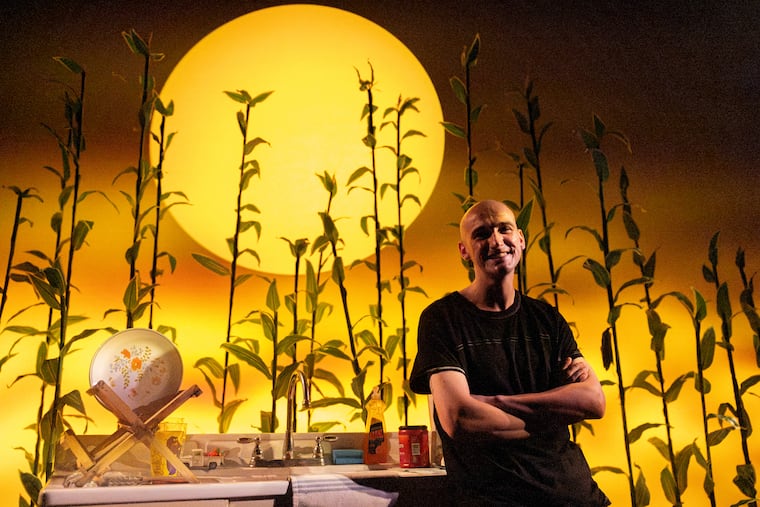
A rural Pennsylvania tableau is laid out across a stage on South Broad Street for the Wilma Theater’s latest production.
There are fresh green cornstalks in the foreground, and the sky glows violet behind them as the two main characters of Horsegirl & Cowdaddy take the stage.
Horsegirl, played by Samora de la Brisa, is a trans woman in her thirties, living and working near a farm in an unnamed southern Pennsylvania town with Cowdaddy, her father, played by Mt. Airy’s Lindsay Smiling.
Horsegirl, it turns out, told her father she was trans years earlier, and while he’s still a bit confused by pronouns, his daughter’s identity is not an issue.
“I thought she was just, er, you know, gay,” Cowdaddy says in a scene, explaining the day Horsegirl came out to him, to his daughter’s love interest. “But then she said, she told me, ‘I’m a girl,’ er, and I thought, ‘well’.”
Writer DJ Hills, a Queen Village resident who grew up in rural Western Maryland, said one of the goals for their play, which had its world premiere at the Wilma on Friday, was to show that rural America isn’t always a hellscape for queer people.
“I don’t think that there was ever a moment of my life when society didn’t see me as queer in some way,” Hills, 31, said at Wilma on Thursday. “I was really cared for by my family, even when they didn’t always have the language or an understanding of who I was; there was always a lot of care, my grandmothers in particular.”
A 2019 report by the Movement Advancement Project, a Colorado nonprofit focused on LGBTQ equality and democracy, found that approximately 16% of trans Americans live in rural areas. The nonprofit said this population faces unique challenges, including higher poverty rates and “increased visibility.”
“There’s a present-day myth that trans people can only find happiness in metro areas and cities,” said Samora de la Brisa, who is trans. “We are everywhere. We exist in multitudes.”
In 2023, The Inquirer spent several months chronicling the lives of two transgender women making their way in rural Dauphin County. One woman — Stephanie Fritsch — wanted to stay there. The other, Billie Jean Williams, wanted to get to Philadelphia or another city.
“You know, I want to be happy, she wants to be happy, and I want people to be happy with their lives. That’s pretty simple, right?” Billie Jean told The Inquirer. “I don’t know what happened in America that made that so difficult.”
In the play, Horsegirl faces a difficult decision about where to live, whether to follow a love interest across the country or stay in rural Pennsylvania with her father. Cowdaddy struggles with past losses and, possibly, future ones, worrying about how his daughter would be treated in a new place.
“Folks here know her,” Cowdaddy says.
Smiling, who was recently named artistic director at the Wilma, said he empathized with the character Mills created.
“He’s got his issues but [is] a very loving father, a patient father doing the best you can for his kid,” Smiling said. “He’s human, just like us, and one of the wonderful things about the play is there are villains.
Hills said Horsegirl & Cowdaddy was inspired by a simple conversation they had with their father one afternoon in Greencastle, Franklin County, during the pandemic. While the play will be heading to New York City next year, Mills would like to have a run in Pittsburgh and, perhaps, rural settings.
“You can’t call yourself an American playwright if you’re only interested in New York, speaking to New York audiences,” they said.
“Horsegirl & Cowdaddy” plays through Oct. 4 at the Wilma Theater.