What 100,000 fans saw at the Linc: HBCU excellence is the norm
Across two years and three football games at Lincoln Financial Field, the part of the country that most needs to see it got a demonstration of what HBCUs do.
Loren LoRosa is the cohost of “The Breakfast Club,” a 2014 graduate of Delaware State University, and the founder of Brown Girl Grinding. Tony Allen is the president of Delaware State University, a senior fellow at the Dr. N. Joyce Payne Research Center, and a recipient of the National Urban League’s Whitney M. Young Jr. Award.
One of us — Loren — graduated from Delaware State University in 2014, the first in her family to finish college, and now sits behind a microphone that reaches millions of people every weekday morning.
The other — Tony — was also a first-generation college student, and has been president of Delaware State since the start of the decade.
We are a generation apart, but we were both at the Linc on Oct. 31, and we came away believing the same thing — that what happened in South Philadelphia that night wasn’t just a football game. It was a demonstration of what historically Black colleges and universities do, staged for the one part of the country that most needs to see it.
Ask any high school junior in North Philadelphia, Camden, Chester, or Wilmington to picture an HBCU, and they will likely picture the South: Atlanta, Houston, Tallahassee.
They may not know that the oldest HBCU in the country is 40 minutes from their house, that Lincoln University gave Philadelphia its mayor, or that the most diverse HBCU in America is an hour south of Wilmington, in Dover. The Northeast Corridor, from Washington to New York, is home to nearly a dozen HBCUs and one of the largest concentrations of Black families in the country.
Howard and Lincoln first played each other in 1894. In 1919, they began the Thanksgiving Day series that Black Philadelphia and Black Washington simply called “the Classic,” alternating between the two cities. Then the tradition thinned.
Two years ago, Mayor Cherelle L. Parker, the Philadelphia Eagles, Norfolk State University, and Delaware State University brought it back.
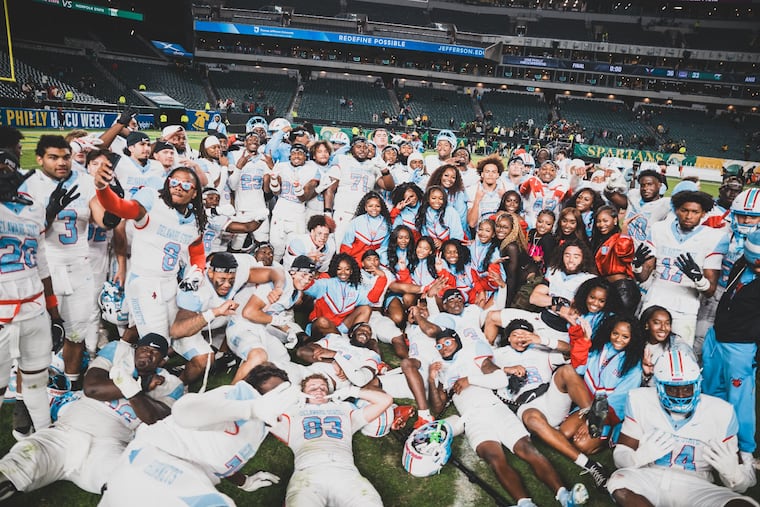
Across two years and three games, more than 100,000 people have come to Lincoln Financial Field to watch One Philly HBCU Week football. On a cold, wet night in October a year ago, 47,266 were there for the first meeting of Michael Vick’s Norfolk State and DeSean Jackson’s Delaware State teams. It was televised on ESPNU, and Good Morning America was in the building.
This year, 21,000 gathered at the Linc on Friday, Oct. 30, for a matchup between Lincoln University and Virginia Union, and 32,500 on Saturday, Oct. 31, watched this year’s rematch between Norfolk’s Spartans and Delaware State’s Hornets — with the Hornets storming back from 17 points down to win the game.
The winning quarterback, Marqui Adams, grew up in Philadelphia and went to Neumann-Goretti. Coming back to his home city, he said afterward, felt like a blessing.
Here is what the weekend did for the young people in those stands and in the region.
It put the institutions in front of them. On Friday afternoon, before anyone kicked a ball, the Linc hosted a college and job fair where high school students met admissions officers and employers from colleges across the country, then a step show.
It put HBCU culture on the air.
On Friday morning, The Breakfast Club, heard in more than 90 markets and streamed live on Netflix, broadcast from the stadium; for the first time in the show’s history, it has gone on the road. HBCU graduates, the presidents of the Divine Nine organizations, the mayor, the West Philadelphia High School band, Lincoln’s cheer squad, and Miss Lincoln filled four hours of national morning radio with the sound of these schools.
The millions who listen to The Breakfast Club every morning heard a 189-year tradition of excellence that began just outside Philadelphia, at what is now Cheyney University.
It put the evidence on the table. The Dr. N. Joyce Payne Research Center at the Thurgood Marshall College Fund reported last year that nearly 70% of public HBCU graduates reach the American middle class or above — a rate about half again higher than graduates of predominantly white institutions — and that applications to public HBCUs have risen 126% since 2004.
This summer, the center, with Gallup, surveyed HBCU alumni from the last 15 years and found 70% thriving in their everyday lives, against 46% of Black adults nationally; 79% saying the education was worth the cost, 46% engaged at work (half again the national rate), and half holding a good job within two months of graduation.
These are not feel-good numbers. They are return on investment, for the student and for the region that keeps them.
And it put money and attention into a city and a corridor. More than 100,000 fans across two Octobers filled hotels, restaurants, and SEPTA cars; four universities, a city, and an NFL franchise learned to work together; and a generation of Philadelphia students now has a reason to look at Lincoln, Cheyney, Delaware State, Morgan, Howard, and the rest of the corridor’s HBCUs as their own.
When one of us — Loren — enrolled at Delaware State, people told me I’d never get a good job. I interned at a magazine in New York, produced television, reported for TMZ, and brought a national broadcast to the Eagles’ stadium. I’m not the exception. This is normal.
The other one of us — Tony — has spent my career watching the country treat HBCU success as a surprise. The facts say otherwise. The steady, ongoing pattern of HBCU-driven success has built much of the Black American middle class.
That is what the weekend at the Linc was for. Not to prove HBCUs can fill a stadium. To let the Northeast Corridor’s young people see, in person and on the air, that the schools down the road from them produce exactly the lives they want. And that choosing one is not a long shot. It is normal.
About guest essays
Guest essays, or op-eds, are commentary pieces that present the opinion or perspective of the author. Many are submitted to us by Inquirer readers and writers with insight on the news, but we also solicit op-eds from authors on specific topics. For more information visit our guidelines.