A Penn professor thought she’d sell 1,000 copies of her ‘Odyssey’ translation. She sold more than a million, thanks to Christopher Nolan.
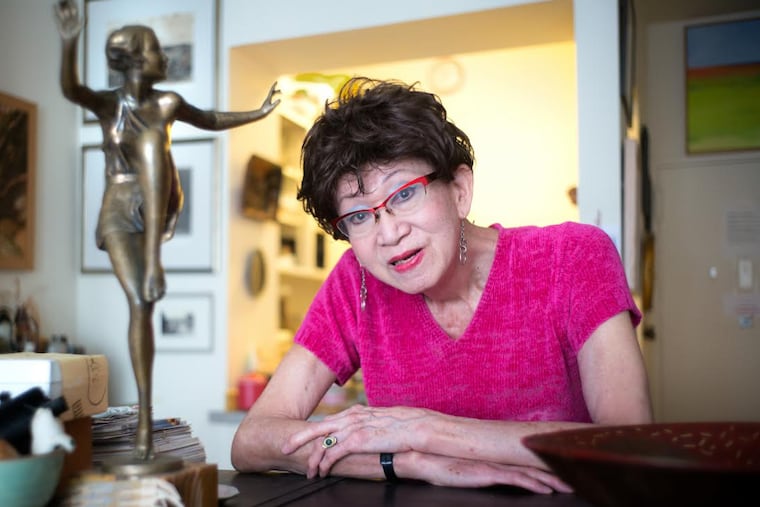
West Philly's Emily Wilson, who penned a highly acclaimed translation of the epic poem in 2017, is having a big summer.
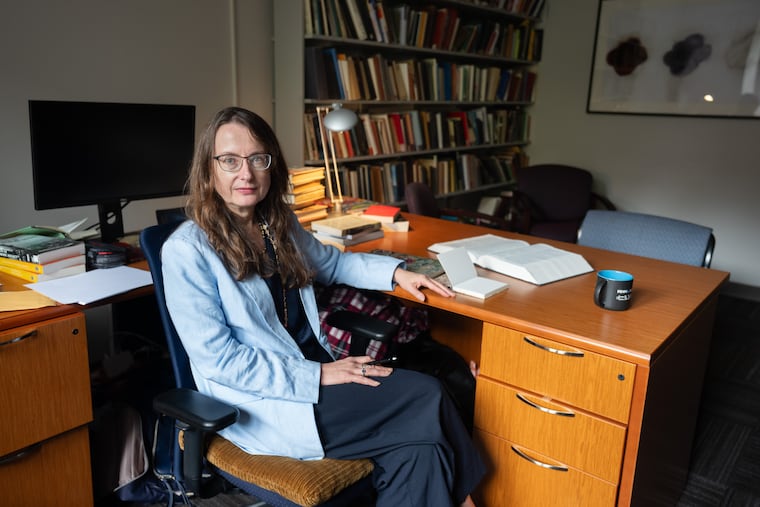
Classics scholar Emily Wilson was in Greece’s Costa Navarino last year when she heard the news that would change her life: Filmmaker Christopher Nolan was planning to release a star-studded adaptation of The Odyssey, the epic poem that Wilson had spent years painstakingly translating from Homeric Greek into English.
Nolan’s film crew, Wilson learned, had just left the Greek town where she was now staying. As she walked along the beach, the University of Pennsylvania professor imagined what scenes of adventure had been conjured on the ground where she stood.
The seductively scary sirens calling out to Odysseus? The giant Cyclops who eats his men? (Spoiler alert: It was the latter, shot at Nestor’s Cave in nearby Messenia.)
Nolan’s film was a thrilling prospect for the classicist who made her name penning a quick-paced and strikingly contemporary translation of the nearly 2,700-year-old story for modern audiences. While the Oppenheimer director wrote his own version for the big screen, along with partner-collaborator Emma Thomas, he has cited several translations, including Wilson’s, as references.
“It’s great that there’s going to be a whole new wave of people who may not have thought much about The Odyssey, may not even be familiar with the narrative, who may then get excited about it, because Christopher Nolan is a big name,” said Wilson, who lives in West Philly with her partner, David Foreman, a Swarthmore College administrator, her two younger daughters, Psyche and Freya, their cats, Pumpkin and Spice, and their dog, Pepper. (Her eldest daughter, Imogen, just graduated from Temple University.)
The Nolan bump is already in effect: The Odyssey made $263.7 million globally on opening weekend, and it has been hailed as a total triumph for the filmmaker behind Inception and Interstellar. The cast features Nolan regulars like Matt Damon (Odysseus), Anne Hathaway (Penelope), Robert Pattinson (Antinous), and Elliot Page (Sinon), as well as Tom Holland (Telemachus, son of Odysseus and Penelope), Zendaya (Athena), John Leguizamo (Eumaeus), and Lupita Nyong’o (Helen of Troy/Clytemnestra).
But even before the red carpets and glitzy media tours, Wilson saw a surge of interest in her 2017 translation. Last year saw a significant increase in book sales following the film announcement, and those numbers have continued to rise into 2026, said Louise Brockett, head of communications at W.W. Norton & Co., Wilson’s publisher.
As of July 2 this year, total sales reached a major milestone: “In 2026, notably, domestic sales across all formats surpassed 1,000,000 copies,” Brockett wrote in an email.
For Wilson, the overwhelming response has been stunning to witness. Long before The Odyssey again seized the zeitgeist, she took on the project with rather low expectations of readership.
“I remember being very much aware that most retranslations maybe sell 1,000 copies if you’re lucky … you’re going to work very, very hard on it for five years, and then maybe a tiny number of people will read it — and of course I thought it was still worthwhile,” said Wilson, who first became enamored with Greek mythology as a child growing up in Oxford, England.
Her book was a success, lauded for its compelling storytelling and accessible, modern language; it led to her being named a prestigious MacArthur “genius” fellow. With its release, Wilson also earned special recognition that initially surprised her: She was the first woman to publish an English translation of The Odyssey.
“I used lots of translations of Homer in my teaching, and it hadn’t actually occurred to me that they were all by men. It was only once that became the headline about my translation that I then looked back at it, and realized how there is a pattern here,” she said.
But that distinction does not quite resonate with her. While classical studies still tend to be male-dominated, Wilson said, literary studies feature many women scholars in classics who have made major strides in scholarship across generations before her.
“So I guess I partly want to push back against the idea that it’s completely unique to be a woman in classics, because it certainly isn’t,” she said. “There are many other women classicists, and I don’t want the headlines to serve as a way of erasing their work. It makes me really uncomfortable.”
She doesn’t think her translation is inherently feminist because she has earned the title of “first.” A better example of a feminist retelling, for her, is Circe, Madeline Miller’s popular fantasy novel adaptation of several Greek myths, including The Odyssey. (Miller’s book focuses on the perspective of the eponymous witch who turns men into animals, played by a chilling Samantha Morton in the Nolan film.)
Still, Wilson’s translation provided new language that stripped away some of the previous translators’ gendered biases: For instance, when the poem mentions the servant women in Ithaca who cater to Penelope’s suitors, other translators called them “sluts” and “whores,” but Wilson eschewed those derogatory terms and instead opted for “slaves” and “house girls.”
That nuance, however, was lost when Nolan’s Odyssey became a proxy for culture wars on the internet. Scores of mostly male critics decried Nolan’s casting decisions as inaccurate for racist and transphobic reasons (many claim Helen of Troy, portrayed by Nyong’o, cannot be a Black woman).
Wilson herself has become a target for much of the outrage, too — so much so that she added a contact form to her website specifically marked for “misogynistic trolling” alongside the other button for “kind words and praise.”
She has brushed off the noise, though, and kept working at her craft with little regard for the haters who believe The Odyssey is meant to portray only one demographic.
From more than two decades of teaching, she knows they are simply wrong because these myths hold universal power.
“It is really exciting to see just how many young people, especially young women, are fired up about ancient literature and classics in a new way,” she said. “It’s a whole wave of current classical scholarship and books for the general public that are showing that these texts are not just for men, not just for white people, not just for any particular modern demographic. … This is a subject that anyone from any background can engage with.”
Wilson’s teen daughters have been swept up in the Nolan excitement, too. After Zendaya was pictured holding her book, Wilson’s daughters were thrilled.
“There’s nobody cooler than Zendaya, obviously, so now I’ve made it,” she said, laughing.
Beyond all the film news, Wilson is now hard at work on another translation of The Odyssey with different parameters than her first; primarily that it will be longer. Maybe Nolan’s film will spark some new ideas.
Her next release, Crossing the Wine-Dark Sea: Journeys Through Ancient Literature, comes out this fall. It is a series of essays about her translation process and the work of connecting modern audiences with ancient literature.
It can serve as a blueprint for anyone else eager, like her and Nolan, to take on an epic challenge.
The headline and the article were updated to reflect updated information from the publishing house. The book’s all-time sales surpassed 1 million in 2026.