Penn launches mobile eye clinic to detect disease early and help prevent blindness
The mobile screening van aims to prevent blindness in underserved communities by improving access to eye care. It will make its first appearance on Saturday.
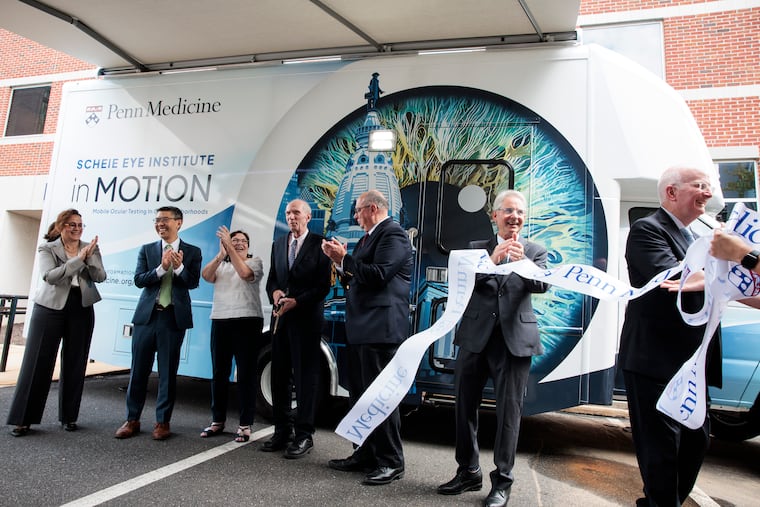
Penn Medicine’s newest mobile medical van features a giant mural of Philadelphia’s City Hall set against a bright, colorful eye.
It’s right on theme: the 26-foot-long van will travel around the city, offering free eye exams and education services to underserved communities. The project is led by Penn ophthalmologist Lama Al-Aswad, whose vision is to prevent blindness by improving access to eye care.
Called the Scheie Eye Institute In MOTION, the van will screen adults for the four major causes of blindness: glaucoma, macular degeneration, diabetic retinopathy, and cataracts.
The goal is to detect eye diseases early, so they can be treated before progressing to blindness. Half of an estimated 2.2 billion cases of visual impairment worldwide could have been prevented or still haven’t been properly treated, according to the World Health Organization.
Al-Aswad had previously launched a similar effort in New York City that screened more than 8,500 people for glaucoma. She found more than half of them had never seen an eye doctor before.
By teaching community members about eye diseases and expanding access to care, she hopes they can avoid worse outcomes.
“By the time we say [patients] have a disease, we are improving their eye health literacy, so they understand the impact and the need to follow up,” Al-Aswad said.
Those who cannot afford follow-up care can receive services for free, thanks to donations from Philadelphia native Rick Campbell and family, and the New York-based organizations, Save Vision Foundation and Envision Health Technologies.
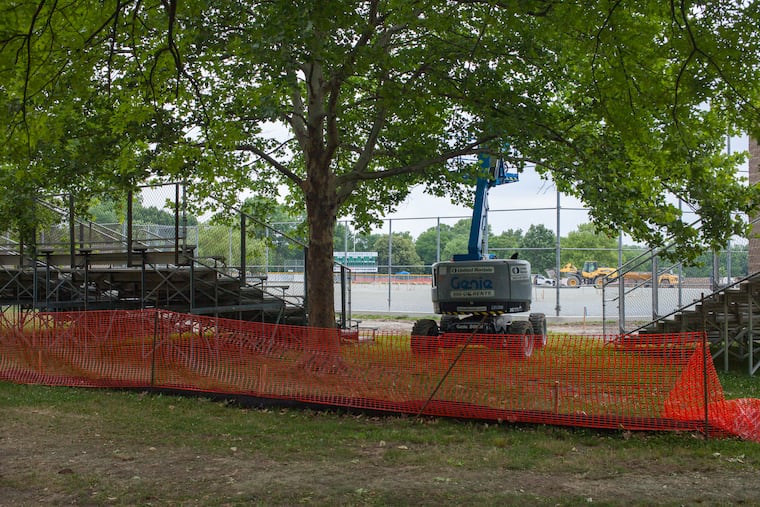
The van will make its first appearance at Saunders Park in West Philadelphia this Saturday from 10 a.m. until 4 p.m. The unit aims to run at least two to three times a week and see 25 patients at each event.
The Inquirer spoke with Al-Aswad about the new mobile screening van in an interview lightly edited for length and clarity.
What should the public know as part of eye health literacy?
The four leading causes of blindness: That includes cataracts, which are reversible. People who have cataracts slowly lose vision, but once we do cataract surgery, it goes back to your baseline vision.
Glaucoma is the leading cause of irreversible blindness. It’s called the silent thief of blindness because it’s asymptomatic until the end.
Diabetic retinopathy is another leading cause of blindness. That’s preventable too, if there is annual evaluation for it and better control of diabetes.
Macular degeneration is a disease that affects the macula and, with aging, slowly over time can affect vision. That can be treated with injection and monitoring.
A lot of eye diseases can be blinding. But, in general, if we catch it early and take care of it continuously, we can prevent blindness.
What communities are you hoping to reach?
We are hoping to reach the underserved or vulnerable communities in West Philly, North Philly, and other places. We are even targeting the unhoused community with this mobile unit.
What are some lessons that you learned in New York that will be guiding your new effort at Penn?
One of the lessons that I learned is how to close the loop.
Let’s say you go out to the community and you screen. But what happens after that? You tell the patient they have a disease. If you’re lucky, 50% follow up.
When we did a lot of the screening in New York, I did an analysis of the people who followed up and people who didn’t follow up. A couple of things came up:
It’s hard for individuals with mid- to low-socioeconomic status to take time off work. Second, eye health literacy is very, very important for blindness prevention. A good number of patients didn’t understand the need to follow up.
We would call them and they would say, “I have no problem, I don’t feel anything, and I have other priorities.” The other thing is how to target populations at a higher risk.
How will you help patients who require follow-up care after screening?
If we identify disease, we refer them to our practices to be seen in person by one of our physicians. If they are uninsured, we see if we can help them access insurance, and if they cannot access insurance, we can provide care for them for free, thanks to Mr. Campbell and his family’s generous support for this project.
Why is it important to catch eye diseases early?
People go to their internists or other doctors, but the last thing that they think about is their vision.
That’s because eye diseases most of the time are asymptomatic early on, so patients only go when it’s advanced. That’s a problem in itself because a lot of the vision loss we cannot reverse.
It’s really important to identify disease early and manage it for blindness prevention.
How do you feel about the launch?
Closing the loop is going where patients are, providing screening and diagnosis, providing education, and providing care to the uninsured. This is a dream come true to be able to do all of this together.