District to reveal plan for revamping schools
Superintendent Arlene Ackerman last week urged Philadelphia to imagine wholesale change for its schoolchildren - a district where all students thrive, even the ones now being failed in large swaths by the public school system.
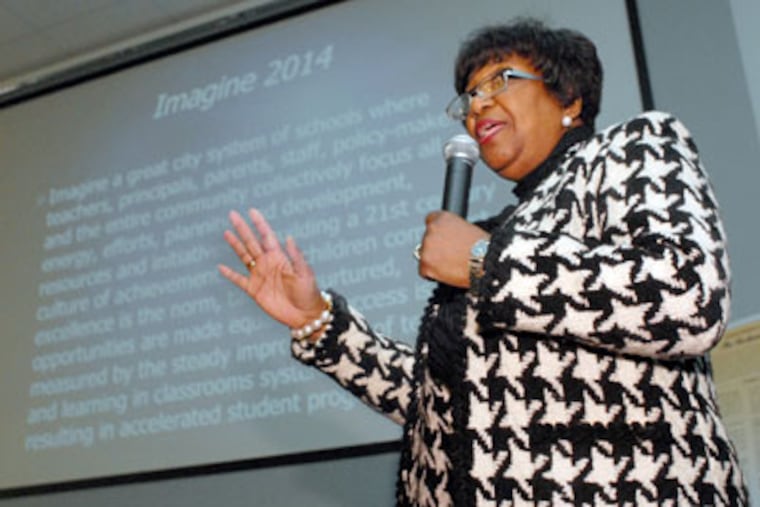
Superintendent Arlene Ackerman last week urged Philadelphia to imagine wholesale change for its schoolchildren - a district where all students thrive, even the ones now being failed in large swaths by the public school system.
Today, the district is scheduled to release a draft of the steps needed to achieve her vision, which includes shuttering failing schools and possibly reopening them as charters. Community meetings will be held for several weeks, and then the plan must be approved by the School Reform Commission in April.
But those in city education circles have heard about plenty of plans in the past and want details before they decide whether Ackerman's vision is a real blueprint for reform.
"In the broad stroke, there are lots of things that are really encouraging," said Helen Gym, a founder of Parents United for Public Education. "But there's a lot that needs to happen for this vision to work."
Ackerman's five-year, $50 million strategic plan calls for shutting down up to 35 failing schools and reopening them as charter schools or schools run by outside managers; reducing class size; boosting counseling services; and expanding enrichment activities for students.
She wants to add centers for early-childhood education and English-language learners, parent universities, and college-access centers. She wants to build high schools for career and technical education, and for future Philadelphia schoolteachers.
She wants to revamp the district's cumbersome hiring process, introduce a weighted student-funding formula with additional money going to needier students, and seek out more private and public partnerships.
"For Philadelphia, it is a dramatic shift," Jon Supovitz, associate professor at the University of Pennsylvania's Graduate School of Education, said of Ackerman's "Imagine 2014" plan.
Most attention has been focused on Ackerman's wish to close the 35 chronically underperforming schools and reopen them as charters, or as schools run by outside managers or by successful district principals eager to replicate their model.
The new schools - 10 are expected to open in the fall of 2010 - would have new staffs and leadership.
Her "system of great schools" approach would also give a group of high-achieving district schools more autonomy.
Much of what would happen has already been tried, the superintendent acknowledged. Under former district chief Paul Vallas, a dizzying array of programs - from small high schools to privately run schools - was introduced in Philadelphia.
Outside managers - including some for-profit companies, such as Edison Schools Inc. - have run Philadelphia schools since 2002. Most research has shown that despite receiving additional funding to bolster student achievement, the private managers have done no better than the district has.
The district did have some success with its 21 "restructured schools" - with their special interventions, they outperformed schools run by private managers - but that model was abandoned in 2005 for lack of funding.
There has already been a public outcry over the plan to hand over district schools to outside organizations and charters. Jerry Jordan, president of the Philadelphia Federation of Teachers, worries about the message such a move would send.
"To now say, 'Oh, we're just going to get rid of these schools,' that's not fair to the teachers and to the kids. We're making them feel like they're throwaway kids instead of giving them what they need," said Jordan, whose union has questioned the district's prior turn to outside managers.
But Ackerman vowed that "this won't be experimenting on kids. It's taking what's tried and true."
Only organizations with proven track records would be considered to run schools, she said, Mastery Charter Schools and the Knowledge is Power Program being examples.
But as Supovitz, the Penn researcher, pointed out, it's unclear whether providers who have produced promising results with a handful of schools can effectively scale up to run multiple organizations.
"Ultimately, we've got lots of demand for a very limited supply of known, effective providers out there," Supovitz said.
The district would also have to step up its oversight of outside managers and charters, experts say. It has taken heat for lax management.
The plan draws from models already in use around the country - Chicago's controversial Renaissance 2010, Boston's pilot school plan, programs under way in New York.
Ackerman said she did not know much about the Chicago effort, which calls for the opening of 100 new schools by 2010 and the closing of dozens of underperforming schools. That plan has come under fire most recently for producing test scores that were little better than those in traditional public schools.
But Ackerman does like the Boston program, which frees some schools from most district mandates and union work rules.
Boston's pilots have autonomy over their own budgets, curriculum, staffing, schedule, and governance.
"If it worked in Chicago, if it worked in New York, if it worked in Boston, I'm for it," Ackerman said.
Imagine 2014 draws cheers from parents, advocates, and educators for some points - lowering class sizes to 20 in kindergarten and 22 in grades one through three, and beefing up guidance services.
With a tough economy and a tight district budget, money could be one sticking point, and will certainly mean that any changes would come over time.
Chief business officer Michael Masch said that he had been directed to find ways to make this plan work, but that "we have to get a better handle on our funding sources so we know how far we can go."
Ackerman said cost was not going to stop her.
"I don't want the price tag to get in the way of what we can do for our children," she said.