It just rankles Blaze Lombardo when a guy writes a check he knows won't be covered, even temporarily, by the funds in his bank account.
Lombardo, to be sure, has seen a bit more of that than the rest of us in the 20 years he's owned Blaze's Check Cashing at South Street near Front. Still, he said, it is endemic to the what-can-I-get-away-with culture he finds so aggravating.
"What is the limit?" he said. "Why do we have rules and laws? Is it just to challenge people?"
Whether it's placing 27 items in the supermarket lane for "15 items or less," going 60 m.p.h. in a 55 m.p.h. zone, or telling a 14-year-old to say she is 12 for the sake of getting the children's rate at a museum, there seem to be certain regulations and customs that exist just to be flouted.
Experts say such low-level lawlessness rises during tough times - like the current economic downturn - and in tough places, as in cities such as Philadelphia.
People feel they deserve a break, experts say, and if they suspect others would do it, why not?
Trace it to prehistoric times, this tendency to fudge the law just a little bit. It's not armed robbery, after all, to exaggerate slightly on a tax return, upping the amount on the charitable donation line, for instance, or increasing those medical expenses a couple hundred bucks.
"It may well go back to when we were roaming the savannah," said Peter Huang, a professor at Temple University's James Beasley School of Law. "If you are a caveman, you can't be a doormat, or you won't survive. If you can't show you are above the law in some way, you show you are weak."
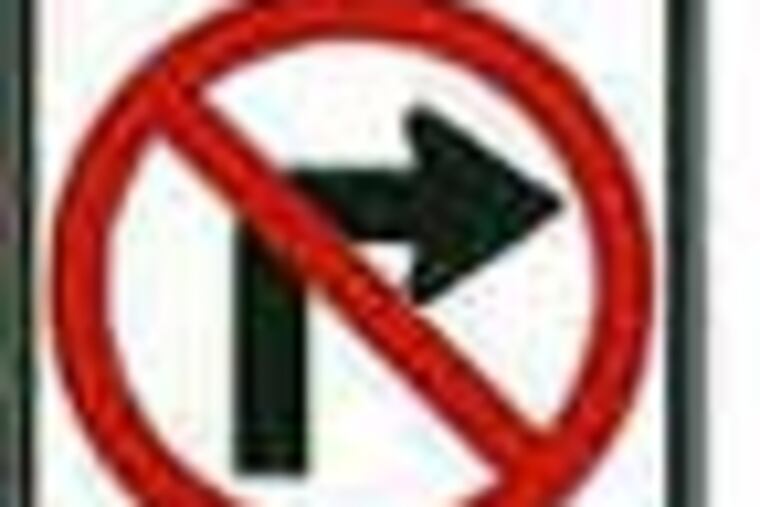
Many of the laws and regulations most often ignored are related to driving. Despite years of evidence of the benefit of seat belts, nearly two-thirds of those killed in auto accidents in 2006 were not wearing them, according to the National Highway Traffic Safety Administration. Drivers chat with abandon on cell phones, roll past stop signs, blast through pedestrian-filled crosswalks, and ignore "No Turn on Red" signs.
"The tendency in the United States is to think of traffic violations as not real violations of the law," said Tom Vanderbilt, author of Traffic: Why We Drive the Way We Do (And What It Says About Us). "Myself, for example, the only time I have run afoul of the law is driving. I haven't been busted by the IRS, and I haven't stolen anything."
What's more, people like to boast about their violations, often unmindful that even the smallest infractions can have serious repercussions. "A traffic violation is a folk crime," he said. "People revel in their stories of them. 'Everyone does it,' people say. 'So why shouldn't I?' "
John Wall teaches what he believes is the only university course in the country on evil at Rutgers-Camden, where he is a professor of religion and philosophy. He started the class in reaction to the Sept. 11, 2001, terrorist attacks but has expanded it to include everyday life.
Most people think evil means doing something deliberately villainous, but often the evildoer's actions merely reflect what he or his peers consider acceptable, according to Wall. As an example he offers Adolf Eichmann, the Nazi official often called the architect of the Holocaust. Eichmann believed his actions were a reflection of society norms.
"That those norms - rabid anti-Semitism and exterminations of 'lesser' people - aren't ours didn't matter to him. In his mind, he was being 'moral.' "
Throwing your coffee cup out the car window is no crime against humanity, but the comparison goes to illustrate how definitions of acceptable behavior can change depending on the neighborhood and the situation.
Sometimes, it's the attitude of law enforcement that determines what's acceptable, said Jerry Ratcliffe, a Temple criminology professor who does consulting work on crime in New Jersey with the Camden County Prosecutor's Office.
"For instance, why is there so much double-parking in South Philadelphia?" he said. "That wouldn't be tolerated in the suburbs. It wouldn't even be tolerated a couple of miles away in Center City. It is almost an animal behavior. We double-park because we can."
And no one is going to challenge behavior that's acceptable, albeit illegal, in that environment.
"The true standard may not be the law, but what people would confront someone on," Ratcliffe said. "In a crowded city, are you going to confront someone inching out past a stop sign? In a clean suburb, you might do it when someone throws trash on your sidewalk. Sometimes people tolerate things because they don't feel they have the power to do anything about it - drug dealing in a high-crime area, for instance. Different scenes for different places, I think."
Author Vanderbilt pointed to the so-called broken windows hypothesis, formulated by James Q. Wilson, a Harvard government professor, and George Kelling, a Rutgers criminology professor, in a 1982 Atlantic Monthly article. It was an era when New York City's crime rate was soaring, with seemingly no end in sight.
They posited that repairing broken windows in buildings and cleaning up trash in otherwise dangerous neighborhoods would lessen crime there. In an experiment to prove it, researchers abandoned a car in a high-crime neighborhood in the Bronx. Nothing happened until they took a hubcap off. Soon afterward, it was stripped nearly bare.
"We don't want to be the last person to get away with something," Vanderbilt said. "Once we see someone driving and on a cell phone or speeding a little bit, we feel entitled."
Huang believes one of the better deterrents is the prosecution of the famous. If Leona Helmsley or Martha Stewart can go to jail for cheating on finances, then maybe the rest of us will feel the government may come down on us, too. How big an effect celebrity involvement might have on those not-so-serious rules is harder to say. Would cell-phoning-while-driving go away if Brad Pitt were thrown in the clink for doing so? Would the R-movie 17-or-no-go rating have more bite if, say, Barack Obama's daughter got caught sneaking into American Pie?
"Some of my students think they might be above things like cell-phone talking in cars, that they can multitask. It's not like it is civil disobedience. They know the law is important, but for, I guess, lesser people," Huang said. "It may always be that there are always going to be rules that some just don't think apply to them."