WHYY’s ‘Fresh Air’ host Terry Gross is at the center of catfish-style scams targeting stars and media personalities
A recent string of scams and catfish-style attempts targeting stars and other media personalities are using Philly’s own Terry Gross as the bait. Writer Bruce Vilanch says he was the latest victim.
Comedy writer Bruce Vilanch was enamored.
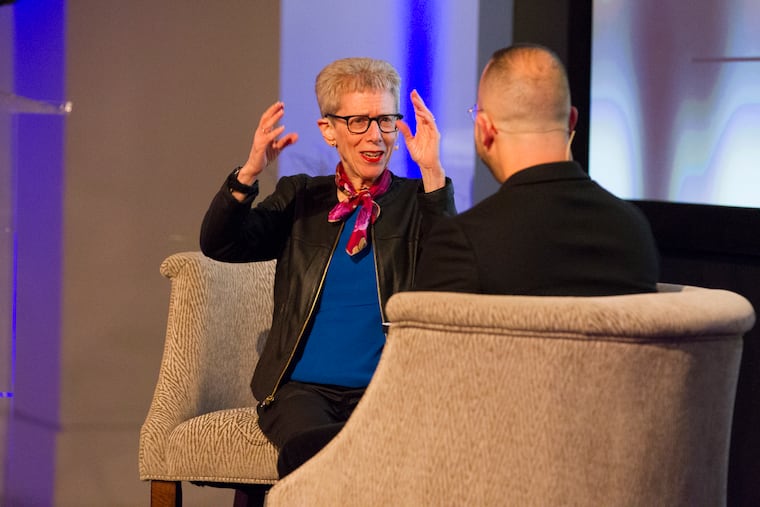
He had received an email from WHYY’s Terry Gross, herself, asking to be interviewed on NPR’s Fresh Air.
“It was so articulate and so like her,” the writer told the Hollywood Reporter. She laid out talking points and a run of show, according to Vilanch. “It felt real.”
But when Vilanch jumped on their scheduled video call, Gross was nowhere to be found. It finally dawned on Vilanch: He had been scammed. And he was not alone.
A recent string of scams and catfish-style attempts targeting stars and other media personalities are using Philly’s own Gross as the bait. Vilanch says he was the latest victim.
“If somebody claiming to be Terry Gross contacts you for an interview, it is a scam,” the comedian said in a Facebook post last week. He encouraged other potential victims to contact NPR and WHYY.
Online forums reveal a number of recent catfishing attempts involving someone purporting to be Gross.
“These impersonation scams are increasingly common,” said Siwei Lyu, digital media forensics expert and director of the Institute for Artificial Intelligence and Data Science. “Authors are a particularly attractive target because an unexpected invitation from a prominent host or podcast can seem both flattering and plausible.”
It is unclear if one person is behind all of the Fresh Air-centered fraud or if multiple impostors are responsible. Lyu says scam scripts and techniques are easily shared, adapted, and copied, “so the same premise can be used by many unrelated actors.”
On a Facebook group for authors, a writer posted in July about being approached by Fresh Air and asked to donate money. Months earlier, psychologist Steven Pinker, author of The Better Angels of Our Nature, said he was similarly approached by “Terry Gross” via a fake Gmail account as part of a scam targeting authors.
In Vilanch’s case, he said “Gross” asked him for money to support NPR’s nonprofit public radio efforts amid government cuts. He told the Hollywood Reporter that he thought the request was odd, but that enough credibility within the email chain had been established. So he went for it.
From there, the scammers prepped him for Fresh Air, sending interview questions and scheduling their virtual interview. When the big day arrived, Vilanch was greeted by two video boxes: a screen that read “NPR,” and one with a man who identified himself as “Mike,” the new interviewer. When Vilanch eventually bailed, he sent a final message, according to the Hollywood Reporter: “Whoever you are, I hope you enjoy the paltry sum that I sent.”
Then he reached out to NPR and WHYY. WHYY confirmed it was aware of the scams and investigating.
“WHYY, NPR and Fresh Air with Terry Gross & Tonya Mosley are aware of fraudulent emails in which individuals have impersonated Terry and members of the Fresh Air team attempting to deceive potential guests,” the news organization said in a statement. “As the article in The Hollywood Reporter mentions, other programs and podcasts have also been the subject of these scams.”
The Fresh Air situation is one of several podcast/radio scams targeting Hollywood. According to the Hollywood Reporter, Broadway actor Seth Rudetsky was targeted by a scammer posing as Nikki Glaser who solicited a podcast interview in exchange for a fee. Later, Rudetsky also received an invitation from someone supposedly working on Amy Poehler’s podcast, Good Hang.
In addition to money, some of the scams also target the victim’s social media accounts or login credentials.
Sportswriter Jemele Hill said someone once lied and claimed to be booking her for a new Facebook show hosted by Rob Dyrdek of Ridiculousness. She handed over her Facebook credentials. It took weeks to get them back, she wrote in an X post. “It’s a very sophisticated operation.”
In April, figure skater and personality Adam Rippon told a story on his podcast about being similarly catfished by someone purporting to be on Katie Couric’s podcast via Facebook Live. The follow-through scammed him out of his own Facebook credentials.
“I know I made a grave error,” he said. His Facebook account was ultimately suspended.
A spokesperson for WHYY added that Fresh Air cohost Tonya Mosley has been the named catfish in similar scams, imploring would-be guests to send money in exchange for a radio slot. As a nonprofit organization, WHYY says, it never requests payment for interviews, nor does it pay guests to be interviewed on any of its programs.
“Any communication asking a prospective guest to pay a fee — or offering payment for an interview while claiming to represent WHYY or Fresh Air — should be treated as suspicious,” the statement said.
It is unclear if any of the scams are connected. What they all have in common, though, is their apparent leverage of a celebrity figure along with heavy use of AI to capture the alleged host’s voice and flatter victims with deep-cut knowledge about their work. Lyu said generative AI’s rise in popularity and usage makes hoaxes like this even easier, allowing scammers to quickly personalize messages and operate at a greater scale.
“The technology is new, but the underlying strategy is classic social engineering,” Lyu said. “Establish trust through a recognizable identity, then use that trust to obtain money or account credentials.”
WHYY said it is concerned about its own brand and credibility being used in this case.
“We take the misuse of our journalists’ and programs’ names seriously and are concerned that scammers are exploiting the trust audiences and guests place in Fresh Air,” WHYY said. “We are working with law enforcement to address the situation.”