The Nvidia mess should end the era of unregulated AI | Editorial
Jensen Huang’s resignation after acknowledging an affair with a suspected Chinese spy makes the Trump administration’s irresponsible approach to the technology that much more untenable.
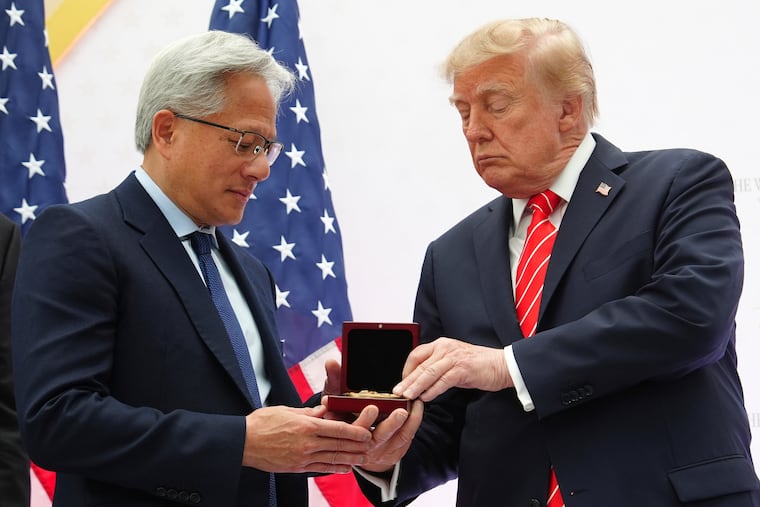

Even among a legion of Big Tech sycophants, Jensen Huang had stood out for his capacity to flatter Donald Trump into giving him what he wanted. It turned out that Huang, the perpetually leather-swathed chief executive of Nvidia, was not impervious to such motivated means of persuasion himself — and he has paid a devastating price for it.
Huang resigned Thursday as the head of the microchip giant, days after acknowledging an extramarital affair with a Singapore-based tech executive known as Alice Huang, who is believed to be a Chinese spy. The revelations about their relationship would have been awkward for anyone, but it was particularly so for the man who successfully lobbied the president to ease restrictions on exporting his company’s AI-enabling chips to the agent’s alleged handlers.
Further complicating matters for Huang was a report by the New York Times late Wednesday that he had engaged in a second affair with a subordinate at the company.
» READ MORE: Bike protest of Jewish businesses was indefensible, and it must be condemned | Editorial
The scandal seems to have done what all the artificial intelligence industry’s warnings about its own destructive potential somehow did not. It triggered a sell-off of Nvidia stock, federal investigations and renewed questioning of the headlong, government-assisted rush to develop a dangerous, ill-understood technology regardless of the consequences.
“I hope there’s no problem,” Trump said of Jensen Huang on Monday, but it seemed a little late for that. The problem is that the cofounder of the world’s most powerful and valuable AI company — and the closest adviser to the president on the technology — appears to have been hopelessly compromised by our chief adversary, China. As Stephen Witt, who wrote a book about Nvidia, told the New Yorker, “If the CEO is sleeping with spies, that’s generally regarded as bad.”
Worse, the president appears to have known that for some time, even though he persists in assurances that Huang is “a very high-quality,” “amazing,” and “honorable guy” who will end up “in good shape.” Trump was warned of Huang’s relationship with a suspected Chinese intelligence asset last year and again in May, the Times reported, just before the executive joined the president on a trip to Beijing.
And yet, Trump appears to have done nothing about it apart from enthusiastically facilitating the goals of a man who may have been in thrall to the Chinese Communist Party. Huang has somewhat paradoxically argued that the United States must maintain its chipmaking advantage over China by selling more chips to the country, which Trump helped him do by easing export controls established under President Joe Biden. The Commerce Department also reportedly abandoned an investigation into whether Alice Huang’s company smuggled chips into China after an Nvidia lawyer contacted the administration.
» READ MORE: Gov. Shapiro’s victory positions him as a formidable national force | Editorial
Nvidia is among the major investors in an estimated $1.4 trillion initial public offering being prepared by the AI company Anthropic, which has warned potential investors that the technology poses “catastrophic or existential risks to humanity.” And yet, Trump has hewed to the laissez-faire approach to AI that Jensen Huang has pushed, concluding after meeting with him and other tech executives that the companies should “self-police.”
Nvidia itself illustrates the folly of this notion. The company’s generally deferential board is populated by early investors and longtime associates of the cofounder, and — prior to Huang’s resignation — there was no succession plan or clear replacement. Nvidia’s chief financial officer, Colette Kress, will lead the company while the search for a permanent replacement commences.
Perhaps the only good that can come of all this recklessness is the thorough debunking of the irresponsible idea that such a powerful technology should go unregulated. Changing the current policy, or lack thereof, will certainly be challenging as long as Trump remains in power. But the new Congress is full of members elected on promises to rein in data centers and other aspects of AI, and, in some cases, with a history of doing so.
This mess shows they won’t arrive a moment too soon.
About our editorials
Editorials express an opinion about a matter of policy or public interest that has been researched and written by our Editorial Board, a group of journalists separate from the newsroom. Unlike news stories, which are fact-driven and written by reporters, editorials advocate, champion, argue, critique, and offer solutions. Editorials are not intended to dictate what readers should think, but to cut through the noise of polarized debate and provide a catalyst for elevated discourse.