THE JOY of MATH
NEW YORK - Mathematics. It's a subject that can elicit groans and exclamations of "Boring!" But Glen Whitney, a former hedge-fund quantitative analyst, is betting he can change that with a formula that looks like this: math = discovery = beauty = fun.
NEW YORK - Mathematics. It's a subject that can elicit groans and exclamations of "Boring!"
But Glen Whitney, a former hedge-fund quantitative analyst, is betting he can change that with a formula that looks like this: math = discovery = beauty = fun.
Whitney is planning to open the only museum in the United States dedicated to mathematics. MoMath, which will center on the wonders of mathematics and its connections with art, science, and finance, is scheduled to open in New York City in 2012, with the help of a $2 million grant from Google Inc.
The joy of discovery in math is lost to the "tyranny of the curriculum and the almost treadmill of standardized testing," Whitney said. "That sensibility has sucked out the life of the subject."
The museum will provide the element of surprise and excitement that textbooks cannot, added Cindy Lawrence, the museum's chief of operations.
The $30 million museum will occupy the ground floor and lower level of a 20-story building on East 26th Street; $22 million already has been raised.
Whitney and Lawrence have been testing the waters of creating a museum of mathematics for nearly two years with MathMidway, a traveling exhibit that has been shown in seven cities, and counting.
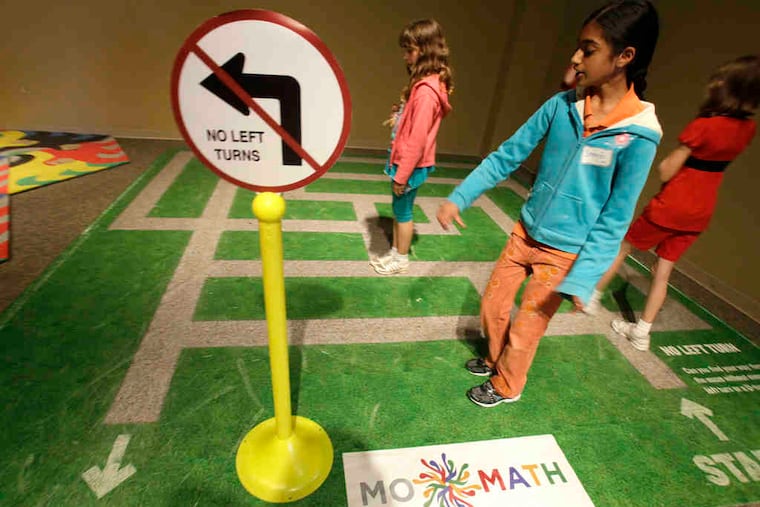
It is currently at the Museum of Nature & Science in Dallas through May 10, where schoolchildren recently scampered through the kind of carnival-themed, brightly colored exhibits planned for MoMath.
Tents along one wall offered a variety of activities, including a depiction of a ship on a moving circle that can only be "righted" by placing equal amounts of weight on each side; a roller-coaster track that kids can adjust to test out what angle gets the fastest time; and a harmonograph, which uses pendulums to draw a geometric image.
"It's just a very hands-on, exciting exhibit" that appeals to many ages, said Jason Treadway, an educator at the Dallas museum. "I think one of the great things about it is you're basically learning about math without knowing you're learning about math."
Another activity, "Pedal on the Petals," lets visitors ride square-wheeled tricycles on a track with a series of curves shaped like a huge sunflower.
A nearby sign proclaims, "There's a road for every wheel!" and also asks, "Do you dare to ride on a square?" The sign poses the question: "Why is the ride so smooth?"
The concept is based on a mathematical theorem that there's a way to contour a road surface so that wheels of that shape will roll smoothly.
"Visitors can see - and physically experience - how math makes the seemingly impossible not only possible, but fun," Whitney said.
"The kids actually get to explore math rather than be told about it," said Marea Kelly, who brought her fifth graders to the exhibition. "It's really going to help the kids who don't see the concepts right away."
She said it made perfect sense to her students as soon as they rode the tricycle.
These and about 50 other interactive activities at the new museum will also demonstrate math's collaborative process.
Math museums exist in other countries, including Italy, Germany, South Korea, and France, but none in the United States. Studies consistently show that Asian students outpace their counterparts in other countries in math achievement.
The most recent Trends in International Mathematics and Science Study found that 40 percent of fourth graders in Singapore and Hong Kong, for example, reached the advanced benchmark in math, compared with 11 percent in the United States.
"Given that math is used in more and more fields," from climate study to finance to astronomy, "there's a public problem here that needs to be addressed," said Sylvain Cappell, a professor at the Courant Institute of Mathematical Sciences at New York University.