Blowing their own horn
With the Sci Fi Philly concert series, young Philadelphia jazz artists are helping to create a scene for themselves.
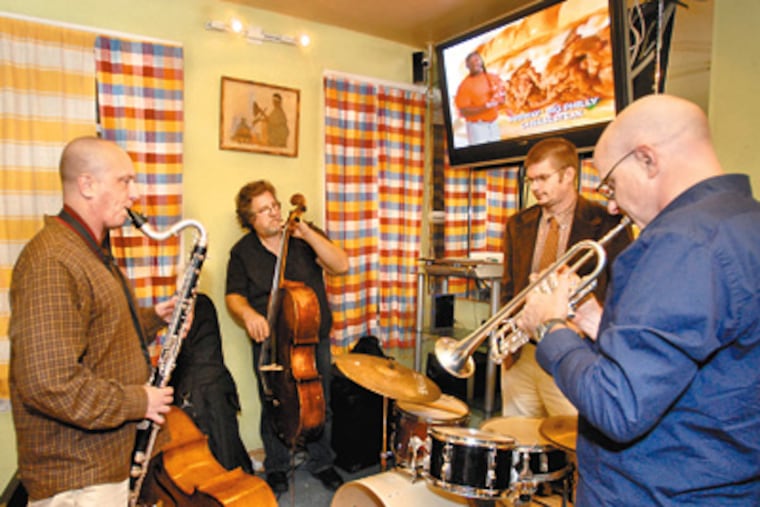
It's Game Four of the World Series, and patrons of Gojjo, an Ethiopian restaurant at 45th Street and Baltimore Avenue, watch the Phillies downstairs on two screens. Upstairs in the cafe, Ethiopian men are just as engrossed in a version of bocce played on a green felt table. Across the hall, behind a closed glass door, avant-garde jazz is sounding at full intensity.
For the young musicians who run the Sci Fi Philly concert series, it's a fairly typical Sunday night.
Since launching in May, Sci Fi Philly (scifiphilly.com) has become a cornerstone of jazz and improvised music in the city, a haven for underexposed local talent and a magnet for high-level out-of-town bands.
At a time when musicians of all genres are forming their own labels, distributing their own music, and directing their own careers, Sci Fi Philly follows the same imperative: Create your own gigs, form your own scene.
Sci Fi evenings are held nearly every Sunday at 9 p.m. and normally feature two or three acts for a $5 cover. On World Series night, Philly's own Sonic Liberation Front, an edgy Afro-Cuban group, shared the bill with Complex Tumble, a Baltimore free-jazz quartet featuring esteemed bassist Michael Formanek.
Despite the ball game, turnout was a respectable two dozen or so. "The energy is always happening, regardless of the attendance. If 20 people show up, it feels great," says bassist Jon Barrios, 35, who runs the series with his roommate, alto saxophonist Dan Scofield, 27, and their friend Stephen Buono, 32.
Listeners in the rear were multitasking, watching the Phillies with the sound off. Screams and applause erupted sporadically from downstairs. Drummer Will Redman of Complex Tumble called out between numbers: "What's the score?"
Bad economy or not, musicians are accustomed to hard times. Yet in jazz the talent pool is deeper than ever.
For several years, Ars Nova Workshop and Bowerbird have nourished Philly's experimental music circuit, staging concerts in various venues. Tritone, the South Street rock club, reserves some nights for cutting-edge jazz as well. But these presenters alone can't meet the demand.
Sci Fi Philly, with sponsorship from Ars Nova and support from the High Two record label, has picked up some of the slack.
"Gojjo fulfills a need for not-so-famous musicians to take their music outside of New York, to help it grow and to cross-pollinate with players from other cities," says New York-based saxophonist Michael McGinnis.
Sci Fi also provides a consistent space that can foster not just close listening but also social interaction among fans.
"A lot of shows," says Scofield, "you go and sit in your folding chair and leave. You see all these people with common interests who don't necessarily hang out. Here they can show up an hour before and eat, and then stay later."
Gojjo's manager, Habtamu Shitaye, 48, gives Sci Fi free rein and likes what he sees. "The music is a big plus," he says.
And it attracts all types, from young guys in Sonic Youth and Tool T-shirts to older enthusiasts. Maggie Davenport, "50-something" and from West Philly, enjoyed her first visit, noting, "There's more to the place than meets the eye."
Carl Anderson, 62, from Yeadon, has attended nearly every Sci Fi event. "It's young, talented people, it's cheap, and if I'm not enjoying it I can walk out, which I haven't done."
The series has exceeded expectations. "We're booked into March," Scofield says. "Except for maybe three shows, the turnout has been either solid or fire-code violation."
Spreading the wealth is the rule here - the musicians receive 100 percent of proceeds from the door. "People are pleasantly surprised even to be paid, which is bizarre," Scofield adds.
Barrios, who used to run a club in Fayetteville, Ark., called the Five Squirrels, knows all too well why music venues tend to focus on their bottom line. "The benefit of our series," he says, "is you're taking an unused space, and musicians run it and bypass that whole struggle. It's very hard for a club to make money, I understand. But musicians shouldn't be paying that price."
Sci Fi has showcased a broad spectrum of local talent, from aspiring players such as bassist Evan Lipson, violinist Katt Hernandez, and trombonist Daniel Blacksberg to veterans Bobby Zankel, Edgar Bateman and Elliott Levin.
At the same time, Sci Fi is raising Philadelphia's profile as a destination for touring bands, and a regional hub for new and progressive music. Recent shows have featured the groundbreaking New York groups Brinsk, OK|OK, and Mostly Other People Do the Killing, as well as the Chicago ensemble Herculaneum. These bands boast some of the country's most promising player-composers, including Jon Irabagon, Jacob Wick and Aryeh Kobrinsky.
On Nov. 16, Sci Fi presented Ionic Bonding, a benefit for Neighborhood Bike Works, with more than a dozen saxophone-drum duos playing five-minute sets. Tonight's show will feature the quartets Racket Club and MSPV, Michael Mantra's Audio Emotif, and a duo between local sax veteran Jack Wright and his bassist son, Ben. Other shows have involved the balafon, mandolins and computers.
Music this offbeat may never gain a mass following, but there's no reason it can't appeal to fans immersed in avant-rock, DJ culture, and other alternative orbits. This is one of Sci-Fi's loftier long-term goals: audience outreach and development.
The series is also offering incentives for the creation of new music. In partnership with a nonprofit run by Zankel, Sci Fi will award $250 for a selected musician to premiere his or her funded work at Gojjo on Dec. 21. A small grant, perhaps, but "it's symbolic," says Scofield. Submissions have poured in.
When possible, Sci Fi and its allied presenters avoid scheduling shows at conflicting times, which says a lot about the camaraderie of this underground musical sphere. Even if Sci Fi, Ars Nova, Bowerbird, the electro-minimalist Philadelphia Sound Forum, and Tritone's Avant Ascension series (third Wednesday of every month) have their own agendas and appeal to different crowds, there's a good deal of overlap. "Everyone knows it's in their interest to work together," Barrios says.
Initiative is the key ingredient, and Sci Fi proves the do-it-yourself route needn't be arduous. As Barrios says: "You find the place, set it up, get the right people involved. Something needs to be done, you can do it."