Effort to integrate Girard College documented in new film
At one of the city's newest schools Friday, one dedicated to primarily serving African American and Latino children from low-income families, students learned of long-ago efforts to integrate one of the area's oldest, Girard College.
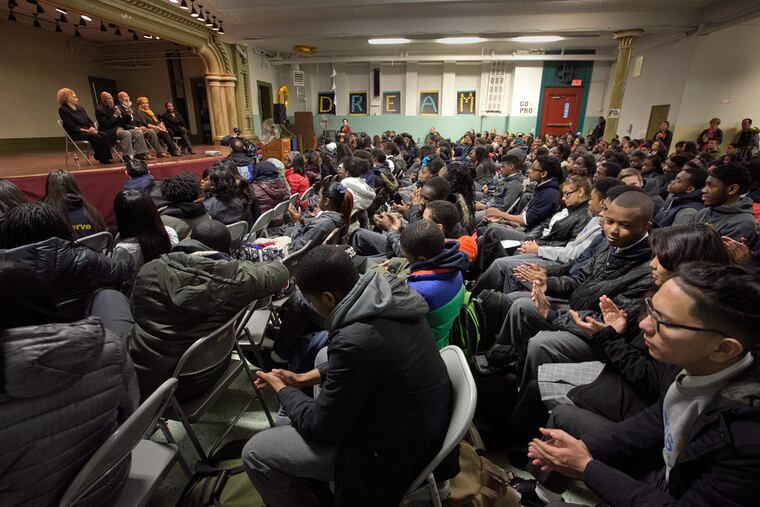
At one of the city's newest schools Friday, one dedicated to primarily serving African American and Latino children from low-income families, students learned of long-ago efforts to integrate one of the area's oldest, Girard College.
The students at Cristo Rey Philadelphia High School learned of that episode in the city's racial troubled history by watching a documentary on the efforts of civil rights leader Cecil B. Moore and dozens of young people in 1965 to force the integration of the then-all-white male boarding school.
The 350 students who filled Cristo Rey's auditorium also heard from some of those then-young people who marched alongside Moore, and were moved by the short film, clapping and singing at certain moments.
"I thought it was amazing," Bianca Mitchell, 17, said. "This is the first time we did something like this at Cristo Rey."
"It speaks to us," she added.
Cristo Rey, a private Catholic school in Logan, opened in 2012. Mitchell, a senior who has been accepted by seven colleges, is part of its first graduating class. The school says it has a 100 percent college acceptance rate.
Another senior, Isaiah Gabriel, 17, of Northeast Philadelphia, has also been accepted to a number of schools and is awaiting a response from the University of Pennsylvania. He said the experience was enlightening.
"I never really heard of that struggle," Gabriel said. "I found out that Martin Luther King came here."
Cecil's People: The Freedom Fighters portrays the young people who marched in protest around the walls surrounding Girard's campus every day for seven months, often accompanied by a large police presence. The marchers stopped when city and state officials challenged Girard's policy in U.S. District Court. Desegregation finally came in 1968 after numerous legal proceedings.
The film is the third and final installment in a series produced by Sam Katz's History Making Productions. Cristo Rey students viewed the first two parts in class. The third film focused on King's visit to Girard College, and the difference in approach between King and the sometimes-combative Moore.
Moore, a former city councilman and president of the Philadelphia NAACP, made it his mission to desegregate Girard College. The school, which educates first through 12th graders, opened in 1848 under the will of the merchant and banker Stephen Girard to educate "poor, white, male orphans."
After the U.S. Supreme Court outlawed legal segregation in 1954 in Brown v. Board of Education, Girard fought efforts to integrate until 1968. The school began admitting girls in 1984.
Katz, a past Republican candidate for mayor, started History Making Productions to produce documentaries on Philadelphia history, with the idea of educating people, especially students.
The company's films, along with related educational material, will be available free at www.historyofphilly.com/.
"All the films we created - there's no boundary to entry," Katz said.
History Making Productions also works with teachers to provide supplemental materials to use along with the films for lessons, said the company's director of education, Amy Cohen.
For the "Freedom Fighters" who attended, the experience was unique - they were the stars of the show.
"It brought back a lot of memories," Karen Asper Jordan, 67, said. "We never expected this."
They also told the teenagers to keep fighting against racism and discrimination by following their dreams.
"You can't remake the world before you remake yourself," Kenneth "Smitty" Salaam said.
Before they left the stage, the Freedom Fighters and the students sang an enthusiastic rendition of a civil rights anthem, "Ain't Gonna Let Nobody Turn Me 'Round."
Moore's daughter Alexis, who for safety reasons was not one of the marchers, said "not a day goes by" that somebody doesn't talk to her about her father, who died in 1979. She challenged the students to replicate his leadership.
"The civil rights movement made my life one of choices, not one of constraints," Moore said. "The leadership baton has passed to you. It's your turn. Pick it up."
JTomczuk@phillynews.com@JackTomczuk