A Phila. gem's high note
What becomes a legend? A premiere.
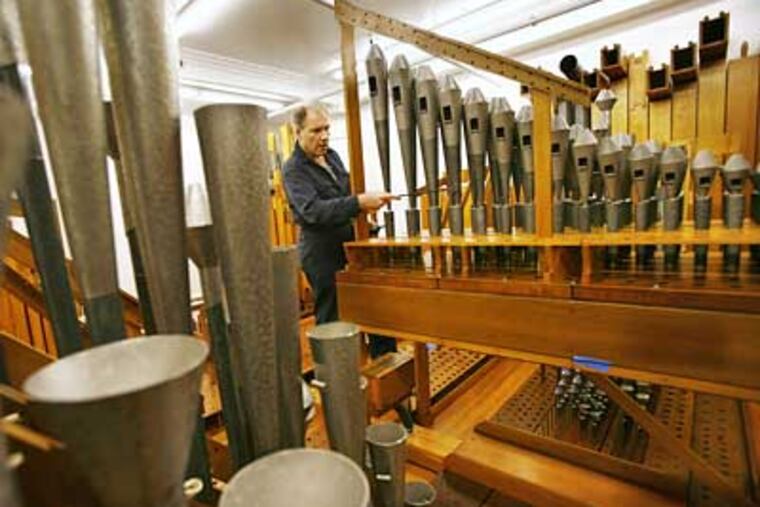
Philadelphians sometimes need reminding by outsiders: Though they're used to having the world's largest pipe organ in the downtown Macy's department store, virtually no similar establishment, possibly worldwide, has everyday organ concerts from Bach to Broadway raining down from the women's lingerie department.
Also unusual is the Philadelphia Orchestra's 7:30 p.m. concert this Saturday with the gargantuan instrument, known as the Wanamaker Organ after John Wanamaker, who imported it from the site of the 1904 St. Louis World's Fair in 1911. For the first time since 1926, the Grand Court will be cleared for the Fabulous Philadelphians and roughly 1,200 listeners seated on the main floor and two successive tiers - and paying $100 to $5,000 a ticket.
The organ's range and magnitude - which is expected to be exploited anew in a newly commissioned fanfare by
Lord of the Rings
film composer Howard Shore - reflect its status as the largest currently functioning musical instrument in the world, with 461 ranks (or possible voices) and 28,482 pipes. The organ is said to equal three orchestras. On Saturday the Philadelphia Orchestra, in theory, will make four.
"There are malls with pianos. There are commercial spaces that feature jazz trios and that kind of stuff - but not every day since 1911," says Macy's executive Robin Hall, a born-again booster for the Wanamaker organ who works out of New York and coordinates such events as Macy's Thanksgiving Day Parade. "I can't think of a parallel experience or situation in American culture. From the perspective of Philadelphia tourism, this is an unmined resource."
Already, a holiday disc with the Philadelphia Brass, titled
Wanamaker Organ Christmas
, is recorded and will be sold exclusively at Macy's (which just happens to be celebrating its 150th anniversary). In the future, Hall would love to have a midnight Christmas Eve event.
Nobody in the organ community needs convincing of the instrument's importance. Neither do out-of-towners, whose glowing entries in the organ's guest book often contain the word
awesome.
But in decades past, even the organ's admirers admit there are reasons the instrument was taken for granted.
The artistic vision that brought the organ to Philadelphia hasn't exactly been sustained: Emblematic of that is the centerpiece of Saturday's concert - the Wanamaker organ premiere of
Symphonie concertante
by Belgian composer Joseph Jongen. Now considered one of the great organ/orchestra works, it was commissioned for the Wanamaker organ, to be performed with the Philadelphia Orchestra, but its projected 1928 performance was postponed - until now.
As the 20th century waned and the store's fortunes declined, it entered a series of ownership changes. During that time, maintenance of the instrument was so minimal that by the mid-1990s, its capacity had dwindled to 20 percent.
Now, however, large parts of the organ that haven't functioned for 27 years are being restored on a daily basis. Though Macy's officials won't discuss how much money has been poured into the organ since Macy's took over the store in 2006, the estimated cost of hiring the Philadelphia Orchestra and putting on the concert alone is more than $200,000, not counting lost sales in areas of the store closed for stage building.
Sitting at the array of six keyboards and a network of 700 knobs, music director Peter Richard Conte demonstrates the improvements
.
"This oboe [stop] just came to life last night, and today, as of five minutes ago, we have this basset horn, this big, overgrown clarinet," he says. "It's wonderful!"
The difference has been increasingly audible in the daily concerts, which are played by a collegial rotating group of five players. One recent morning when the scheduled organist's car broke down, another slipped into a blue blazer and by 12:05 p.m. was playing "Give My Regards to Broadway" - gussied up with festive effects not possible only days before.
The mechanism behind the sound - packed into a crowded, invisible, three-story chamber behind the facade pipes - is navigated via steep, narrow M.C. Escher-like stairs amid air ducts the size of sewer pipes, accordionlike artificial lungs that pump air and, of course, pipes.
"One of the pipes," says Peter Batchelder, an organ technician who is now based in New York but grew up here playing hooky from homework to hear the organ, "is so huge that its walls are more than a quarter-inch thick, made of zinc, and weighing almost a ton." Its sound - 16 cycles per second, in contrast to 440 cycles per second that symphony orchestras tune to - are at the lower limits of human audibility.
As the noon concert moves on to "Climb Ev'ry Mountain," Batchelder opens the door to the organ's intensive-care unit: brass pipes so temperamental that they're cloistered. "If there's any dust or dirt on the surface of the brass, it'll keep the pipes from speaking," he says. Elsewhere, patches of available wall space are hung with vintage photos of local organists and stern directives as to how things should be handled, written in a genteel cursive. It's 1920s time warp - but the 21st century peeks back at you when, between the facade pipes, you spy racks of currently stylish clothes.
Conte loves to call the store "a cathedral of commerce," but the Wanamaker organ has thrived only when not asked to make financial sense.
When constructed in Los Angeles for the St. Louis World's Fair, the $105,000 cost represented almost twice the original budget. Transporting it to Philadelphia required 13 freight cars.
But John Wanamaker was willing to lose money and go to considerable trouble to make music history. Hiring Richard Strauss to conduct his grand orchestral work
Symphonia Domestica
in his New York City Wanamaker store wasn't an act of thrift. Unveiling the Philadelphia organ at the exact moment of King George V's coronation in England probably wasn't easy.
When Wanamaker's son Rodman set about expanding the organ in the 1920s, he sought out a now-venerated French/Belgian generation of organists/composers, Marcel Dupré (1886-1971) chief among them. In one Wanamaker concert, Dupré was given a sealed envelope of melodies on which to improvise, which went so well that he retreated to his hotel room to write down what became his celebrated
Symphonie-Passion
. As the organ expansion adviser, he is said to have been told: "Use everything you've ever dreamed about."
With Rodman's 1928 death and the onset of the Great Depression, the 40-member organ-building staff was cut to two. The Jongen premiere was postponed when the composer had a family illness. Still, recitals continued, often by music director Mary Vogt, who held forth from 1917 to 1966 with an unorthodox technique, operating the stops by swatting them with a rolled-up newspaper.
Under Lord & Taylor's ownership, the organ was so improved that new recordings commenced in 2001. Its further renaissance under curator Curt Mangel was made possible by what Conte characterizes as Macy's "whatever it takes" attitude.
Even problems caused by installation have been addressed: Because facade pipes initially were clustered so that sound was blocked, audiences are now getting more out of the organ than ever. "Nobody ever really heard this stuff," Conte says. "It was just so buried."
Contact music critic David Patrick Stearns at dstearns @philly news. com.
If You Go
Tickets for the 7:30 p.m. Saturday concert are priced from $100 to $5,000. Information: 215-893-1999
or