Millions for marsh project questioned
Next to a fallow farm field, with the Salem nuclear power plant visible over his shoulder, David Bean stands ankle-deep in marsh muck, extolling the site's future.
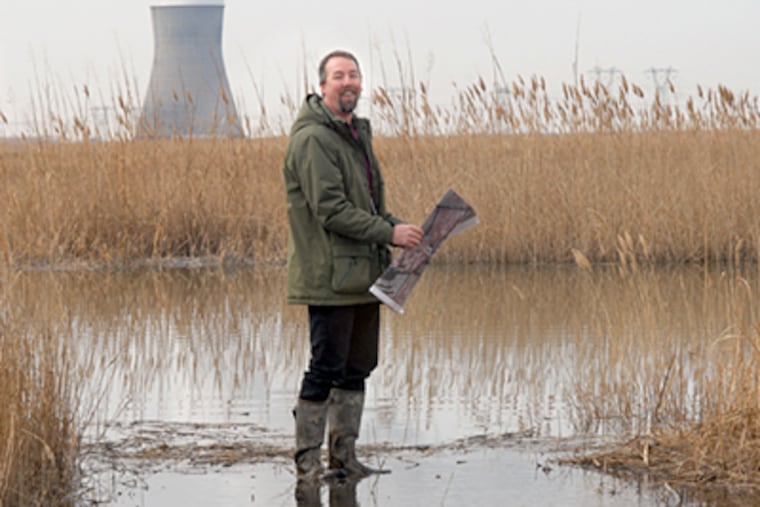
Next to a fallow farm field, with the Salem nuclear power plant visible over his shoulder, David Bean stands ankle-deep in marsh muck, extolling the site's future.
For now, it's a tiny remnant of a once-thriving marsh along the Delaware River.
But on this soggy South Jersey farm, officials are making a stand, proposing a trophy project that, along with eight smaller ones, would compensate for environmental "injuries" from the Athos I oil spill four years ago.
If the plan is approved, the 198-acre plot in Lower Alloways Creek will get a major makeover, re-creating the original marsh and grasslands.
But the cost - $18.5 million - makes even the river's most ardent supporters suck in their breath.
Critics question whether the project is worth all that money, which comes from a fund financed by the oil industry. They say an inflexible process does not allow for officials to do what is best for the river in the long run.
Worse, Eric Stiles of New Jersey Audubon said, the restoration, 40 miles downstream from the spill site, is a mismatch, because it restores a saltwater marsh when the bulk of the harm was to freshwater marshes. "They're trying to mitigate apples with oranges," he said.
Those involved say that the Salem County site is the best available and that the price is fair, even a bargain. In time, they say, the return of native plants, fish, birds, and other wildlife will help make up for the oiled geese, fouled shorelines, and other losses.
"It's going to be a huge amount of ecological uplift," said Bean, an environmental specialist with the New Jersey Department of Environmental Protection.
The spill occurred on the night of Nov. 26, 2004. The Athos I oil tanker was approaching a dock near Paulsboro when it hit a submerged anchor. Eventually, 263,371 gallons of heavy crude leaked from the gash.
Bean was one of dozens of scientists who began studying the impact in the weeks after the accident.
The oil had spoiled more than 280 miles of shoreline. Nearly 12,000 birds had died. About 412 acres of river bottom were coated with the heavy crude, potentially suffocating the life underneath.
Bean also was part of the team of officials from three states and two federal agencies - considered "trustees" for the public resource - deciding what to do next.
In a report released last month, the group proposed eight smaller projects with a total cost of $6 million, including a small freshwater tidal restoration at the John Heinz National Wildlife Refuge at Tinicum.
At $18.5 million, the crown jewel of the plan would be the Salem County farm, within the 9,000-acre Mad Horse Creek Wildlife Management Area.
A public-comment period ended Friday. The trustees will submit the final plan to the Coast Guard, possibly within months. Work could begin late this year.
Wetlands such as Mad Horse are a signature ecosystem of the Delaware Bay.
Danielle Kreeger, science director for the nonprofit Partnership for the Delaware Estuary, called them the lungs and kidneys of the bay. They improve water quality by filtering contaminants. They are fish factories. And they are the first barrier against floods.
At one time, they lined most of the shore from Cape May to Trenton. But now, they are in deep trouble.
The insults began three centuries ago, when settlers began filling in the soggy spots to make better farm fields.
Repeated dredging of the river channel has altered the sediment patterns. Snow geese - now overpopulated - have left vast "eat-outs" in the grasses. Invasive species such as phragmites reeds have taken over.
Some 3,000 ships a year use the Delaware River channel to reach the nation's third-busiest petrochemical port. The wakes travel shoreward, and erode the marshes day by day, foot by foot.
Funds to monitor the damage are so scarce that scientists cannot assess the losses adequately. "We're still trying to determine how bad it is," Kreeger said.
But satellite imagery suggests two-thirds of the bay's remaining marshes are in poor health.
Any marsh restoration is "important, very important," said Maya van Rossum, head of the nonprofit Delaware Riverkeeper Network.
But Kreeger said $18.5 million could do a lot more. "I can think of so many applications where even a small chunk of that" would make a bigger difference, she said.
Just $1 million for, say, shoreline protection from ship wakes might save 1,000 acres of marsh, she said.
She faulted not the trustees - "they did their job" - but an inflexible process that tethers them to the effects of the spill rather than what is best, overall, for the bay.
Likewise, David Velinsky, a wetlands expert with the Academy of Natural Sciences, wishes more could have been done to address climate change, such as buying easements of land so marshes would have a path to escape sea-level rise.
If the current rate - some say a foot a century - doubles, "then you've got to question some of these projects at some point," he said.
Others would like to have seen more projects closer to the spill site.
The remediation, however, can't do it all, Bean said.
"Ideally, we'd like to have a piece of property like this in Camden," he said. "But it's just not available. We've got to work with what we have. This is as good as we could get, which is pretty good."
The Mad Horse project had been in the wings for years, just waiting for funding.
In 1989, the President Rivera ran aground near Marcus Hook and spilled 300,000 gallons of oil. Some of the $2.14 million in damage was used to buy the farm.
"We couldn't have guessed, not in our wildest dreams, that another oil spill would come along," said Carl Alderson, a National Oceanic and Atmospheric Administration marine resource specialist, based in Sandy Hook.
The 38-acre wetlands portion will cost $188,000 per acre, which officials say compares favorably with the $250,000-per-acre cost of a similar restoration in Woodbridge, N.J.
Restoration is exacting work that requires specialized equipment. Grade to the wrong level - a matter of inches - and the tide won't flow in, the right plants won't grow.
All the more reason, says Velinsky, to monitor the project more closely. State rules call for five years of oversight to make sure the hydrology is correct and the plants survive.
But what about the fish? The birds? "They're not monitoring functionality as much as I'd like to see it," he said.
But Alderson calls the potential of the restoration "extraordinary" and feels confident the marsh will do everything expected of it.
"In restoration, you literally sow the seeds of the future," Alderson said. "This is going to build back a component that has been missing for years."