Next N.J. transit chief faces rough road ahead
James Simpson, nominated to be New Jersey's transportation commissioner, faces a daunting list of challenges: a nearly bankrupt transportation fund, the worst roads in the nation, and higher bus and transit fares.
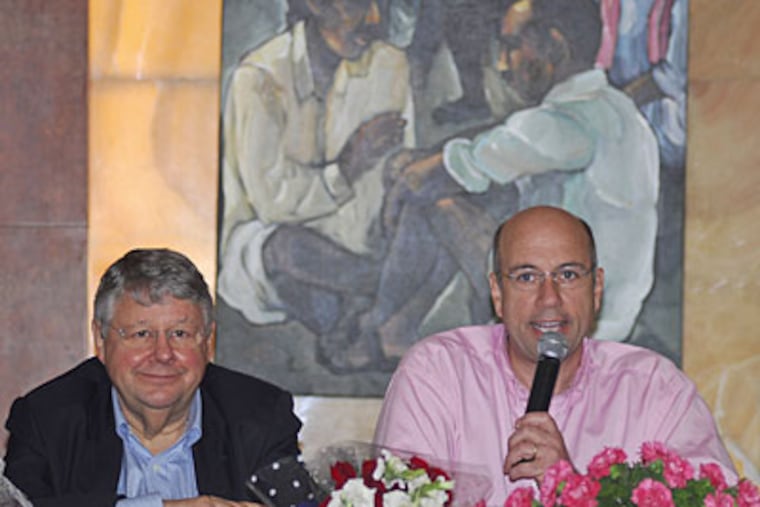
James Simpson, nominated to be New Jersey's transportation commissioner, faces a daunting list of challenges: a nearly bankrupt transportation fund, the worst roads in the nation, and higher bus and transit fares.
Simpson, a former trucker who led the Federal Transit Administration in the second Bush administration, is scheduled for a confirmation hearing tomorrow before the state Senate's Judiciary Committee.
He'll face tough questions about how to solve problems inherited from his predecessors, with his options limited by Gov. Christie's rejection of any increases in gas taxes or highway tolls.
"We were operating under the mantra that 'you have to do more with less,' while he'll have to do more with virtually nothing," said Kris Kolluri, transportation commissioner for most of the Corzine administration.
The state's Transportation Trust Fund, which pays for highway and transit projects, is projected to run dry in about 16 months, leaving Christie with two unpleasant choices: Borrow more money or raise taxes and tolls. He has said he is against both.
After June 2011, all of the $895 million that annually flows to the fund from gas taxes, tolls, and sales taxes will be needed to pay the interest on previously borrowed money. No money will be available for projects.
Already, Christie has ordered a cut in the state subsidy for NJ Transit's trains and buses, which is expected to result in higher fares and reduced service.
Some transportation experts and user groups are arguing for higher gas taxes and a constitutional amendment to require that all transportation-related tolls and fees be dedicated to the transportation fund rather than shifted to the general fund.
But polls indicate that New Jersey residents, who pay the nation's highest taxes overall, are not eager to pay more in gas taxes.
New Jersey has the third-lowest gas tax in the nation, behind Wyoming and Alaska, according to data compiled by the American Petroleum Institute, the trade association of the oil and natural-gas industry. New Jersey's tax is 14.5 cents a gallon (including a 4-cent-a-gallon petroleum products gross receipts tax), 15 cents lower than the national average.
The state's roads also are in the worst shape of any in the nation, according to ratings compiled by the Federal Highway Administration.
"With our roads deteriorating and no money to fix them, we do need a solution," said Tracy Noble, spokeswoman for AAA Mid-Atlantic, the motorists' organization.
Without an increase in the gas tax, she said, the state is likely to face higher transit fares, resulting in lower ridership, increased highway traffic, and even worse roads.
AAA looks at a gas-tax increase "as the responsible thing to do, or at least index it to inflation," Noble said.
But in a AAA survey last year, 65 percent of New Jersey members opposed a gas-tax increase.
AAA also advocates that other transportation-related fees collected by the state, such as good-driver surcharges, motor-vehicle fees, heavy-truck fees, and all tolls, be constitutionally required to go to transportation projects, Noble said.
Currently, much of that money goes to pay for general state spending.
Jack Lettiere, a proponent of raising the gas tax while New Jersey's transportation commissioner from 2002 to 2006, said, "That's a very difficult thing to ask of people in this economic climate."
"It really is a new day. We have to figure out how to keep roads and bridges in good working order at a lower cost. That's the order of the day," Lettiere said. "We have to bend that cost curve down."
He suggested such things as buying standard-issue buses and train cars rather than custom-made ones, combining transportation authorities, using pre-built components in construction projects, and creating partnerships with companies to build or operate transportation facilities.
"Simpson's got a challenge," said Mike Joyce, director of legislative affairs for a truck drivers' group, the Owner-Operator Independent Drivers Association, which has 158,000 members, including 4,523 in New Jersey. "He's a dynamic, well-connected guy who I think will search every avenue for solutions without putting an undue burden on users. I hope I don't regret those words."
Joyce said truckers would prefer an increase in the fuel tax to a boost in tolls.
"For our members, tolls are just an enormous burden. . . . Our members are a little more accepting of increasing the fuel tax. It's the least costly to administer, and it's the best way to fund transportation."
However, Joyce said, "Highway users don't trust what politicians have done in the past."
If new revenues are "dedicated to transportation use, I think people would vote for it."
Zoe Baldwin, New Jersey advocate for the pro-transit Tri-State Transportation Campaign, said an increased gas tax "is the easiest, least painful way" to raise the money needed to improve roads and transit.
A 10-cent-a-gallon increase would cost New Jersey households an average of $93 a year, and a 25-cent-a-gallon increase would cost $232, Baldwin said. The calculations are based on the average household use of 930 gallons a year.
The state shouldn't rely only on a gas-tax increase, Baldwin said. Among other possibilities, she said: a surcharge on vehicles that get poor gas mileage, an increase in heavy-truck fees, and a ballot initiative to mandate that transportation-related fees go to the Transportation Trust Fund.
In a survey of state residents for the Tri-State Transportation Campaign released last week, only 54 percent of respondents knew the Transportation Trust Fund soon would be broke. Even after being made aware, residents were evenly split on whether to pay more to address the problem.
Robert B. Noland, a Rutgers University professor who is director of the school's Alan M. Voorhees Transportation Center, said the gas tax should be tied to inflation and rise automatically.
"The infrastructure for collecting the gas tax is already set up. It's a very efficient revenue collection, and if you raise it by a few cents, after the initial complaints people won't even notice," Noland said.
The Christie administration has made clear its opposition to tax increases. So if Simpson is confirmed as commissioner, he may seek greater use of private companies in building and operating transportation facilities.
Or he may advocate for user-funded expansions to the highway network, such as tolled "Lexus lanes" on existing free roads.
He may look at tolls on interstate highways, as suggested by Christie's transition team. Such a change would likely require federal approval, since most of the state's interstates were built with federal money.
And he may consider another recommendation of the transition team: consolidating authorities such as the Turnpike Authority and the South Jersey Transportation Authority, which operates the Atlantic City Expressway and Atlantic City International Airport.
Simpson served from 1995 to 2005 as a commissioner of the New York State Metropolitan Transportation Authority and was a member of the New York State Job Development Authority Board. After he left the FTA, he cofounded and served as chairman of Spartan Solutions, an infrastructure-management firm, and directed its Philadelphia office.
A resident of Wayne, he has said he will move to New Jersey if confirmed.