Progressive Christian Democrats aren’t likely to win over conservative white evangelicals
Since 1980, conservative evangelical voters have cared more about politicians' stance on the role of religion in American public life than their personal morality or religiosity.
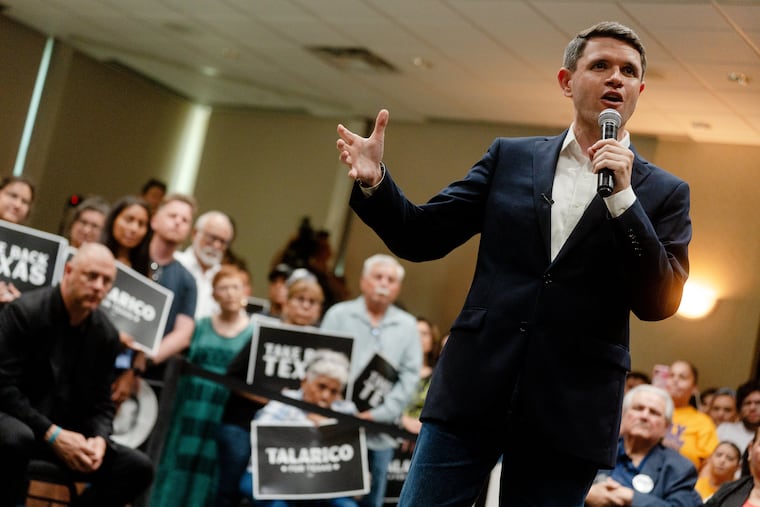
A group of Democratic candidates has drawn attention this election cycle because of their deep religiosity. Two prominent candidates for the U.S. Senate, for example, James Talarico of Texas — a Presbyterian with a recent seminary degree — and Adam Hamilton of Kansas, senior pastor of a United Methodist megachurch, frequently discuss their faith and cite the Bible on the campaign trail.
But those candidates are not winning the support of many white evangelicals.
A recent Fox News poll showed that only 21% of white evangelical voters in Texas support Talarico, even in a race against a scandal-ridden opponent who had an extramarital affair.
Policy differences over abortion and LBGTQ+ rights — two issues that have long been central concerns for white evangelical conservatives — at least partly account for this. Talarico and Hamilton both support abortion rights, and they’re running against Republicans who do not.
But a more fundamental issue also makes it hard for Christian Democrats such as Talarico and Hamilton to make inroads with conservative white evangelical Christians. The Religious Left champions cultural pluralism, while a Christian national identity drives the Religious Right — and there’s an unbridgeable gap between the two. This divide has helped to shape American politics for more than a half century.
It helps explain why more than 80% of white evangelical voters cast their ballots for President Donald Trump in each of his three presidential races. It’s also the reason why, in 1980, a majority of white evangelical voters supported Ronald Reagan, who had been divorced and was a less frequent churchgoer, over President Jimmy Carter, a Southern Baptist deacon and Sunday school teacher.
In each case, white evangelicals considered a candidate’s faith and personal behavior to be far less important than their top priority: finding someone who championed their understanding of the place of Christianity and Christian-based sexual morals in the nation.
This wasn’t always the case. In the mid-1970s, leading American evangelical magazines such as Christianity Today called for the election of morally exemplary, born-again Christian candidates on the grounds that only Christian politicians could rescue the nation from moral decline. When Carter ran for president in 1976, many evangelicals decided he fit the bill, and backed the Democrat.
But some evangelicals quickly regretted this choice. Both Carter and more conservative evangelicals believed that the United States was morally adrift. Yet, their understanding of the sources of that national moral decline differed.
For Carter, whose moral consciousness was shaped in part by his interactions with civil rights activists, racism and the destruction of the environment were moral evils. That meant that the solution to America’s moral problems would focus on greater equality, as well as a more responsible use of the environment. The United States faced a “moral and spiritual crisis,” he said — but that crisis could best be addressed by a reduction in “self-indulgence and consumption,” not through a public affirmation of America’s Christian identity.
Moreover, as a moderately liberal Baptist — a tradition that had historically championed religious liberty — Carter was a religious pluralist who eschewed public endorsements of Christianity and embedding his personal religious beliefs in public law.
He opposed the White House church services that President Richard Nixon had created. He publicly endorsed the Supreme Court rulings that curtailed classroom prayer in public schools, because he said that “as a Baptist,” he believed that “the Government ought to stay out of the prayer business.” And although he personally opposed abortion, he refused to support a constitutional amendment to overturn the Supreme Court’s Roe v. Wade decision — which conveyed a right to have an abortion — because he thought that in a pluralistic society, it was improper for the federal government to impose one religious group’s view of abortion on others.
Conservative evangelicals, however, recoiled from these views. To them, the sexual revolution of the 1960s and 1970s was a much greater evil than racial injustice or environmental destruction. It threatened the fundamental building block of society: the family. And the source of the sexual revolution, they thought, was a national rejection of God, which was manifest not only in religious pluralism but also in the Supreme Court decisions on school prayer and abortion.
In the late 1970s, this concern prompted the formation of the Christian Right. At its heart, this movement was a campaign to restore an imagined lost world of the 1950s — an era that had combined more conservative sexual standards with national legislation to make “In God We Trust” the national motto. Conservative evangelicals thought those values had been lost amid the anti-war protests and cultural changes of the 1960s and 1970s.
Some evangelical leaders argued that the answer was mobilizing and electing a president who shared their hunger to return to the world of the 1950s. “The hope of reversing the trends of decay in our republic now lies with the Christian public in America,” Moral Majority founder (and Baptist megachurch pastor and televangelist) Jerry Falwell declared in 1980. “Our Founding Fathers separated church and state in function, but never intended to establish a government void of God … We cannot be silent about the sins that are destroying this nation … We must turn America around or prepare for inevitable destruction.”
White evangelical Christians had voted for Republican presidential candidates before — including in 1972, when they overwhelmingly supported Nixon’s reelection. But Falwell’s Moral Majority and other allied groups, such as Christian Voice and the Religious Roundtable, broke new ground in channeling evangelicals’ generally conservative instincts into a much more tightly focused campaign to restore Christian values through public law. That campaign put them at odds with religious pluralists like Carter.
These new groups backed Reagan, and other candidates like him, who they believed would oppose further secularization of the nation’s laws and culture and prevent any further sexual liberalization. The Religious Right also opposed candidates who were strong cultural pluralists, since they thought that secularization and a pluralistic understanding of the nation’s religious identity had undermined the country’s moral foundation.
Sometimes that meant backing less personally devout, morally compromised candidates, since the most vocal advocates of a public affirmation of Christianity’s place in public life were sometimes infrequent churchgoers whose sexual lives were far from monogamous. To these evangelical activists and voters, politicians’ policy choices mattered far more than their personal behavior. As Christian Voice executive director Richard Zone put it when endorsing Reagan, he “was not the best Christian who ever walked the face of the earth.” But to Zone, “we really didn’t have a choice.”
When the group issued a “Moral Report Card” in 1980 that rated every member of Congress on the morality of their votes, pious churchgoers such as Sen. Paul Simon (D-Ill.) and Rep. Robert Drinan (D-Mass.), the only Catholic priest serving in Congress, received moral ratings of zero, while Rep. Richard Kelly (R-Fla.), who was sentenced to prison a few months later for accepting bribes in the Abscam scandal, received a rating of 100. Even the devout evangelical Baptist Sen. Mark Hatfield (R-Ore.), a liberal Republican who opposed abortion but warned against “mix[ing] piety with patriotism,” found himself at odds with the Christian Right.
And little has changed in terms of this picture over the last 46 years. Once again, in 2026, in Kansas, Texas and elsewhere, evangelical voters have a choice similar to the one that evangelicals confronted in 1980: vote for the most religiously devout Christian candidate on the ballot or vote for a candidate who shares their vision of the nation.
If history is any indication, most of them will choose the latter. Fundamentally, white evangelical voters understand that progressive Christian candidates are usually cultural pluralists whose faith is shaped by values of equality. They don’t see secularization and the sexual revolution as the threats that most white evangelicals do. Instead, progressive Christians are often more concerned about what they see as the threat to the rights of religious and sexual minorities posed by Christian nationalism.
This history suggests that if progressive Christians like Talarico and Hamilton win their House and Senate races in November, it will be by overcoming white evangelical opposition, not because they hit upon a formula to win over the most conservative churchgoers.
Daniel K. Williams is an associate professor of history at Ashland University and the author of God’s Own Party: The Making of the Christian Right.
Made by History takes readers beyond the headlines with articles written and edited by professional historians. Opinions expressed do not necessarily reflect the views of The Inquirer.