The downfall of Mayor Parker’s tax on Uber was her biggest legislative defeat to date. Here’s what went wrong.
The budget fight revealed that Parker’s hard-nosed negotiating style will not always work with a City Council that is increasingly willing to throw around its weight.
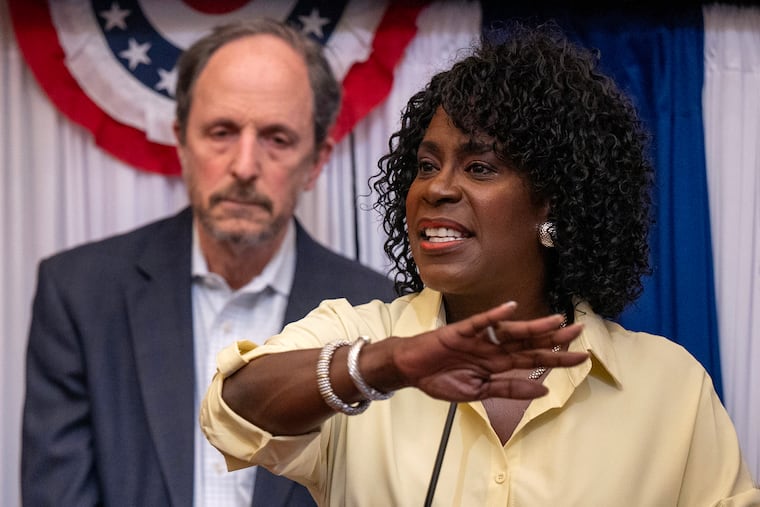
Philadelphia Mayor Cherelle L. Parker often cites a formative moment from her past when talking about her approach to political dealmaking: As a young legislator in Harrisburg, she helped authorize a cigarette tax to fund Philadelphia schools by persuading Republicans to vote for it.
Today, the centrist Democratic mayor who leads the state’s bluest city proudly maintains relationships with members of the Pennsylvania GOP. But as of late, Republicans are not the ones holding back her agenda.
Her biggest obstacle is, apparently, much closer to home.
On Thursday, Philadelphia City Council, with its Democratic supermajority, rejected a series of tax increases that the mayor proposed as part of her budget for the coming fiscal year. The most high-profile and controversial was a $1-per-ride tax on rideshare services like Uber and Lyft, intended to generate $48 million annually for the Philadelphia School District, which is facing a $300 million structural deficit and hundreds of planned staff cuts.
For weeks, Council members appeared skeptical of the surcharge and worried that it would fall on their constituents. They were angry that they were being asked to raise taxes for public education while the district’s leaders simultaneously advanced a plan to close 17 schools.
Meanwhile, their Democratic colleagues in Harrisburg — including Gov. Josh Shapiro — showed little appetite to raise taxes themselves.
But Parker did not change course. She insisted that her $1-per-ride plan was the best way to fund the schools. And she stuck with parallel proposals to raise the city’s hotel tax to generate money for homelessness prevention and to levy a 25-cent fee on retail deliveries to fund pothole repairs.
None of it will become reality. In the end, Parker said she persuaded only three of Council’s 17 members to vote yes on her rideshare tax, and Council President Kenyatta Johnson never called it up for a vote.
All told, the budget fight — which came the year before the mayor and every Council member are up for reelection — revealed that Parker’s hard-nosed negotiating style will not always work with a City Council that is increasingly willing to throw its weight around.
It showed that the traditional assumptions about alliances in City Hall do not always ring true, and that even Parker’s allies in Harrisburg may not play ball with her plans.
And ultimately, it was the structure of Parker’s budget proposal that made it possible for Council members to reject it.
While securing funding for schools is a time-honored political argument, the $48 million per year that the rideshare tax was expected to generate is a relatively small amount of money in a $7 billion budget.
» READ MORE: Philly teachers union and advocates implore school officials to restore 340 classroom positions
Johnson said his staff, working in partnership with the administration, found nearly $50 million — without approving a tax increase — in the existing budget in about two or three hours. They added that money to the district’s annual allocation this year, and said they were under the impression that the school staff cuts would be averted.
On Thursday, the district said it will make the cuts anyway.
Parker’s negotiating style may have backfired
Parker entered this budget season with a reputation of strength. During her first two years in office, the mayor essentially got what she wanted out of City Council when it came to her spending and revenue proposals, even after at-times contentious negotiations.
This year, Parker employed her usual unbending approach to negotiations, in which she often refuses to blink first. But she ran up against a Council that also entered this budget season empowered.
In March, Parker initially proposed a 20-cent-per-ride fee on rideshare services to help fund the school district. There was little immediate pushback from Council.
Two weeks later, she increased that plan to $1 per ride, saying the district needed more recurring revenue to avoid hundreds of planned staff cuts. That is when Council members balked.
Some members said they would have been open to finding a number lower than $1 per ride. But, according to Council sources familiar with the closed-door discussions, there was little talk of reducing the rate until the final days before lawmakers had to vote.
By that point, members — who were lobbied by Uber for months and heard from constituents who did not want a tax increase — had already made up their minds and wanted to reject the tax outright.
Multiple members of Council’s leadership publicly alluded to the mayor’s posture on Thursday, saying that negotiations at times felt “one way.”
“It’s never going to just be one way [where] we get a proposal and say ‘you know what, we’re gonna just follow suit,’” said Johnson, a centrist Democrat who has generally sought to project unity with the mayor. “We’re going to do our due diligence as a body and respond accordingly.”
Councilmember Katherine Gilmore Richardson, the majority leader, similarly said Council must “make difficult decisions and choices, and that is what negotiations are: They’re a two-way street, not a one-way street.”
Parker forcefully pushed back against the notion that she was not willing to compromise.
She said Thursday that there were discussions of “an adjusted rate,” as well as considerations to amend the district’s controversial school closure plan. She said it was Council that failed to offer an alternative funding stream that would provide recurring revenue to the district as it faces a $300 million structural deficit.
“If anyone says to you that Mayor Parker and her team refused to move and drew a line in the sand, it is a bald-faced lie,” she said. “We did everything we could to get to yes. That’s who I am. That’s what I do.”
Rideshare tax reveals Philly politics’ upside-down world
The rideshare tax seems to have prompted an ideological role reversal in City Hall — and it did not work out in Parker’s favor.
After Council rejected her proposal, Parker on Thursday held a fiery news conference in which she could have been mistaken for a devotee of progressive U.S. Sen. Bernie Sanders. She railed against “billionaire tech companies” that “control algorithms and what we see on social media” while wielding “million-dollar lobbying budgets” and “extracting a great deal of wealth from Philadelphians.”
And as budget negotiations were still unfolding on Wednesday, it was Councilmember Kendra Brooks — a democratic socialist and leader of the progressive Working Families Party — who bluntly rejected the new rideshare tax.
“I’m a no,” Brooks said.
Parker found herself aligned with the teachers union. Meanwhile, Brooks and some other left-leaning members were on the same side as the city’s business-friendly tourism agencies.
Parker said it was “not lost on” her that some lawmakers who can usually be counted on to tee off on large corporations did not back her taxes on gig economy firms, which, she noted, avoid paying for employee benefits by relying on independent contractors as their frontline workers.
“Did that come across my mind that I thought that there would be some synergy?” she said. “Yes, but this is politics and government, and you can’t assume.”
Brooks indicated Friday that she is not opposed to a rideshare tax in concept, but did not support Parker’s proposal due to the mayor’s handling of the budget process and the details of the plan.
“There was no outreach to us on this set of proposed taxes and we prefer any rideshare taxes go to funding SEPTA — like other cities across the country have done to support public transit," Brooks said in a statement. “We want a real sustainable option for the school revenue, not a last minute tax increase on the backs of working people which doesn’t make sense.”
She and fellow Working Families Party Councilmember Nicolas O’Rourke said in a joint statement Thursday that they “welcome Mayor Parker’s newfound interest in taxing billionaires and corporations,” noting that they opposed a major business tax cut bill that Parker pushed through Council last year. They also reiterated their support for a “wealth tax” on Philadelphians’ stocks and bonds — a proposal that has not gained traction in Council — and said they “look forward to exploring revenue proposals with our City Council colleagues.”
Another factor complicating the politics of the rideshare tax was the separate but related fight over the school district’s long-awaited facilities plan, through which 17 school buildings are slated to be closed and 169 renovated. Many lawmakers said they thought it was a bad look to raise taxes for the district when buildings were being shuttered, and threatened to block the rideshare tax when the school board approved the facilities plan in April.
For instance, Councilmember Jamie Gauthier, a progressive Democrat who was likely one of the members Parker hoped would back the tax, fought aggressively to spare the Robeson High School building in her West Philly district from closure. Robeson was never removed from the closure list, and Gauthier never warmed to the rideshare tax.
Parker has framed her tax proposals’ defeat in this year’s budget negotiations as big tech companies winning “round one.” She did not specify what could be involved in round two but said she would not rule out making another attempt at passing a rideshare tax.
Harrisburg wouldn’t play ball
Parker ran for office on a promise to emphasize intergovernmental cooperation. She leaned on her experience as both a state legislator and a member of City Council to say she was uniquely positioned to find compromise.
Since taking office, the mayor has worked to maintain relationships on both sides of the aisle, and has made a special effort to court Republicans. She often goes out of her way to extend gratitude to GOP leaders in the General Assembly, and recently ate cheesesteaks with U.S. Sen. Dave McCormick (R., Pa.).
When Parker unveiled her budget in March, she made clear that the General Assembly needed to authorize two of the measures: a proposed increase of the hotel tax to generate money for homelessness programs, and a plan to close a loophole that allows out-of-town online retailers to avoid paying the city’s sales tax.
Republican leaders, often loath to raise taxes, seemed surprisingly amenable. Senate Majority Leader Joe Pittman, a Republican from rural Indiana County, said he admires the mayor and was open to her proposals but would defer to Philadelphia’s delegation in Harrisburg.
» READ MORE: Mayor Parker turns to Harrisburg — and GOP allies — to make her budget priorities work
It was members of Parker’s own party whom she was unable to convince.
Shapiro, who is up for reelection and is a rumored contender for president in 2028, made clear as early as March that he was not looking to raise taxes.
And Democrats in both chambers of the General Assembly were notably quiet about Parker’s proposals. That’s despite the fact that members of the Philadelphia delegation, such as House Speaker Joanna McClinton, are leaders in the chamber and allies of the mayor.
“No one in Harrisburg came to me and said, ‘Hey, you better pass that tax,’” Council’s Johnson said. “And I’m a former legislator from the General Assembly. I have relationships on both sides of the aisle. And I never got one call.”
Their disinclination to raise taxes spilled out into public view Tuesday, just hours before Council was scheduled to convene to vote on Parker’s entire budget. The Inquirer reported that the state legislature was unlikely to approve any new tax associated with the mayor’s proposal.
City Council members took note. By Wednesday, Johnson made it clear to Parker: A majority of Council wouldn’t vote to approve her new taxes, either.
