Fewer people are running red lights, PPA says
Red-light cameras have proved their worth, says the Philadelphia Parking Authority's leader. Enforcement is scheduled to end July 15, 2027, unless the state legislature renews the law.
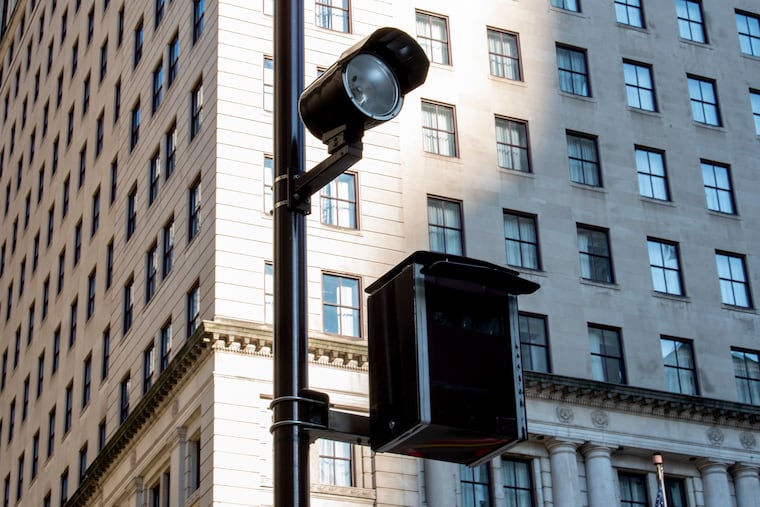
Automated red-light enforcement cameras caught up to 17.4% fewer violations this year than in 2025, according to the Philadelphia Parking Authority’s annual report to the state legislature.
Those cameras have been on guard in the city since 2005, but the program will expire next July, unless legislators renew the law that authorized them.
“The numbers speak for themselves, and our hope is that they see the benefit of it,” said Gabe Roberts, interim executive director of the PPA.
Recorded violations citywide declined from 340,931 in fiscal year 2025 to 338,979 in fiscal year 2026 — a decrease of 0.58%
However, four new intersections were added at different points during this fiscal year. For the PPA, the fiscal year runs from April 1 through March 31.
Excluding those four intersections, violations at existing program locations declined by 17.4%. Compared with 2024, they dropped 10.4%.
“The way we measure success is through consistent enforcement, demonstrated changes in behavior, fewer people running red lights, and safer streets,” Roberts said.
The red-light program has proved its worth, he said.
New locations
Over the 21 years of red-light cameras in the city, violations have trended down overall, Roberts said, though when a new location is added, tickets spike at first before leveling off and declining.
As of March 31, PPA was operating 160 cameras at 38 locations.
The newest locations are: 20th Street and John F. Kennedy Boulevard; Front Street and Hunting Park Avenue; Kelly Drive and Eakins Oval; and 58th Street and Baltimore Avenue.
Cameras there led to 50,589 warning notices and violations.
When a red-light camera is installed, there is a 45-day grace period when violators get a warning before tickets start. The fine is $100 per offense, but no points are assessed to a driver’s license.
There has been continued demand for red-light cameras in the city. PPA received requests for coverage of 19 intersections from the Philadelphia Office of Transportation and Infrastructure and City Council members through March 31.
Intersections are evaluated on the basis of crash statistics and a fresh traffic study that includes observations of violation levels there.
Also considered: sight lines, driveways, trees, wires, crosswalk visibility, and the condition of the surrounding infrastructure.
Usually an intersection gets some upgrades when red-light cameras are installed — new sidewalk accessibility ramps, new signal boxes, better lighting, more visible crosswalks, or the like, said deputy PPA director Corrine O’Connor.
“You’re not going to put cameras in and have old infrastructure out there,” said O’Connor, who is in charge of automated enforcement programs. “It’s an opportunity to make it better and safer.”
PPA says it typically takes one to two years to complete an intersection.
Speed cameras
In addition to the red-light program, PPA operates automated speed enforcement cameras.
Speed cameras were first installed on Roosevelt Boulevard in 2020 on a trial basis and more were added in the next two years. State lawmakers made the program permanent in 2023 and gave Philadelphia permission to add them on up to five more dangerous corridors.
Broad Street, for instance, now has 31 speed cameras spread over 13 miles. They began operating last September.
New speed cameras went live on portions of Route 13 in North and West Philadelphia on Aug. 31.