Maduro appears in court, says ‘I was captured’
The deposed Venezuelan president is set to make his first appearance in a New York courtroom on the narco-terrorism charges that the Trump administration used to justify capturing him.
NEW YORK — Deposed Venezuelan leader Nicolas Maduro declared himself “innocent” and a “decent man” as he pleaded not guilty to federal drug trafficking charges in a U.S. courtroom on Monday.
“I’m innocent. I am not guilty. I am a decent man, the president of my country,” Maduro told a judge.
Maduro was making his first appearance in an American courtroom Monday on the narco-terrorism charges the Trump administration used to justify capturing him and bringing him to New York.
Maduro, wearing a blue jail uniform, and his wife were led into court around noon for a brief, but required, legal proceeding that will likely kick off a prolonged legal fight over whether he can be put on trial in the U.S. Both put on headsets to hear the English-language proceeding as it was translated into Spanish.
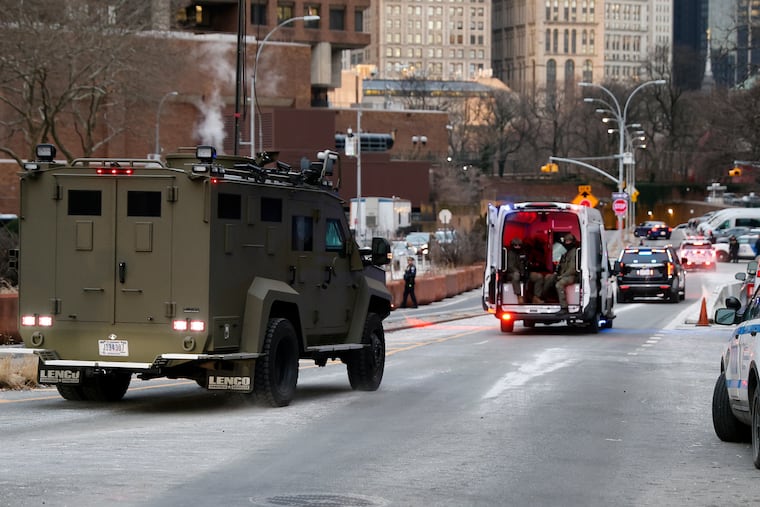
The couple were transported under armed guard early Monday from the Brooklyn jail where they’ve been detained to a Manhattan courthouse.
The trip was swift. A motorcade carrying Maduro left the jail around 7:15 a.m. and made its way to a nearby athletic field, where Maduro slowly made his way to a waiting helicopter. The chopper flew across New York harbor and landed at a Manhattan heliport, where Maduro, limping, was loaded into an armored vehicle.
A few minutes later, the law enforcement caravan was inside a garage at the courthouse complex, just around the corner from the one where Donald Trump was convicted in 2024 of falsifying business records. Across the street from the courthouse, the police separated a small but growing group of protesters from about a dozen pro-intervention demonstrators, including one man who pulled a Venezuelan flag away from those protesting the U.S. action.
As a criminal defendant in the U.S. legal system, Maduro will have the same rights as any other person accused of a crime — including the right to a trial by a jury of regular New Yorkers. But he’ll also be nearly — but not quite — unique.
Maduro’s lawyers are expected to contest the legality of his arrest, arguing that he is immune from prosecution as a sovereign head of state.
Panamanian strongman Manuel Noriega unsuccessfully tried the same defense after the U.S. captured him in a similar military invasion in 1990. But the U.S. doesn’t recognize Maduro as Venezuela’s legitimate head of state — particularly after a much-disputed 2024 reelection.
Venezuela’s new interim president, Delcy Rodríguez, has demanded that the U.S. return Maduro, who long denied any involvement in drug trafficking — although late Sunday she also struck a more conciliatory tone in a social media post, inviting collaboration with President Trump and “respectful relations” with the U.S.
Before his capture, Maduro and his allies claimed U.S. hostility was motivated by lust for Venezuela’s rich oil and mineral resources.
The U.S. seized Maduro and his wife in a military operation Saturday, capturing them in their home on a military base. Trump said the U.S. would “run” Venezuela temporarily, but Secretary of State Marco Rubio said Sunday that it would not govern the country day to day other than enforcing an existing " oil quarantine."
Trump suggested Sunday that he wants to extend American power farther in the Western Hemisphere.
Speaking aboard Air Force One, he called Colombia’s president, Gustavo Petro, “a sick man who likes making cocaine and selling it to the United States. And he’s not going to be doing it very long.”
He called on Venezuela’s Rodriguez to provide “total access” to her country, or else face consequences.
Trump has suggested that removing Maduro would enable more oil to flow out of Venezuela, but oil prices rose a bit more than 1% in Monday morning trading to roughly $58 a barrel. There are uncertainties about how fast oil production can be ramped up in Venezuela after years of neglect and needed investments, as well as questions about governance and oversight of the sector.
A 25-page indictment made public Saturday accuses Maduro and others of working with drug cartels to facilitate the shipment of thousands of tons of cocaine into the U.S. They could face life in prison if convicted.
Maduro has retained Barry J. Pollack, a Washington, D.C.-based lawyer known for securing WikiLeaks founder Julian Assange’s release from prison and winning an acquittal for former Enron accountant Michael Krautz.
Pollack, a partner at the law firm Harris, St. Laurent & Wechsler, negotiated Assange’s 2024 plea agreement — allowing him to go free immediately after he pleaded guilty to an Espionage Act charge for obtaining and publishing U.S. military secrets.
Krautz, acquitted of federal fraud charges in 2006 after a hung jury the year before, was one of the only Enron executives whose case ended in a not-guilty verdict. Nearly two dozen other executives were convicted of wrongdoing in connection with the energy trading giant’s collapse.
Maduro and his wife, Cilia Flores, have been under U.S. sanctions for years, making it illegal for any American to take money from them without first securing a license from the Treasury Department.
While the indictment against Maduro says Venezuelan officials worked directly with the Tren de Aragua gang, a U.S. intelligence assessment published in April, drawing on input from the intelligence community’s 18 agencies, found no coordination between Tren de Aragua and the Venezuelan government.
Maduro, his wife, and his son — who remains free — are charged along with Venezuela’s interior and justice minister, a former interior and justice minister, and Hector Rusthenford Guerrero Flores, an alleged Tren de Aragua leader who has been criminally charged in another case and remains at large.
Among other things, the indictment accuses Maduro and his wife of ordering kidnappings, beatings, and murders of those who owed them drug money or undermined their drug trafficking operation. That included a local drug boss’ killing in Caracas, the indictment said.
Maduro’s wife is also accused of accepting hundreds of thousands of dollars in bribes in 2007 to arrange a meeting between “a large-scale drug trafficker” and the director of Venezuela’s National Anti-Drug Office, resulting in additional monthly bribes, with some of the money going to Maduro’s wife, according to the indictment.