This mini pig has a big job
A woman who works with homeless people finds a partner who can break through their emotional defenses: a 5-pound pig.
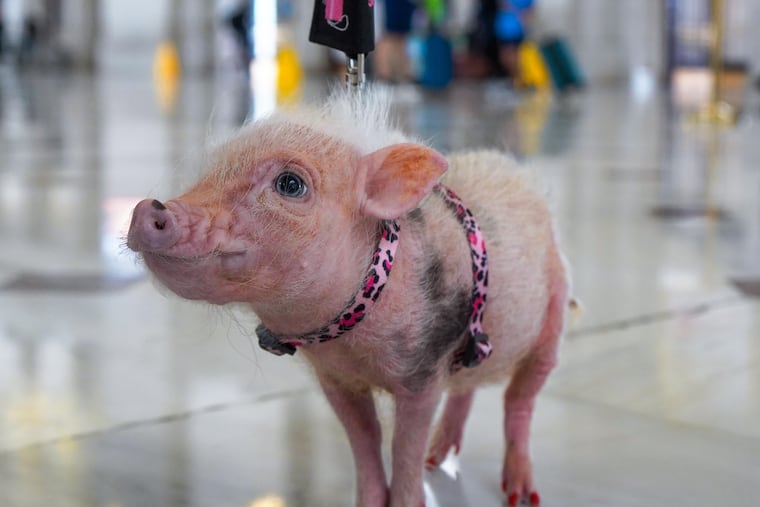
In the Beaux-Arts grandeur of Union Station’s main hall, beneath the gold-leafed ceiling, towering columns, and 46 Roman centurion statues, there is a pig.
She is very small (5.2 pounds) and very young (7 months).
Her name is Synergy.
Her footsteps click-clack as she toddles on the marble floor, and she can’t walk more than a few yards before someone stops her to take a photo. Today, she’s on the job.
About 100,000 people pass through Union Station in Washington, D.C., daily — tourists hoisting duffel bags, or locals bustling to their offices. Train stations also tend to attract a disproportionate share of unhoused people, who come for amenities that are hard to access when you’re without a physical home: air-conditioning, heat, Wi-Fi, bathrooms, restaurants, and, occasionally, generous strangers.
Union Station is also the headquarters of the h3 Project, a crisis intervention and anti-human-trafficking group, founded in 2020. Ami M. Angell started the project, which stands for home, health, and happiness.
Synergy is her pig. Angell is her real last name.
“It is a little pig! I’ve always wanted one!” shouts Logan McGraw, Angell’s client, from across the plaza.
He makes toward Angell with his wife, Evone. As they scratch behind her ears, Synergy rubs her back against the foot pedal of Evone’s wheelchair.
“Can I take her home with me?” she asks.
In the last year, Angell has matched 93 individuals with housing, administered 217 doses of the overdose reversal drug Narcan, and ordered 537 documents, including legal identification. But the year also brought challenges, including decreased funding, directives from a Trump task force to sweep homeless encampments. and the long-standing notion that homelessness outreach organizations attract more unhoused people.
Angell has long partnered with Amtrak police, who know to call her team if they witness someone experiencing a crisis. She says the influx of federal law enforcement officers at Union Station, most of whom are unfamiliar with her work, has led to heightened interactions between armed guards and her clients, often at their worst moments.
But Angell’s clients have also adapted. Several have told her that instead of posting up somewhere semi-permanently, they break down their tent every morning and wait to pitch it until late at night.
“Our folks are so resilient,” she says.
Difficult moments require creative solutions. Synergy, for example.
‘Moving forward because of Synergy’
Angell isn’t a smoker, but she always keeps a pack in her bag. She can’t count how many times she’s offered a cigarette to someone in a crisis, often mental-health- or substance-induced. It buys her the time and calming distraction she needs to de-escalate and provide case management.
“We have to think outside the box, because every individual is unique,” she says. “What works for one individual may not work for another person. It’s figuring out the way in, and if you can get that door open a little, then you can get it open a lot larger.”
So when a friend of a friend told her about Juliana pigs — a hypoallergenic, friendly breed colloquially known as mini pigs — she started thinking about her clients.
“A lot of the folks that we work with, they’ve never seen a pig, let alone touched one,” she says. “With pigs, it doesn’t matter your age, your race, your gender; they love you equally.”
She found a breeder in Michigan and waited for a litter to be born in late December. Synergy moved into her home in March.
Every day that Angell goes to work, Synergy tags along. In the h3 Project office donated by Union Station, she’s hidden now under a mountain of blankets. The vast space is crowded with shelves and bins of donations — tees and sneakers organized by size, toothbrushes and deodorant stashed in boxes. And in the center is Synergy’s pen, with a litter box and a bowl of apple juice.
“Synergy!” Angell calls.
Up pops a little pink head with blue-gray eyes and a perpetual smile. Her flat nose is damp, and her skin is wrinkled and covered in wiry hair, a miniature Benjamin Button.
“Want a treat?” Angell asks.
Synergy presses her snout to a green button atop the carpet, which chimes out “Yes yes yes yes yes.”
“Do you want it right now?”
“Yes, baby!” says Synergy via a button. Angell obliges with a treat.
At her young age, Synergy already knows how to pass a tunnel-and-ring agility course and play a toy piano. She’s learning how to skateboard. Like many toddlers, she is still learning how to like vegetables.
Angell says she’s already helping people.
One woman in her late 60s, whom Angell has known for seven years, has continually refused case management. “She’s not rude or anything,” Angell says. “She just wasn’t ready.”
When she saw Synergy, her face erupted into a smile, and she shook her head. It was the icebreaker Angell needed.
“Now she wants to work with me,” she says. “As long as the pig is right there, she will answer my questions, she will do the work with me. She’s moving forward because of Synergy.”
‘That’s my pig!’
The pig is, notably, not called Babe or Wilbur. Angell instead chose a name that spoke to what she hoped her pig would be. We are where we are, Angell says, because of our positive and negative experiences.
“There is a synergy to it all,” she says. “I just wanted her to ground folks and remind them that there’s always more to life and more to be than what is right now. For my homeless, they aren’t defined by who they are now. This is just one piece of their life. They deserve to be somewhere better.”
And it seems like Synergy knows it, too. Because now, as Angell and her pig take the elevator down to Union Station’s west porch to work with clients, her stringlike tail is wagging.
“That’s my pig!” says Randall Baldree, with whom Angell has worked for several years.
“Well, you’ve definitely kissed her more than anyone,” Angell responds.
Baldree describes himself as “one of the originals of h3.” He’s among Synergy’s biggest fans.
“She helps me when I’m down, helps me when I am depressed and when I can’t get through life,” he says. “I have somebody to depend on.”
According to Angell, pets are a lifeline for some unhoused people — they can help prevent substance use or motivate people to seek stability. A man most people know by the name Cheez It (legally Joshua Bunker) has been working with h3 for eight months but is just meeting Synergy today. He didn’t bring his pit bull, Dot Dot, but thinks they would get along.
“I’ve always had dogs, and a bird, and a turtle,” he says. “They say what humans can’t say. They see what humans can’t see.”
Working, please do not disturb
When they see Synergy tip-tapping through Union Station, people tend to react as if they’ve seen a celebrity — phone cameras whip out, hands cover open mouths, gasps of delighted shock erupt.
With her nails painted red and her pink cheetah print harness, she does look like a diva.
As she’s working with clients, Angell tends to brush off other conversations with a business card that links to information about h3 and Synergy’s Instagram. She trades Synergy’s leash sash from one that reads “I Am Working, Please Do Not Disturb” to one that reads “Wellness Ambassador for the Homeless.”
The questions come immediately.
“Can I get a picture?” asks one traveler.
“How old is she?” questions another.
“Will you be able to carry her forever?”
“It’s diet and genetics,” Angell answers, over and over again. “One parent is 12 inches tall, one is 13 inches tall. She will get bigger.”
But to Angell, the best questions are the ones that give her an opportunity to talk about the h3 Project.
“Are you a vet?” says Wendy Lesko, who was shopping in the station.
Angell responds that she worked in international law. “I came here for human trafficking, but in D.C., homelessness is closely intertwined.”
Synergy isn’t just a way in for unhoused people — she’s also a conversation starter with the public at large. And for the people who work with h3, she can be the difference between accepting help and going it alone.
“Hey little piggy!” calls one of Angell’s clients, Dannitta Jenkins.
Her voice echoes under the stone awning. “She’s such a cutie pie!”
“I can’t believe you haven’t met Synergy,” Angell responds as Jenkins hustles over.
Jenkins goes in for a hug. Synergy, cradled snugly in Angell’s arms, aims a lick at Jenkins’s bag of cinnamon sugar pretzels.
“I’m so glad you’re in your house now,” Angell whispers. “It’s been a long time.”