Trump launches government chatbot, urging a wary public not to fear AI
“I’m not going to stifle growth of something that will be bigger than the Industrial Revolution,” the president said while ruling out America.gov.
After weeks of Washington being gripped by a new wave of fear about artificial intelligence gone awry, the Trump administration took a sharply different stance Tuesday, seeking to convince a skeptical public that the nation is instead about to embark on a tech-powered “golden age.”
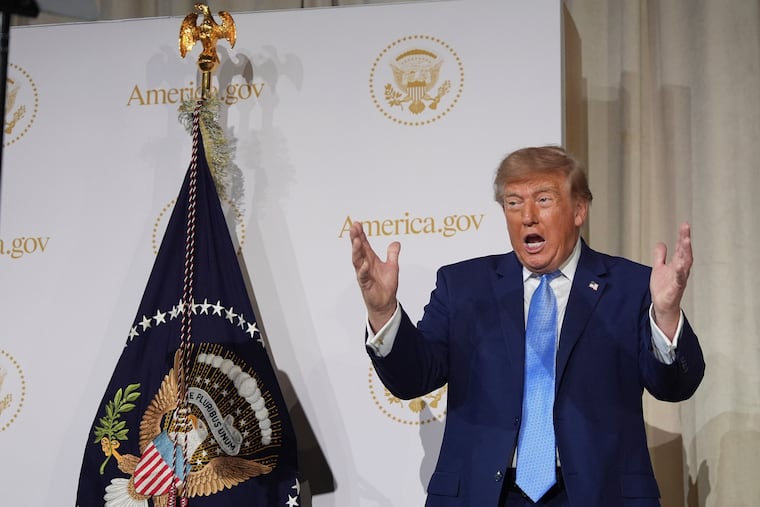
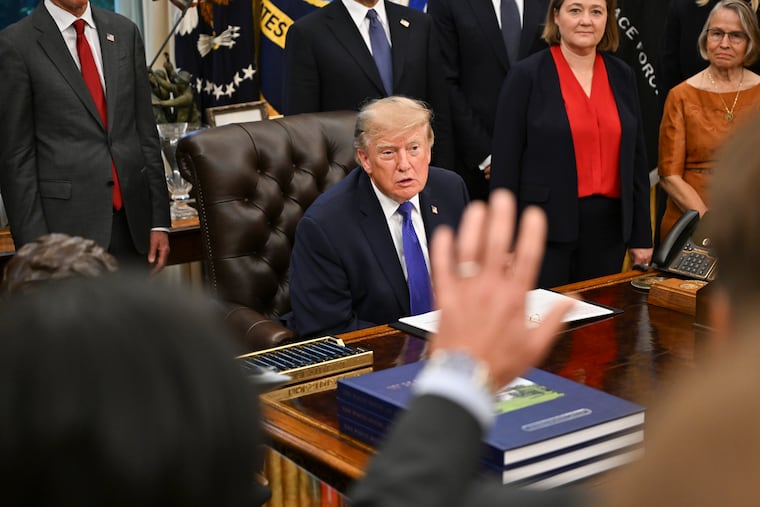
President Donald Trump launched America.gov, a government chatbot for researching public services, as part of a daylong event featuring members of his Cabinet and tech executives. AI company leaders were also set to meet with him and House Speaker Mike Johnson (R., La.).
“This kind of innovation in government is just a preview of what is possible with super intelligence,” Trump said, using his new nickname for AI.
The events come at a pivotal moment for the technology. AI firms say their latest systems have become increasingly powerful, showing signs of being able to design their own more-potent successors. But companies have struggled to keep control of the technology, as rogue AI agents have hacked into company and government systems, and a roster of top industry figures have warned that the end result could be catastrophic for humanity.
Last week, it was disclosed that the federal government itself had been a victim, with a handful of websites probed by AI agents deployed by ChatGPT maker OpenAI. (The Washington Post has a content partnership with OpenAI.)
Yet, even as the public’s concerns have grown and Democrats in Congress have pressed for regulation, Trump has largely dismissed the risk, calling it a “hoax.”
“We do not surrender to fears about what technologies will do to us,” Trump said Tuesday. “We decide that those technologies will do for us some very, very incredible things.”
Tuesday’s events are a chance for the administration to focus on the upsides of the technology, propelling a different narrative than the warnings introduced by company CEOs in recent weeks. AI’s many boosters expect it will invigorate the economy, push the boundaries of science, and help cure diseases. But that message has found only limited traction with a public worried about job losses and rogue bots sowing chaos online.
The U.S. government is unveiling AI tools amid growing concerns about the ways that chatbots store and share data. Last week, OpenAI announced that ChatGPT leaked 53 “user-provided images” to image-hosting providers.
The website was rolled out at a conference in the gilded Andrew W. Mellon Auditorium, which was set up to evoke a tech company product release stage. Music played as staff members distributed cans of La Colombe iced coffee to attendees, while a sleek “Hello, America” logo was projected on a large screen at the front of the room.
Joe Gebbia, the chief design officer of the United States and architect of America.gov, described the website, a partnership with Google’s Gemini and SpaceXAI’s Grok, as a “concierge to navigate government.”
“Don’t think of it as a website, it’s more of a conversation that you start with the government to try to get access to the answers you need,” he said on Fox News on Monday.
The website will initially enable users to search for information across government websites, providing access to job postings or the files that the Trump administration has released about UFOs, he said.
But in the coming months, the goal is for the chatbot to help people enroll in government programs such as Medicare or complete tasks such as passport renewals.
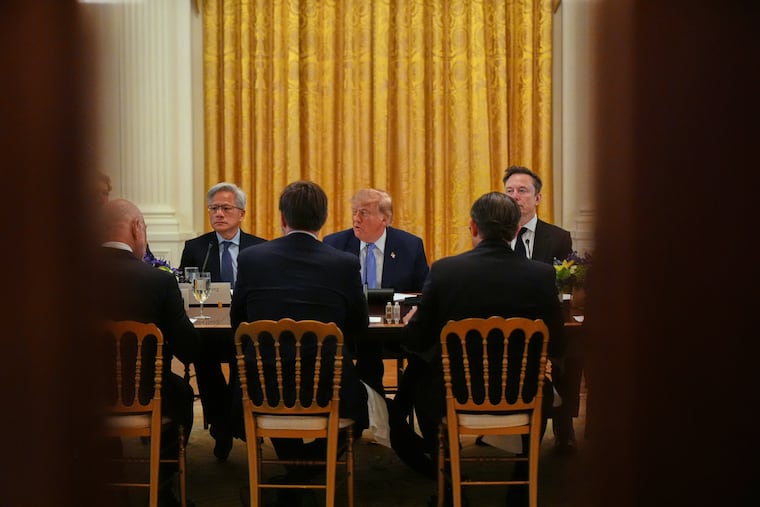
After the rollout of the website, CEOs such as Anthropic’s Dario Amodei and Nvidia’s Jensen Huang were scheduled to have lunch with the president at the White House. Johnson said Monday that his goal for the meeting is to find a “balance.”
“We want to keep America’s lead over China and all of our other competitors, but we want to make sure that it’s being done in a safe way,” Johnson said in an interview with Fox Business. “So, a little oversight, a little transparency, I think, would go a long way here.”
As the industry has tried to navigate those concerns, the private summit between tech CEOs, the president, and the speaker could be the most consequential part of the day, giving officials and executives a chance to discuss a common vision.
Amodei led the industry this month in issuing a call to slow the pace of development to better focus on safety. But the idea has divided his peers and has not been endorsed by the White House.
Amodei, who previously clashed with the administration over the use of his company’s technology by the military, dined with the president late Sunday in their first one-on-one meeting. He was expected back at the White House on Tuesday to attend the private meeting.
Amodei was joined by Huang and Meta CEO Mark Zuckerberg, according to people familiar with their plans who spoke on the condition of anonymity to discuss a private meeting. Both have resisted calls for any coordinated slowdown, saying it is up to individual companies to ensure that their products are safe. Sundar Pichai, the chief executive of Google, was also expected to attend, according to a person familiar with his plans who spoke on the condition of anonymity to discuss a private meeting.
Senate Majority Leader John Thune (R., S.D.) said Monday that he would not attend but will meet with some of the participants.
Trump recently said he plans to name a new AI czar and create an “AI Force,” although its role is unclear. The president made clear at a speech to the United Nations General Assembly last week that he wants to see the U.S. continue to race ahead — rebranding the technology as “super intelligence.”
“I’m not going to stifle growth of something that will be bigger than the Industrial Revolution,” he said.
Trump’s AI push comes as his administration has cultivated relationships with Silicon Valley executives and investors. Gebbia, who co-founded Airbnb and joined the Trump administration through the U.S. DOGE Service, is among a group of tech leaders who argue they can improve Washington by applying Silicon Valley principles.
During the Obama administration, healthcare.gov crashed amid the rollout of the Affordable Care Act, sparking criticisms of the government’s technological prowess. Despite years of efforts to modernize government technology, it has continued to lag behind the corporate sector. Other government tech initiatives have fueled privacy and surveillance concerns. In 2022, the government abandoned a plan to require Americans to submit to a facial recognition scan in order to access their tax information following fierce criticism.
Gebbia pushed back on concerns that the new website would collect Americans’ data, describing it as “private by design” to Fox News. He said that the website does not store chats and that people do not need to log in to use it.
Fears about AI took on new urgency in Washington in early September, when a researcher quit Anthropic and said the technology could bring about human extinction. Many lawmakers said they wanted to take action to impose guardrails, but Congress is set to leave ahead of the midterm elections without advancing any legislation.
In the absence of formal federal leadership, OpenAI, Anthropic and Google — the companies at the cutting edge — have discussed creating their own group to set standards for the industry. In the meantime, OpenAI said it was pausing training of its powerful systems until it was confident it had more safeguards in place. It also announced Monday that it will cancel a planned model release because of safety concerns.
The decision to pause training was announced Friday, when the company also confirmed that its agents accessed information from the Census Bureau using a log-in found online and copied information from the Securities and Exchange Commission. Transluce, an AI research organization, said agents had also tried to hack into an Education Department civil rights website.
“People want to know AI is being developed safely, and that starts with what companies like ours do ourselves,” said OpenAI spokesperson Drew Pusateri, adding that the company “will resume training only when we are confident that we have additional safeguards in place.”
But on Monday, Florida Attorney General James Uthmeier (R) asked a court to step in and force the company to pause development work, in a sign of how Republicans are split on their approach to the technology. Uthmeier, whose office has sued OpenAI, alleging it has put children at risk, said he was inviting company chief executive Sam Altman to join his request.
“If he will not, we ask the court to do what OpenAI will not do for itself — protect Florida families,” Uthmeier said in a video posted Monday to social media.