Contaminated fish prompts ‘do not eat’ advisory for Wissahickon and cancellation of Philly trout stocking
Some officials fear that as more waterways get tested there will be more advisories and trout stocking cancellations.
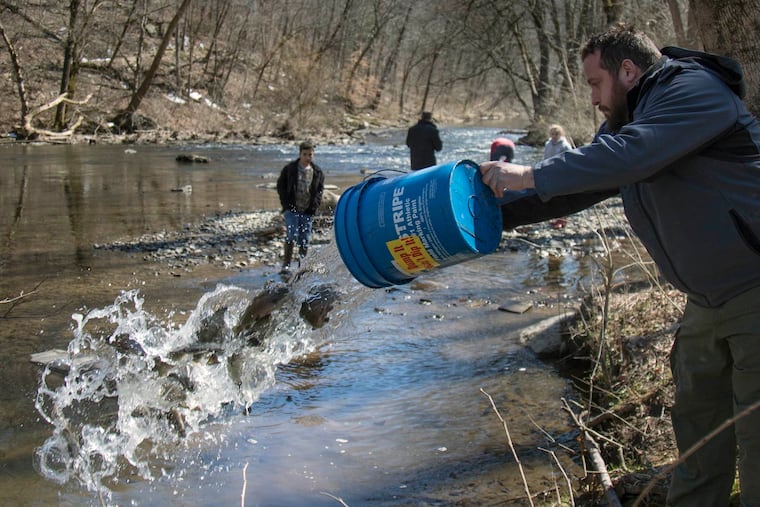
Pennsylvania officials have issued a “do not eat” advisory for fish caught in Wissahickon Creek after PFAS — known as “forever chemicals” — were recently found in a sample.
The advisory prompted the Pennsylvania Fish and Boat Commission (PFBC) to cancel a trout stocking scheduled for Oct. 15 on a section of the creek in Philadelphia.
Moreover, the advisory has caused consternation among officials who fear that as additional waterways get tested, more will see similar advisories and stocking cancellations.
Already, Neshaminy and Pennypack Creeks have been impacted by similar advisories.
» READ MORE: Pa. warns not to eat fish from Neshaminy Creek due to ‘concerning’ levels of PFOS contamination
The issue is serious enough that the commission has scheduled a public meeting Nov. 5 at 6 p.m. at the Schuylkill Center in Philadelphia to address how it handles advisories going forward.
“We’re open to hearing what anglers think,” said Mike Parker, a spokesperson for the commission.
What caused the advisory?
The most recent advisory was jointly issued by the fish and boat commission, Department of Environmental Protection (DEP), and Department of Health (DOH).
The “do not eat” advisory applies to all fish species in the Wissahickon Creek basin, which runs through Montgomery and Philadelphia Counties.
Neil Shader, a spokesperson for the DEP, said scientists analyzed fish tissue samples collected in the vicinity of Fort Washington State Park, including archived samples collected between 2013 and 2021.
He said results were as high as 0.0567 parts per million of perfluorooctane sulfonate, exceeding the 0.04 parts per million threshold for PFOS for a do not eat advisory.
PFOS, falls under a class of synthetic per- and polyfluoroalkyl substances (PFAS). These are commonly referred to as “forever chemicals” because they resist breaking down in human bodies and the environment.
The advisory extends to all species of fish within the entire Wissahickon Creek basin.
“The DEP takes the health and safety of Pennsylvanians seriously and will continue to use the best available science to monitor and protect the Commonwealth’s waterways,” Shader said.
Research shows some links between PFAS and altered metabolism, cholesterol levels, risk of childhood obesity, increased risk of some cancers, and a reduced ability of the immune system to fight infections.
PFAS regularly build up in fish tissue over time. The testing was carried out under Pennsylvania’s Fish Consumption Advisory Program, which evaluates sport-caught fish for contaminants, including polychlorinated biphenyls (PCBs), pesticides, and heavy metals.
After the DEP takes samples, the three agencies, along with the Department of Agriculture, determine whether an advisory is needed.
The impact on trout stocking
Parker, the PFBC spokesperson, said it’s often unfortunate that testing can lead to a no eat advisory for an entire basin, which refers to all the waterways that drain into a creek or stream.
The policy to cancel trout stocking occurs even though no PFAS would likely be present in any released trout.
Parker emphasized that hatchery-raised trout enter streams “clean” with no PFAS and spend a very short time in the water compared to resident wild fish. That gives them less time to become contaminated.
The trout are typically placed in streams only a week or two before opening day, though some could be as long as a month. Most are quickly caught, die when water temperatures rise, or are eaten by wildlife.
Comparatively, wild fish can spend years in water accumulating PFAS.
Parker said limited testing has found that stocked trout have little to no PFAS after two weeks in the water. Some showed slightly more after three or four weeks.
It took three months or so of continuous exposure in contaminated water before PFAS tissue levels reached even a “one meal per month” advisory threshold, let alone a “do not eat” level.
Additionally, trout that move into clean water saw the accumulated chemical flush from their bodies over time.
Parker said PFBC officials will discuss advisory options with anglers at the November meeting at the Schuylkill Center, 8480 Hagy’s Mill Rd., in Philadelphia. He said PFBC is working with DEP on how testing is carried out.
“They’re really only testing in one or two spots throughout the entire creek,” Parker said. “They’re collecting samples from areas suspected for PFAS, and that makes sense.”
But, Parker noted, advisories go out for entire basins, no matter how long they are.
“What’s problematic is the sampling being done is just not really enough,” he said. “We have concerns that if … we keep getting entire basins designated as ‘do not eat,’ it’s going to put a big dent put into where we’re able to stock trout.”
That could be a blow not only for anglers, but the PFBC itself, which is funded through licenses. The spring and fall trout stocking seasons are a draw for anglers.
However, a recent independent PFBC study showed that fishing license sales have declined steadily since the pandemic in 2020 and 2021. And many buying licenses are older and transitioning to senior lifetime brackets, suggesting the sport is not attracting many younger anglers.