Philly food drive supports Chinese immigrants while raising awareness about SNAP cuts and a plan to tax the wealthy
The aid
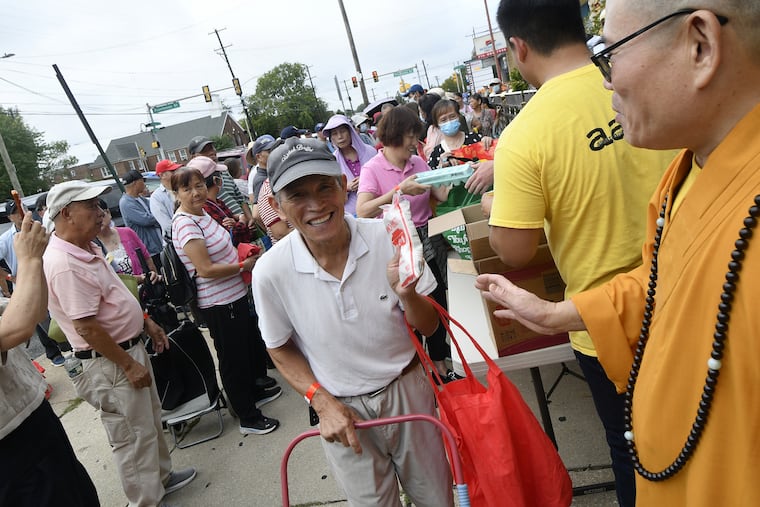
The line formed early, and by noon more than 200 people stood outside the Kai Yuan Temple in Northeast Philly, waiting to receive food.
This wasn’t a typical food pantry. The food drive was organized to provide familiar grocery staples to the city’s sizable Chinese immigrant community.
“It really shows the need for culturally relevant food — and food access in general,” said Sunhee Volz, an organizer.
The food drive was a grassroots response to the city’s affordability crisis at a time of rising food insecurity, fueled by federal cuts to the Supplemental Nutrition Assistance Program. Some immigrant families also fear seeking government assistance, according to Asian Pacific Islander Political Alliance, which organized the event. The food drive was part of the group’s awareness campaign to tax corporations and the very wealthy.
An anonymous donor footed the bill for 200 bags of groceries ordered from Heng Fa food market in Chinatown, organizers said. Rice noodles, napa cabbage, sweet potato starch, MSG, and fruit were among the food items packaged into large, green bags for distribution.
Eggs were kept outside the temple for religious reasons, organizer Jenny Zhang said. Large glass bottles of soy sauce were handed out separately from the bagged items to prevent them from breaking.
In a way, those soy sauce bottles were the inspiration for the food drive, said Hanna Kim of Asian Food Collective. At previous food distributions, Kim had noticed how excited people became when they received a particular brand of soy sauce.
Kim held up a yellow bottle of Haday premium soy sauce, which she said is immediately recognizable to many Chinese immigrants.
“When you have that familiarity, it’s a feeling of home, too,” Kim said.
Wei Chen, civic engagement director of Asian Americans United, explained that the Buddhist temple had recently completed its annual Hungry Ghost Festival. The 30-day celebration honors ancestors and the dead, and giving away food is part of the tradition, Chen said.
Centuries ago in China, the government prohibited food distribution for the those experiencing hardships. But under the pretense of giving food away to “hungry spirits,” the temples were able to circumvent the rules, Chen said.
These days, Sunhee Volz said, the government has made it harder for immigrants in need of food to get help. Recent ICE deportations have made it worse, she said.
“Some people aren’t even applying because they’re afraid. That fear is intentional, to keep people from even trying,” Volz said.
The food was distributed with flyers from the group, printed in both English and Chinese, explaining that in 2025 Congress cut $187 billion from the Supplemental Nutrition Assistance Program. New work requirements and rules have made it harder for people, especially noncitizens, to qualify for assistance, the flyer states.
“Step one is just awareness,” Volz said. “A lot of people don’t even know why funding is being cut.”
From there, the group hopes to build relationships with people and plan more actions. “The affordability issue is affecting everybody, of course,” Volz said.
APIPA is one of about 30 political groups pushing a plan called “Tax Billionaires, Fund PA,” Volz said. That plan seeks to add state revenue by closing corporate tax loopholes, instituting a digital advertisement tax, and adding a tax on “unearned income” such as stock dividends, according to its website.
Democratic State Rep. Sean Dougherty met with the group before the food drive and helped hand out cartons of eggs. Dougherty cosponsored one legislative proposal supported by the group, which would tax online advertisements from tech companies. The bill stalled in the Republican-controlled state Senate.
“Just look at this line. It also shows that affordability and the cost of living is a real issue,” Dougherty said.
As families lugged the heavy tote bags full of groceries from the Buddhist temple Sunday, many expressed their gratitude.
Through a translator, Rong Chen said that she was “very excited” to receive food for her family. Chen has been in Philadelphia since 2019 after moving from Fujian, China.
Bobby Lin said the free food helps offset the rising costs of living expenses and gas prices.
Lin’s partner, Joyce Yan, said some people waited three hours in the line, but it was worth it.
“This kind of food is very good,” Yan said, as she held her infant daughter in her arms.