Grover Cleveland has a lesson for Donald Trump facing a perilous midterm election
The “sixth-year curse” may dog the president and his party.
Colleen J. Shogan served as the 11th archivist of the United States. She is the CEO of More Perfect’s In Pursuit and a practitioner senior fellow at the University of Virginia’s Miller Center. She teaches American politics at Georgetown.
In November 1894, President Grover Cleveland suffered one of the most devastating midterm defeats in American history. His Democratic Party lost 125 seats in the House of Representatives, surrendering its majority to the Republicans. Democrats also lost control of the Senate. The election severely curtailed Cleveland’s ability to lead his party, and foreshadowed a major transformation in American politics, as Democrats moved to abandon his conservative economic policies in favor of populism.
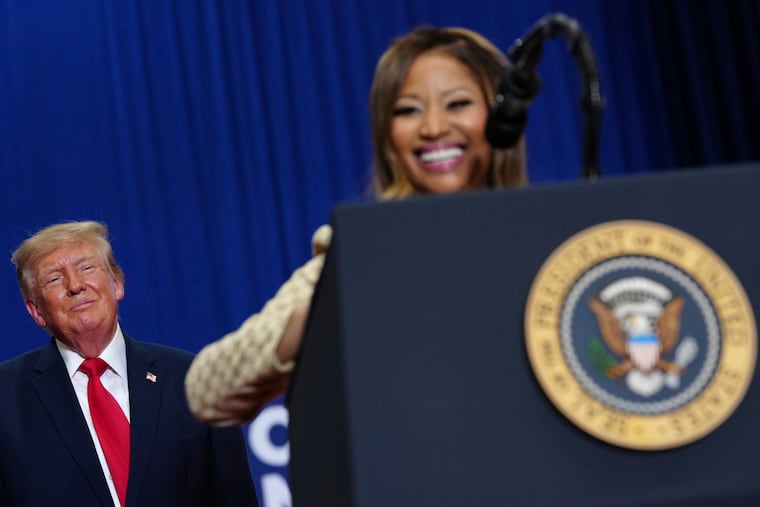
More than 130 years later, there is reason to revisit 1894. Donald Trump and Grover Cleveland share a rare distinction: both returned to the White House after losing reelection. But their historical connection extends beyond this unusual political achievement. Trump now confronts a phenomenon that contributed to Cleveland’s downfall — what political observers have described as the “sixth-year curse.”
Twenty years ago, I published an academic article examining the difficulties experienced by presidents during their sixth consecutive year in office as they grappled with three recurring characteristics: political scandals, weakened governing coalitions, and substantial midterm electoral defeats. These problems frequently reinforced one another, creating political obstacles that presidents struggled to overcome.
The electoral statistics are striking. When I updated the data recently, I found that from Ulysses S. Grant through Barack Obama, presidents serving two consecutive terms lost an average of 28 House seats in their first midterm elections, compared with 37 seats in their sixth year. In the Senate, the difference was more dramatic. Presidents experienced, on average, no net losses in the first midterm, compared with nearly seven seats in the sixth year.
My original study excluded Cleveland because his two terms were not consecutive. But in 2026, his administration offers an illustrative comparison that shows how divisions within the president’s party and failures of political leadership weaken administrations and pave the way for electoral defeats.
When Cleveland returned to the White House in March 1893, there was a Democratic Congress and a renewed political mandate. Within months, the Panic of 1893 plunged the country into a severe economic depression. Banks failed, railroads went bankrupt, and unemployment soared.
Cleveland’s response to the crisis exposed deep divisions within his own political coalition. Conservative Democrats favored the gold standard and fiscal restraint, while agrarian Democrats advocated for an expansion of the money supply to help struggling farmers. When Cleveland firmly sided with the conservatives, he alienated an increasingly influential faction of his party.
His handling of the Pullman railroad strike in 1894 further complicated matters. Cleveland deployed federal troops to keep the railroads operating, infuriating organized labor. Meanwhile, disagreements over tariff legislation deepened divisions among congressional Democrats.
By the time Americans voted in November 1894, Cleveland’s governing coalition had fractured, his economic policies were deeply unpopular, and his political authority had deteriorated. The historic Republican victory in the midterms did not create these problems. Instead, the electoral results in 1894 were the byproduct of problems that had already surfaced.
Cleveland never regained control of his party. Two years later, the Democrats nominated William Jennings Bryan for president, repudiating Cleveland’s economic policies in favor of a populist, free silver platform. Cleveland served out his term, but his political influence had largely evaporated.
Other presidents have experienced variations of the sixth-year curse as economic difficulties, political controversies, and weakened governing coalitions undermined their leadership before Election Day. Franklin Delano Roosevelt suffered substantial congressional losses in 1938 following his controversial court-packing proposal and a renewed economic downturn. Dwight D. Eisenhower’s Republicans endured major defeats in 1958 amid recession and political controversy. Ronald Reagan lost control of the Senate in 1986, shortly before the Iran-Contra scandal erupted.
More recently, George W. Bush lost both chambers of Congress in 2006, while Obama surrendered nine Senate seats in 2014 as his party’s fragile political coalition fractured. Bill Clinton was an important exception in 1998, when Democrats gained House seats despite the Clinton-Lewinsky scandal.
But Cleveland’s trajectory provides specific insights into the political dynamics underlying the 2026 election. Like his 19th-century predecessor, Trump returned to office with a renewed mandate and congressional majorities. Unlike Cleveland, Trump has maintained a relatively cohesive political coalition. And yet, economic discontent and disagreements over governing priorities may test that unity. A recent Pew Research Center survey found that 84% of registered voters consider the economy very important to their 2026 midterm vote. Debates over federal spending, trade, and foreign policy also present governing challenges that require maintaining support inside the Republican electoral coalition.
It is worth noting that there are substantial structural differences between 1894 and today. Most notably, partisan loyalties have hardened, and the relatively small number of competitive congressional districts makes a comparable electoral upheaval unlikely.
History does not dictate or predict electoral outcomes, yet it does surface recurring patterns. While second-term presidents are not predestined to lose in their sixth years, historical analysis does strongly suggest that elections deliver a verdict on political problems that have festered for months or years.
Cleveland won the popular vote in three consecutive presidential election cycles. 1894 shows how economic dissatisfaction, unpopular policies, and weakened coalitions can overwhelm a previously durable and long-lasting electoral mandate.
His failures make clear the challenge Trump faces in sustaining a political coalition and governing effectiveness that make electoral success possible. In short, the dreaded sixth-year curse begins long before Election Day. In November, voters simply render their judgment.
Made By History takes readers beyond the headlines with articles written and edited by professional historians. Opinions expressed do not necessarily reflect the views of The Inquirer.
About guest essays
Guest essays, or op-eds, are commentary pieces that present the opinion or perspective of the author. Many are submitted to us by Inquirer readers and writers with insight on the news, but we also solicit op-eds from authors on specific topics. For more information visit our guidelines.