Letters to the Editor | Nov. 2, 2026
Inquirer readers on the role of independent voters in elections and the Kennedy Center renaming controversy.
Not if, but when
As a 79-year-old grandmother of four, I have struggled with my grandchildren’s need for cell phones. After all, I never needed one or even considered them. However, while at my daughter’s house the other day, the topic came up after the bill banning cell phones in schools was signed into law. My son-in-law made the comment, “If phones are banned, how will my son be able to call me when there is an active shooter at school?” Not “if,” but “when.” My heart and mind were shattered. This cannot continue to be an everyday catastrophe. Something must be done.
Heidi Schifferli, Philadelphia
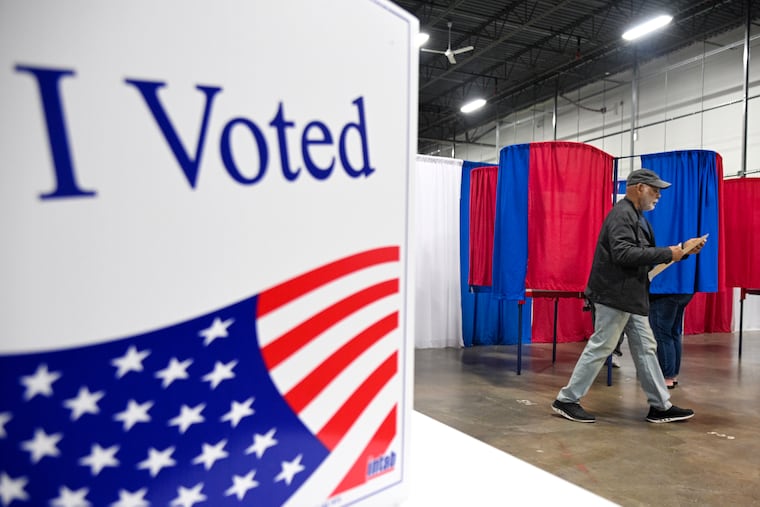
Independent voices
I read and appreciated the essay by David Thornburgh regarding the inability of voters who are registered as independents to vote in primaries. This has always been troublesome to me, as it seems to be designed to ensure that if someone wants to vote in a primary, they must vote in support of their registered party, or they cannot vote.
I had approached one of our local representatives about this in the past, and asked just what it would take to change this law in Pennsylvania so those who are registered as independents could vote in primaries. He indicated that it would be very difficult.
I had always been registered as an independent, and when I complained about this to a friend, he said, “If you want to vote in a primary, just change your political affiliation, and you can vote for whichever party you want.” Years ago, one primary election was particularly important to me, and I wanted to vote, so that is exactly what I did. It’s not a difficult process; it can be done online quickly and easily, and you can change whenever you want. Of course, you are still obligated to vote for your registered party, but that’s exactly what all voters do in a primary election. While this is by no means a perfect solution, given the current system, it does provide a way for an independent voter to vote in a primary.
Barbara Kotzin, Cheltenham
. . .
David Thornburgh argues for allowing open primaries. I, a democrat with a small “d,” am opposed. Most importantly, the purpose of a political party is for people with common goals to win elections. The reason we have primaries is to allow the rank-and-file of a party to choose their candidates, rather than have them chosen by bosses in smoke-filled rooms. Open primaries allow a bunch of nonmembers to show up and throw a primary to a candidate whose views are totally opposed to the party’s principles.
I also struggle to understand why someone would want to be an “independent.” Being registered in a party does not commit a voter to vote for that party’s candidate in the general election.
William Benson, Wynnewood
Different destinies
How sad and heartbreaking it was to read of the three young men — ages 20, 19, and 17 — who were convicted of homicide in a Montgomery County courtroom last week. They were 18, 17, and 15 when the crime was committed. I wonder what type of social services, counseling, and education programs were available to them as they grew up in the Philadelphia area? On the same day of the conviction, an Inquirer reader could have turned to the Sports page and read of a Penn State football player who was able to parlay his talents into enrollment at the University of Colorado, East Carolina University, Iowa State University, and finally Penn State. Think of that for a moment. Taxpayers in Colorado, North Carolina, Iowa, and now Pennsylvania have all underwritten the player’s football playing days, as all of the universities involved are state-subsidized universities. Did the Norristown teenagers have any similar services available to them that may have prevented their decline into criminality?
Thomas M. Lynch, Voorhees
One word
Yay for Atlantic City. Not only because the city has bucked the not-in-my-backyard syndrome around windmills for the last 20 years, but also because it is actively doing something positive for our oceans. Installing the world’s first commercial microplastics filter — which will scrub 580 million nano- and microplastics a year — is ingenious. I agree with Doug O’Malley of Environment New Jersey that the PolyGone machine is what every wastewater treatment facility should have. And every person should care enough about our planet that they stop using plastic as much as possible.
We all need a boost of good news these days, so thank you for sending it.
Judith DiBiase Bennis, Kennett Square
Watch out, President Grant
Amid all of the discussion about the attempted renaming of the Kennedy Center for the Performing Arts, why does it seem like everyone fails to note that it is a memorial for an assassinated president? That the apparently unhealthy — but still living — Donald Trump, with no conscience or empathy, strives to put his name on this memorial is as cold, bizarre, and apparently ignorant as it would be if he wanted to add his name to Grant’s Tomb.
That so many journalists, and others, overlook this point is an undeserved gift to Trump and those who support this renaming.
John Jonik, Philadelphia
Let’s be fair
In her column criticizing President Donald Trump’s plans to renovate a Washington, D.C., golf course amid the conflict with Iran, Jenice Armstrong raises concerns about the administration’s priorities. However, I question the assumption that pursuing a recreational project means neglecting national security.
Presidents have historically managed domestic improvements alongside international conflicts. In 2009, President Barack Obama modified the White House tennis court to accommodate basketball while American troops remained engaged in Iraq and Afghanistan. Although Obama’s project was smaller in scale, it demonstrates that recreational improvements and wartime responsibilities are not mutually exclusive.
Armstrong’s issues about the conflict with Iran deserve consideration. However, ending a war involves diplomatic negotiations, security decisions, and consequences that extend far beyond a president’s personal schedule. Criticism of the golf course’s cost or necessity is reasonable, but it should not automatically serve as evidence that the administration has abandoned its foreign policy responsibilities.
I understand Armstrong’s concerns about everyday Americans potentially losing access to a recreational space they have long enjoyed. Public spaces should remain widely accessible. However, those concerns should be addressed separately from the conflict with Iran. Disagreements over a golf course renovation do not necessarily indicate a failure to prioritize national security.
Brianna Castner, 12th grade, Central Bucks South High School
Stand with Carolyn
The recent news about a woman getting arrested for blocking a delivery robot is yet another sign that the fight for work between people and machines is here — and the police are protecting the robots. We have Waymo taxis driving around town, and we have robots delivering food. Meanwhile, people are struggling to make ends meet. The companies that are racing to replace human labor with automation will only make these difficulties worse. Carolyn Marvin is taking a small action to stand against the slow march toward the obsolescence of human labor, and the city should be applauding her — not placing her under arrest.
Jen Rock, Philadelphia
About letters to the editor
Letters feature a reader’s written opinion and are submitted in response to an article in The Inquirer or another topical issue. Submissions should be sent to letters@inquirer.com. Limit length to 150 words and include the writer’s home address and day and evening phone number. Letters are published in the Inquirer six days a week on the print opinion pages and online.