America survived Y2K.26, but can we make it through 2 more years?
Trump’s regime led by incompetent nincompoops crashed on Friday the 13th. How can we survive 26 more months?


“Totalitarianism in power invariably replaces all first-rate talents, regardless of their sympathies, with those crackpots and fools whose lack of intelligence and creativity is still the best guarantee of their loyalty.” — Hannah Arendt, The Origins of Totalitarianism, 1951
When the day finally came, it was exactly like what so many sirens of doom had predicted.
America’s intricate web of domestic air travel was ground to a sudden and chaotic halt by its overloaded circuits — stranding tens of thousands of dazed and bedraggled passengers. A different communications failure left millions unable to send emails. A large tanker on the mighty Mississippi River apparently lost power and slammed into a cruise ship loading up with tourists. A SpaceX booster rocket blew up in a fireball over the Gulf of Mexico. There were stunning random events — people fled what proved to be a bomb at an ethanol plant in Peoria, Ill. — and the predictable, panicked false rumors that things were even worse, that other systems like weather radar might also be failing.
Nov. 13, 2026 — a date which will live in bureaucratic infamy — played out uncannily like the high-tech Cassandras had all told us that it would...back in the mid-to-late 1990s.
The incredible irony as the nation watched a real-life Friday the 13th horror flick unspool on the cable-TV news channels was that the overlap of failing systems had been predicted for Jan. 1, 2000. That was the now legendary Y2K scare in which a thoughtless human error in early computer coding seemingly threatened to launch a new millennium with a crash that would bring civilization to a halt.
The feel-good story of the OG Y2K was how a crisis born of one mistake — the programming shortcut that weirdly forgot there’d be a 21st century — was overcome by a massive mobilization of professionalism, competence, and foresight, as thousands of unknown soldiers toiled to update our computers just in time.
Friday’s dark sequel — let’s call it Y2K.26, an update turned horribly wrong — followed the Hollywood formula of what can go astray when the lessons from the original’s happy ending are foolishly tossed down a memory hole.
When the hero bureaucrats are fired for no reason. When a political movement rises by ridiculing anyone with expertise. When an increasingly lazy and greedy society farms out all the work to robots, and humans have little agency but to hope for the best.
Yes, you can certainly argue that some of the things that went wrong in a jarringly wild week even by U.S. standards — I haven’t even mentioned the deadly building collapse in Brooklyn, the ship hitting a major bridge here in Philly, or two planes bumping on a Miami runway — were random, unconnected events.
Yet it felt like all of it shared a kind of 21st century hubris — that decades of mocking the pointy-head nerds of bureaucratic professionalism and shrinking government (well, except for the Pentagon, and the graft) to the size where it could be drowned in a small bathtub has created a world where things fall apart, and the center is not holding.
The marquee moment of an American meltdown was the nationwide Federal Aviation Administration (FAA) four-hour ground stop — the longest since the 2001 terror attacks — that cancelled more than 15,000 flights this weekend and delayed thousands more, while stranding confused air travelers who scrambled to get surge-overpriced hotel rooms and missed long-planned journeys or were driven seven hours to a loved one’s 90th birthday party.
As I write this on the Sunday morning after, with the nation’s air traffic not nearly back to normal, officials at the FAA and the Departments of Transportation and Homeland Security are still struggling to explain — in terms that normal people can understand — exactly why its system for communicating with airborne pilots collapsed.
The latest version is that the communication breakdown was because of something that went wrong (exactly what has been met so far with the equivalent of a shrug emoji) when a contractor was replacing the FAA’s outdated copper wiring with fiber-optic cable. Although knowing the Trump regime, it’s possible that someone was fencing the valuable copper on the black market.
I kid, but this is the bigger problem here. People are going to make mistakes, whether it’s the shortcutting two-digit computer programmers of the 1980s or the accidental deletion of a database file that caused a shorter FAA ground stop in 2023, when Joe Biden was president. The public can understand this, but only when there are experienced, competent, caring grownups there to fix the problem and reassure the huddled masses.
On Friday night, America instead got the live-action version of Beavis and Butthead.
This was the nationally televised news conference that featured Transportation Secretary Sean Duffy — in his suitably autocratic monogrammed windbreaker with no visible shirt underneath, as befitting a reality TV star who started out with a striptease video — and pugnacious Oklahoma plumber Markwayne Mullin, who runs Homeland Security. The event only fanned the flames of panic.
It wasn’t just that the two cabinet secretaries had no real idea why thousands of jetliners were idling on American tarmacs, which didn’t stop Duffy’s extortionary demands that Congress fork over $50 billion to his department before it even had a chance to determine what happened to the $25 billion appropriated under Biden.
The real problem was summed up by Mullin when he proclaimed: “This is what the leadership of President Trump looks like...by the organization and the team he’s put together.”
Bingo.
Which takes us back to the very root, and the chillingly prescient observations that Hannah Arendt — our first and still greatest explainer of modern civilization’s weakness for self-proclaimed strongmen like Trump — published way back in 1951.
Arendt, in seeking to understand events like Adolf Hitler’s takeover that led her to flee her native Germany in 1933, wrote that free-thinking intellectuals pose a threat to the total domination sought by totalitarians, and so incompetence becomes a feature, not a bug.
Arendt, in warning us about “crackpots and fools,” did not live to see MTV’s Real World: Boston, yet she essentially predicted there would be a Sean Duffy.
» READ MORE: The biggest story from Tuesday’s Trump rebuke is what didn’t happen | Will Bunch
This is what’s so important for the news media, the new Congress that is promising radical change, and others in leadership to understand in making sense of a moment like this Friday the 13th — that the real problem isn’t the old copper wiring but the invasive new infrastructure of American authoritarianism that has overgrown and strangled everything.
The maladministration of the Donald Trump regime wasn’t the only visible rot when last week’s overlapping failures lifted up the rock to reveal the rancid muck underneath.
The banal evil of their government’s ongoing pogrom against our immigrant neighbors was shockingly revealed when a Colombian-born father and daughter who rarely left home because of fear of Trump’s immigration goon squads were killed in the Brooklyn building collapse, or when painfully shackled detainees were forced to suffer aboard idled aircraft on as many as six tarmacs Friday night.
The massive corruption that guides the 47th president and his minions was also never far from the surface. There were understandable questions about whether an obscure contractor named Air Space Intelligence that nabbed an $875 million contract to develop the FAA’s new AI-powered air traffic management system was rewarded for its $12,500 in donations to GOP U.S. Rep.-elect Michael Alfonso of Wisconsin.
Also known as Duffy’s son-in-law.
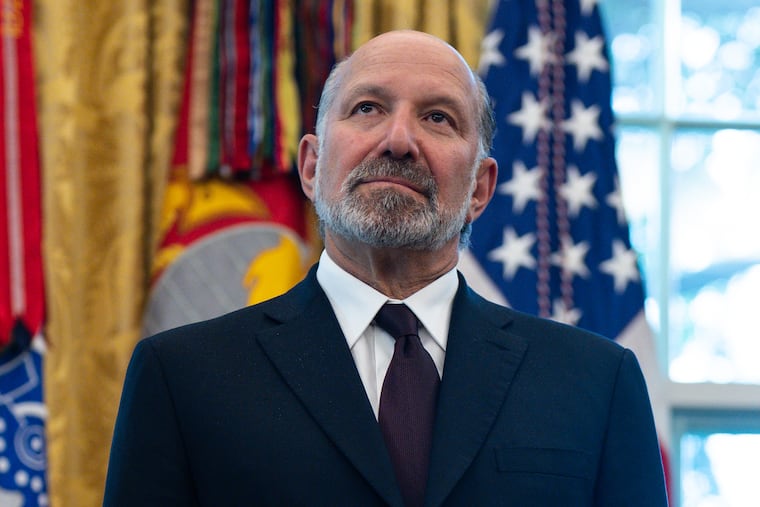
The terminal decay under Trump’s cabinet of crackpots and fools is sudden but also gradual — whether that’s the United States falling off the list of nations that have fully eliminated measles under our health and human service secretary, Robert F. Kennedy Jr., or Commerce Secretary Howard Lutnick looking the other way as Trump’s ballroom-donor pal Jensen Huang and Nvidia were likely selling their powerful chips to China.
Incredibly, this insane clown posse was on full display just as the president’s cartoonishly evil new chief of staff, Stephen Miller, outlined a plan to give even more power to Trump’s cabinet secretaries over the final two years as the president himself drifts into oblivion.
We can’t let that happen.
Although Trump’s Friday the 13th might have felt like a terrifying full-length feature, it was in reality just a preview of coming attractions for a two-year horror show. To be sure, the new Democratic-run Congress will have the ability to do many things: Pass popular legislation and dare Trump to veto it, use its newfound powers to force a lame-duck president to the bargaining table, and investigate and even impeach (but probably not convict) the worst of the worst cabinet members.
But Congress can’t impose smart and competent administrators on an unwilling administration. The beatings will continue until we can find more creative ways to curb the power of a rogue administration. The removal of an increasingly unhinged Trump should be an imperative, but I am terrified that planes will actually have to start falling from the sky before we reach that obvious conclusion.
This month’s Democratic tsunami has triggered talk of new possibilities, like expanding the Supreme Court or ditching the Electoral College. Maybe we should add — in an era of fickle voters, so susceptible to demagoguery — reducing the presidency to a two-year term.
Because I’m not sure how America survives two more years like Friday night.
» READ MORE: SIGN UP: The Will Bunch Newsletter
About our columnists
In contrast to news reporters, who operate within an independent, nonpartisan framework, columnists are charged with including their perspectives, opinions, and viewpoints when presenting their reporting. Inquirer columnists include Jenice Armstrong, Will Bunch, Luis F. Carrasco, Paul Davies, Daniel Pearson, Trudy Rubin, and Sabrina Vourvoulias.