School districts on border patrol
EVERY DAY, they sneak across borders, hundreds of them, hoping to blend in, hoping for a better future. Danger may lurk on the horizon, but they're determined to forge ahead.
EVERY DAY, they sneak across borders, hundreds of them, hoping to blend in, hoping for a better future.
Danger may lurk on the horizon, but they're determined to forge ahead.
These illegals aren't crossing barbed-wire fences that guard the Mexican border, carrying everything they own on their backs.
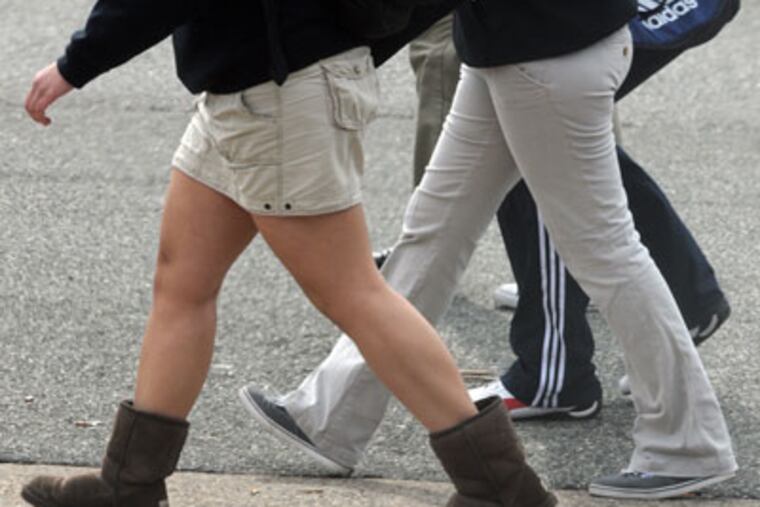
Instead, they carry backpacks filled with books and head to school - but still face a just-as-daunting reality if they get caught.
Hundreds of students from different parts of the city breach the borders of suburban districts every day in pursuit of a better education.
To get them in, their parents often use a relative's address, falsify records or lie on applications.
These families may not mean any harm, but suburban districts say their dishonesty has put a financial strain not only on them, but also on the taxpayers who end up footing the bill.
With more school districts feeling a financial squeeze, fiercely protective school officials have gotten tougher with getting rid of outsiders.
More of them have removed students from schools, fined parents and forced them to pay back tuition, earning them the ire of school-choice advocates who say the parents are only seeking better opportunities for their children.
James Wigo, assistant superintendent for curriculum and instruction for the Upper Darby School District, has seen hundreds of cases of illegal students.
"School choice can't be a free-for-all," he said. "It's a tremendous burden on the taxpayer and the district." He said the problem in Upper Darby has gotten so bad over the past several years that officials reinstituted a screening process to keep track of students' residency.
And when the district suspects foul play, private investigators are hired to follow students and their families.
Illegal registration has cost the district millions and puts it at risk of getting audited by the state Department of Education, which monitors students' residency, he said.
"When I say it's a major problem, that's a relative term," he said. "We have no way to plan what we would need because the numbers are always shifting. It's like punching a butterfly."
Safer schools, better academic programs, scholarship opportunities and college access are major reasons why Philadelphia parents enroll their children in other districts, said Gerald Wright, co-founder of Parents United for Public Education.
"Some people have the idea that the further out you go from Philadelphia, the more opportunities you have," he said. "Parents are seeking the best education for their child possible. Wherever that is, that's where they're looking."
To get their kids into suburban schools, some parents provide school officials with false records or say their kids live with relatives in the area when they don't. But that isn't always a fool-proof plan, said Byron McCook, director of child accounting in the Radnor School District.
A dozen students from Philadelphia were caught attending Radnor schools this year, he said.
"Sometimes mail gets returned, and that's when we do a follow-up," he said. "When we initially enroll students, we see inconsistencies in the application, which raises a red flag."
Local residents have also helped keep the number of nonresidents down, McCook added.
"We don't have too much of an issue because a lot of people know each other in the community," he said.
"We find out from various sources and neighbors who observe cars dropping students off at the bus stop."
Although Upper Darby district officials don't track where students come from, Wigo said an overwhelming majority of outsiders come from Philadelphia.
Between June and September, more than 2,000 families contacted the registration office seeking to enroll their students, he said. A staff of only seven handled the requests.
Of those families - including some with up to four children or children over age 21 - 790 presented false documents or no proof of residency. Despite that, 654 students from outside Upper Darby slipped through the cracks and were registered, costing the district roughly $7.2 million, Wigo said.
About 1,000 families were turned away, he said, saving the district nearly $11 million, he said. "It's an amazing amount of money," he said. "Every one of our schools is bursting at the seams. It would have only exacerbated a natural disorder."
Wigo noted that some parents who've been caught didn't know they were breaking the law. Most leave after they find out, he said.
If they refuse, he added, "We're liable to take them to court to recoup some of that money."
In some instances, he said, some families are too poor to pay what they owe and the district ends up losing.
"Although they owe, we can't recoup the money, but it doesn't change the fact that they took money from us," he said. He noted that no parents have been criminally charged but that in most cases they were forced to pay tuition or leave.
Other districts have been less forgiving. The Lower Merion district tightened how it monitored students' registration last year and has taken 11 cases of illegal registrants to court, said spokesman Doug Young.
"This past summer and early fall, there were several cases that were scheduled for [school-board] hearings," he said. "But in all but a few cases, the parents either voluntarily removed the student from school or the student became a legal resident of the district."
Wright, of Parents United for Public Education, said that he doesn't support parents' breaking the law or being dishonest but that he hopes people are "sensitive to the fact that parents are trying to do the best they can with what they have."
"By focusing on the parents, it's letting districts off the hook," he said. "Parents are in a very poor position. There is no appearance of accountability from the top [of the Philadelphia School District], so what are they supposed to do? They shouldn't have to leave."