Event opera: Curtis Opera, OCP, 'Cunning Little Vixen'
Only in opera can the unreal seem so dimensional, as people sing about elemental reality with a veracity real-life talking cannot touch. Leo Janácek went a step further in The Cunning Little Vixen: Animal characters also sing in a delightful confection that has long defied viable staging partly because it looks like a children's story but shouldn't. It has the most to offer adults.
Only in opera can the unreal seem so dimensional, as people sing about elemental reality with a veracity real-life talking cannot touch. Leo Janácek went a step further in
The Cunning Little Vixen
: Animal characters also sing in a delightful confection that has long defied viable staging partly because it looks like a children's story but shouldn't. It has the most to offer adults.
So if Curtis Opera Theatre's annual collaboration with Opera Company of Philadelphia and the Kimmel Center didn't have the money to convincingly create the work's peculiar world onstage, the production (playing through Sunday at the Perelman Theater) was at least gloriously sung and played at Wednesday's opening. Though the staging was only a partial success, it reflected great consideration of what the opera's ultimately saying, in a simple story of a baby fox who is raised by humans and returns to the wild.
The composer's garrulous, naturalistic dramaturgy lacks the usual arcs of tension and release and often devotes inordinate stage time to incidental characters, implying that each being has its own special importance. In this kill-or-be-killed animal world, life and death come and go without tragedy or judgment. When the title character is shot under foolhardy circumstances, there's no farewell aria. As much as the vixen captures audience sympathies, she has slaughtered some chickens in her time, and left behind so many children even she has lost track.
Curiously, this production places an outdoor opera in an indoor setting. Directed by Emma Griffin and designed by Laura Jellinek, it unfolds on a two-tiered set, the lower one a series of slightly rustic rooms with windows suggesting the world beyond with brightly colored abstractions. The upper tier has mailbox-style slits that show busy legs scampering by. Inside, nature is suggested by a blanket with a brilliant pattern of sunflowers. Characters are defined by a few suggestive costume and makeup touches. Still, audiences not familiar with the opera should read the synopsis: Animal aspects aren't that species-specific and can be confusing.
Perverse? Not if the opera is ultimately about indoor humans. And unlike so many conceptual stagings, this one puts complete trust in the music, leaving the opera's essential pastoral aspects to the orchestra. Its punchy motifs are unusually buoyant and chirpy here, precisely conveying the lushness of nature, whether in full bloom or in wintertime slumber. Still, in the ecstatic final scene, I wanted the set's walls and any sense of containment to disappear.
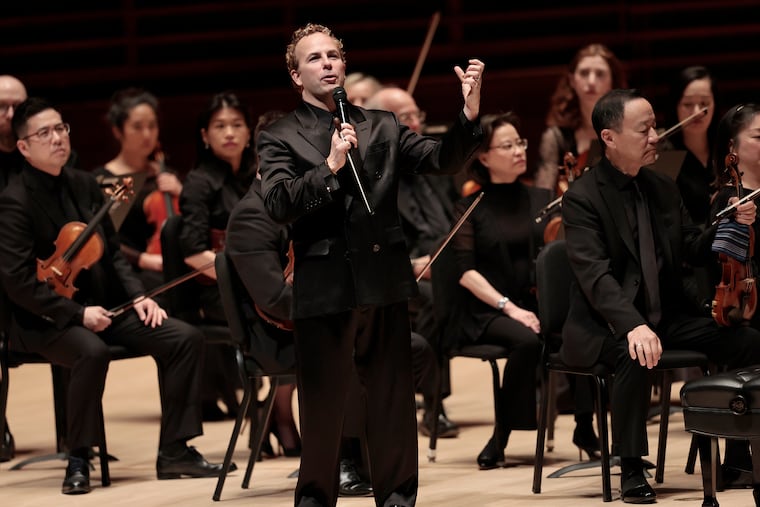
In any case, the music was in unusually good hands. The 1924 work is full of quirky challenges, with declamatory vocal lines supported by rambunctious modules of orchestral sound that don't exactly track with typical logic. Student musicians are less likely to question this - one reason the score came off with mastery and conviction. Opera Company music director Corrado Rovaris added a cantabile quality that gave things a best-of-all-worlds quality. Has he ever been better?
The cast - with incidental animal parts filled out by members of the Pennsylvania Girlchoir - was one fully matured voice after another. The Wednesday singers included Brandon Cedel as the central human character of the Forester, whose poetic soul was beautifully projected by the expanse of his baritone voice. Elizabeth Reiter as the Vixen and Kirsten MacKinnon as her mate developed a convincing body language for their characters and weren't afraid to explore the more shrill edges of their voices, as demanded by the vocal lines.
All said, this is one of the operatic events of the season.
Contact music critic David Patrick Stearns at dstearns@phillynews.com.