Family fights to get N.J. ignition-lock law
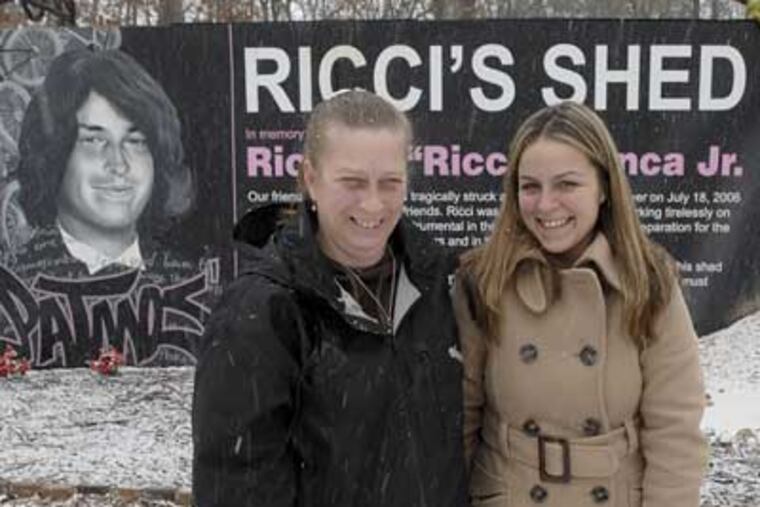
EGG HARBOR TOWNSHIP, N.J. - There's the startling 20-foot-high tribute to Ricci Branca painted on a shed at the BMX bicycle park he helped build, in the rain, behind his church.
EGG HARBOR TOWNSHIP, N.J. - There's the startling 20-foot-high tribute to Ricci Branca painted on a shed at the BMX bicycle park he helped build, in the rain, behind his church.
Branca's mangled bike sits rusting in his parents' garage. And his mother swears that his untouched bedroom in their Atlantic County home still has the snips and snails and puppy-dog tails smell of the boy she loved so much.
Along with family photos of the laughing, shaggy-haired teenager, and memories of the holidays and trips and everyday life he shared with loved ones, those are all that remain of Richard "Ricci" Branca.
One day, however, Branca could be memorialized in New Jersey with tough new drunken-driving legislation that bears his name.
Branca was 17 when he died on July 14, 2006, four days after he and two friends were struck by a hit-and-run drunk driver while biking along windswept Ocean Drive on their way to Ocean City. His buddies suffered minor injuries.
Driver Stephen French, 56, of Ocean City, a repeat DUI offender, was sentenced to 16 years in prison in 2007.
A witness to the accident followed the driver home and called police. French was arrested a short time later with a blood alcohol content of 0.339, more than four times the legal definition of drunken driving. Police said he had as many as 10 glasses of wine at a nearby bar just before the crash.
To help bear the grief, and perhaps to spare others pain, Branca's family spent the last 21/2 years crusading for a state law that would require convicted drunk drivers to install ignition locks on their vehicles. The Breathalyzer-like devices would prevent drivers from starting their vehicles if their blood-alcohol level was over the legal definition.
"The one thing I promised him, when he was lying in that trauma unit dying, was that I was never going to give up for him. I was never going to stop fighting to help prevent other families from going through this," said Sherri Branca, 45, a former school-bus driver.
Branca; her husband, Richard, a heavy-equipment operator; and their daughter, Adriene, 25, have been aided by Mothers Against Drunk Driving (MADD) and legislators who include Sen. James Whelan (D., Atlantic) and Assemblyman Eric Munoz (R., Union) in their campaign to get "Ricci's Law" passed.
Eight other states have ignition-lock laws. New Jersey has a version on the books, but critics say it is rarely enforced and does not address first-time offenses. Pennsylvania does not have a rule mandating ignition-cutoff devices for DUI offenders.
The New Jersey proposal, advanced last week by the Senate Law and Public Safety Committee, extends the lock mandate to first-time DUI offenders whose blood-alcohol content registers 0.15 percent or higher, nearly twice New Jersey's 0.08 legal definition.
The proposed law also would allow judges to order ignition locks for first-time offenders with blood-alcohol levels of 0.08 to 0.15, and to set the length of time locks will be required.
A similar proposal is pending in the Assembly.
The original bill required that all people convicted of DUI, regardless of their blood-alcohol level, be required to install the locks, but it failed to garner enough support among legislators.
Jeffrey Warsh, a spokesman for the American Beverage Institute, said the bill unreasonably punished first-time offenders who barely registered over the legal definition. It would have treated them the same as a repeat offender whose blood-alcohol content far exceeded the threshold, he said. The institute has not objected to the bill's current draft.
Mindy Lazar, executive director of MADD New Jersey, thinks that the law should apply across the board. In 2007, 199 people were killed in New Jersey by drunk drivers, she said. There are 19,841 drivers in the Garden State with three or more drunken-driving convictions, Lazar added.
She calls the devices - which would cost an offender about $80 to install and another $80 in monthly rental fees - an "electronic probation officer." Some models can be equipped with a windshield-mounted camera that takes a picture of the licensed driver's breathing into the device.
"Illegal is illegal and drunk is drunk," Lazar said. "I defy anyone to go to the families of some of those 199 people and tell them that the person who killed their loved one hadn't been quite drunk enough in their previous DUI conviction to warrant the device."
Whelan called the bill, even in its amended version, a good step toward "strengthening our resolve to deal with a drunk's lack of willpower."
"A drinker's own breath will determine whether his or her car will start," Whelan said.
With the device, friends no longer need to persuade someone not to drive after drinking, and bartenders needn't worry about serving "one for the road."
Lazar and Whelan have lauded the Brancas for their resolve in advocating on behalf of the bill.
"They've helped put more than a face and a name of a victim out there, so people can understand the importance of strengthening the laws," Lazar said.
"Sherri and Richard Branca have been forced to live and re-live the tragedy of losing their son every day and night since July of 2006, when an extremely drunk driver dared to get behind the wheel of his car after admittedly drinking in a bar for four hours," Whelan said in a statement.
"That act of criminal stupidity," the lawmaker said, "put an irreplaceable hole in the lives of Sherri and Richard Branca that no amount of jail time for the offender can ever fill. But thanks to the courage of the Brancas, we are here today to turn their loss into something positive for other families."
Sherri Branca and her daughter returned on a recent snowy afternoon to the BMX park behind Shore Fellowship Church.
"Wow, I haven't been here in a long time," said Adriene Branca, looking around the concrete track where her brother used to hang out. It has been adorned with the graphic artwork of urban muralists from top to bottom.
"It's really an amazing place," she said.
"He really loved it here so much," added Sherri Branca, staring up at the black, white and gray depiction of her Ricci. "It feels like he's still here."