U.S. moves to seize Fumo's properties
Now that former State Sen. Vincent J. Fumo is facing the prospect of a long prison term, federal prosecutors moved quickly yesterday to go after his money.
Now that former State Sen. Vincent J. Fumo is facing the prospect of a long prison term, federal prosecutors moved quickly yesterday to go after his money.
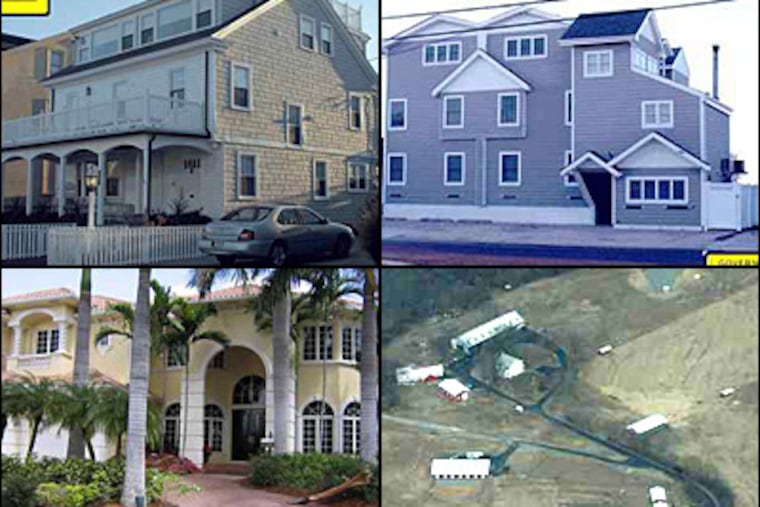
In court papers filed yesterday, Assistant U.S. Attorneys Robert A. Zauzmer and John J. Pease said that the government intended to seize a portfolio of Fumo real estate - his 27-room Philadelphia mansion, his 100-acre farm outside Harrisburg, his properties at the Jersey Shore, and his place in Fort Lauderdale, Fla.
Zauzmer and Pease told jurors that Fumo's scheme had cost taxpayers and a pair of nonprofits nearly $4 million - and now they contend he should cough up his ill-gotten gains.
The prosecutors are also gearing up for what is expected to be a fierce legal battle with the defense over what would be the appropriate sentence for Fumo, 65, who over a three-decade career representing Philadelphia in the Senate became one of the most powerful Democrats in the state, and who on Monday was convicted of 137 counts of fraud, conspiracy, obstruction of justice, and other offenses.
His codefendant, Ruth Arnao, 52, a former legislative aide who once headed Citizens' Alliance for Better Neighborhoods, one of the nonprofits she and Fumo defrauded, was convicted of 45 counts involving Citizens' Alliance and obstructing justice.
The prosecutors listed three of her properties as assets that could be forfeited, including her home in the Spring Garden section of Philadelphia; her place near Miami; and a condo in Ventnor, N.J.
One day after the jury's sweeping verdict, the impact of it continued to reverberate:
The state Attorney General's Office said it was "ramping up" its own investigation into how Citizens' Alliance spent hundreds of thousands of dollars in ways inconsistent with charitable purposes.
Gov. Rendell said he was looking into whether he should try to dismiss Arnao's husband, Mitchell Rubin, as chairman of the state Turnpike Commission.
And a state official said a review would begin of Fumo's $101,000 annual pension.
Fumo and Arnao are due back in court tomorrow for a hearing before U.S. District Judge Ronald L. Buckwalter on the government's effort to seize their assets.
Both are free on bail pending sentencing, which is expected to take place in the next three to six months.
Pease and Zauzmer are expected to seek a sentence of more than 10 years in prison for Fumo, and several years behind bars for Arnao.
For prosecutors, seeking lengthy prison terms in political-corruption cases has become the norm.
Former City Treasurer Corey Kemp, who served under Democratic Mayor John F. Street, is doing a 10-year stretch following a 2005 corruption conviction.
Former City Councilman Rick Mariano, another Democrat, is serving a seven-year prison sentence. Former Democratic Councilman Leland M. Beloff was sentenced to 10 years for a 1986 extortion scheme involving the mob. And former City Councilman James Tayoun, another Democrat who pleaded guilty to corruption charges, received a 40-month sentence.
John S. Carter, the former head of the Independence Seaport Museum - the other nonprofit Fumo was convicted of defrauding - is serving a 15-year prison term for bilking the museum of more than $1.5 million in a case that did not involve the state senator. Fumo was found guilty of defrauding the museum of $115,000 for yacht trips provided for him by the museum.
Fumo's sentence would likely be more than whatever sentence is given to his former computer technician, Leonard Luchko, who played a subordinate role in the scheme to obstruct justice.
Luchko is scheduled to be sentenced in May on his guilty plea last year of conspiring with Fumo to obstruct justice by permanently deleting numerous e-mails sought by the FBI. Luchko originally agreed to be a prosecution witness in return for leniency at sentencing, but prosecutors dropped him as a witness after they learned he had exchanged many e-mails with Fumo before and during the trial.
Buckwalter will have to decide whether any prison sentence should begin immediately, or whether Fumo and Arnao should be allowed to remain free pending the outcome of their appeals, which probably would take about two years.
Citizens' Alliance
A spokesman for Attorney General Tom Corbett said yesterday that the jury's findings established that Citizens' Alliance was indeed victimized.
"Now that the trial is over, this is no longer about alleged criminal activity. It is about criminal activity," said spokesman Kevin Harley. "We are certainly ramping up our investigation."
The verdict gave renewed impetus to the office's review of the nonprofit's heavy spending on lawyers for Arnao, Harley said.
Harley said the investigation could eventually lead to the state stripping Citizens' Alliance of its state charter to operate as a charity, and forcing it to liquidate its assets.
It was unclear yesterday just how big the legal bills had become.
In its last IRS tax return, Citizens' Alliance reported spending $506,00 on lawyers in 2007 - bringing total legal fees since the start of the probe to that point to $2 million. It is not known what share of that went to Arnao's representation alone.
The nonprofit said in its 2007 tax document that it would try to recover legal fees paid on Arnao's behalf and "any assets taken" by her or Fumo if the two were convicted.
After Arnao stepped down as executive director, her place was taken by lawyer Christian DiCicco.
In his closing argument, prosecutor Zauzmer described DiCicco, a former Fumo aide, as part of "a group that is committing a fraud" along with Fumo.
DiCicco refused to talk to the FBI during the Fumo investigation and asserted his Fifth Amendment right to be silent before the grand jury, according to trial testimony.
He did not respond to e-mail and phone requests for comment yesterday.
Mitchell Rubin
Responding to a reporter's question yesterday, Gov. Rendell said he was looking into whether he should try to remove Rubin from his Turnpike Commission post.
Fumo was convicted of one charge contending that he gave Rubin, a close friend, a "no-work" Senate consulting contract.
"I think it's something that warrants investigation and I know the jury convicted [Fumo] on all counts, so we will have to take a look at it," the governor said.
Rendell added, however, that he was not certain that he could easily remove someone from that post. Rubin's four-year term does not expire until 2010.
"Once I appoint a turnpike commissioner, I think it is very difficult to dismiss them," said Rendell.
On some occasions, he said, some appointees have outright refused his request they quit.
Pressed by a reporter about his plans regarding Rubin, Rendell said, "We are going to review this. Hang on."
Rubin, who was not charged in the case, declined to comment yesterday.
Fumo's pension
In an interview yesterday, Robert Gentzel, spokesman for the State Employees' Retirement System, said state officials normally start the process of ending a corrupt official's pension at the point of sentencing, not at the time of a jury's verdict.
However, in Fumo's case, officials have gotten a head start.
"Obviously, this office is aware of the case and is aware that it will have to be reviewed for a potential forfeiture," Gentzel said.
He said he could not offer an estimate on how long the process might take.
While Fumo seems virtually certain to lose his lucrative annual pension, he will be permitted to keep the money he put into the system through payroll deductions over his state service - but without the years of interest. That works out to just less than $100,000, according to figures provided under the state Right-to-Know law.