We don't need HBO to imagine the Confederacy winning — in many ways, it's reality
It doesn't require much imagination to fantasize a world where the Confederacy remained undefeated. President Trump received endorsements from various white supremacist organizations, including the Ku Klux Klan, a group founded by former Confederate soldiers
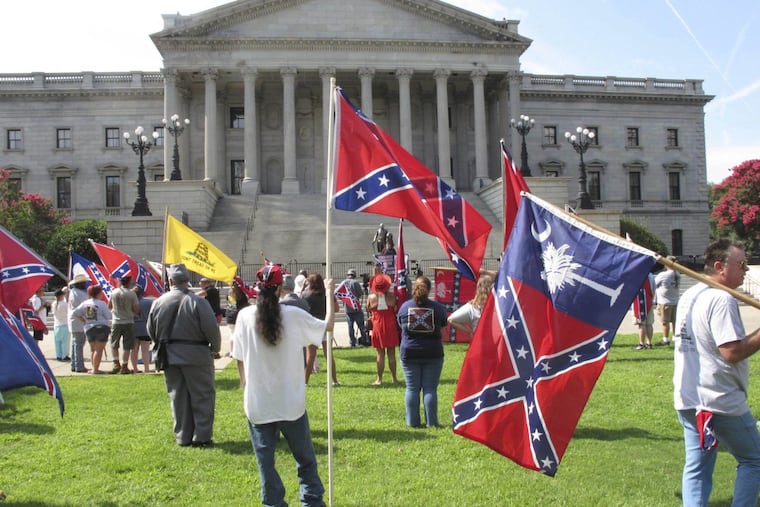
Fade in. The scene is South Carolina in 2015. Thousands of mourners fill the street to watch as a horse-drawn caisson is paraded to the Statehouse in Columbia. Scattered throughout the crowd are dozens of news crews reporting on the assassination of a black state representative and pastor who was shot in his church by a Confederate sympathizer. There's a close-up as the coffin is unloaded and carried into the Statehouse. The camera then zooms out to reveal a flagpole on the Statehouse grounds and the Confederate battle flag flapping in the wind at full staff.
Of course, the scene I just described isn't a movie scene at all, but events that took place just two years ago, on June 24, 2015.
The Confederate battle flag continued to fly above the U.S. flag and South Carolina state flag, which had been lowered to half-staff even as President Barack Obama delivered a eulogy for Clementa Pinckney in Charleston two days later. Addressing a room that included the governor of South Carolina and many other high-ranking officials, the president stated that "removing the flag from this state's capitol … would simply be an acknowledgment that the cause for which [the Confederacy] fought — the cause of slavery — was wrong."
For a nation that supposedly settled the issue of slavery in the Civil War 150 years ago, it seems odd that this statement would have been necessary in 2015. (I can't recall a time, for instance, when a president had to issue a clarifying statement that the United States was on the right side of the Revolutionary War and that, therefore, a monument to King George III was inappropriate in the Capitol.) Perhaps that's because most wars end with one side being clearly defeated, its cause and ideology clearly rejected. By contrast, thanks to monuments, nostalgia, and sociopolitical realities that remain, America has yet to definitively part ways with its Confederate past.
Perhaps this is why HBO's recent announcement of a new show called Confederate, which presents an alternative history in which the Confederacy has won the Civil War, struck many, including myself, as completely tone-deaf to historical reality.
It frankly doesn't require much imagination to fantasize a world where the Confederacy remained undefeated. After all, the current president of the United States received endorsements from various white supremacist organizations, including the Ku Klux Klan, a group founded by former Confederate soldiers whose mission was to terrorize newly freed blacks and the radical Republicans seeking to grant them voting rights. Just last month, members of the KKK gathered for a rally in Charlottesville, Va., to fight the removal of a statue of Robert E. Lee erected in 1924.
It's also not difficult to close one's eyes and imagine what America would be like in 2017 had slavery never ended — because it never really did. Chattel slavery as it existed before the Civil War merely evolved to suit a more advanced, sleek, and efficient economy, but one still built on placing people in chains.
The United States represents roughly 4 percent of the world's population, yet holds nearly 25 percent of the world's incarcerated people. Those incarcerated are disproportionately black, Latino, and poor. This system of mass incarceration is not merely about criminal punishment or rehabilitation, but is a literal economy. Just as chattel slavery was an economy that generated profit in myriad ways for those who participated in it, private prisons are a multibillion-dollar industry that generates profit from locking people up and forcing them to serve as cheap labor.
The roots of mass incarceration in the 21st century trace directly to the period immediately after the Civil War and the emancipation of slaves. Between 1865 and 1866, Southern states passed a series of laws known as the "black codes" designed to grant local authorities power to arrest black people for virtually any reason at all and force them to provide free labor via convict-leasing programs. Some of the most notorious prisons in the South were built soon after: Parchman in Mississippi, built to house black male prisoners, where Rep. John Lewis was held during the Freedom Rides in 1961; and Angola Prison in Louisiana, erected on the site of a former plantation, purchased with profits from a slave-trading firm. Angola remains the largest maximum-security prison in the country and is notorious for its extremely high prisoner death rates.
Given that the true cause of the Confederacy was slavery, did the Confederacy really lose altogether? Confederates were out of power for only about 12 years during the period of Reconstruction (1865-77). Campaigns of terror led by groups such as the KKK were overwhelmingly successful, and, despite a brief period of gain for African Americans during which seven African Americans from the South were elected to Congress, by the beginning of the 20th century, white supremacists in the South had succeeded in returning blacks to a condition as close to slavery as possible, and many of those abuses endure today.
So the Confederacy hardly needs to be imagined. Indeed, David Benioff and D.B. Weiss, the showrunners for Game of Thrones who were tapped to helm Confederate, didn't see fit to cast black actors in their current show for any roles other than slaves who are freed by a white savior, the character Daenerys. Even in a world of fantasy, the show's creators struggled to imagine darker-skinned people as anything other than slaves only capable of being freed by a white person. That's not imaginative, but quite the opposite. In the show's seven-season run, not a single episode has been written or directed by a person of color.
Imagining a world where the Confederacy won, where the legacy of slavery is fresh and the terror of it ever-present, may seem like fantasy for white creatives, but ask most black people living in the United States today. They'll tell you it's their reality.
Bree Newsome is an artist and activist who, after the mass shooting at Mother Emanuel in Charleston, climbed the flagpole in front of the South Carolina Statehouse and lowered the Confederate battle flag. She wrote this for the Washington Post.