Notes of her memory
The grounds at Valley Forge are inspiring, but it's the sounds that tie those who are buried there to creatures big and small who walk nearby. That is how I can connect with my mother.
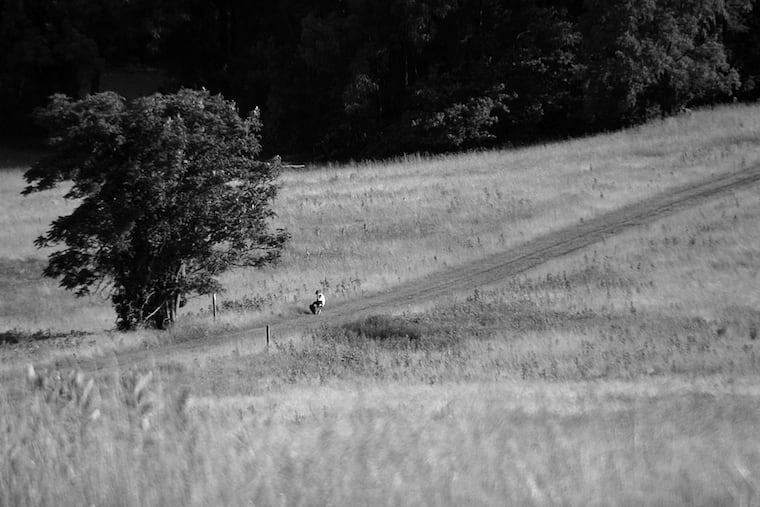
We buried my mother on a January day - into the slope of a hill, under the naked arms of trees, beneath broken earth and petals. Everything depended on where you stood. There was sun, and there was shadow. There was warmth, and there was chill. I had felt my mother's spirit lift on the night she passed away. I felt it hover, still.
Later my father and I would design a red-granite headstone - birds taking flight, lambs seeking rest, a tree in full flower. Later my father would build her a garden - daffodils, phlox, begonia - and on the scorched days (and with permission) connect a long hose to a distant spigot to keep the blooms alive. Later we would bring wreaths (winter) and gifts (spring) - a miniature ornament, the cut sleeves of an oak-leaf hydrangea, words from my son, stories.
It is your birthday.
It is Christmas Eve.
We miss you.
The deer looked on. Warblers. Red-winged blackbirds. Fox.
Beyond my mother's stone, the 3,500 acres of the Valley Forge National Historical Park rolled past. The Knox Estate greenhouse with its teeth of broken glass. The covered bridge, cool as the interior of a shell. The National Memorial Arch (a public discourse) and the redoubts (private knolls) and the spoked and grounded limbs of the Pawling sycamore and Washington's temporary home. In the months just after my mother's death, I was particularly obsessed with the greenhouse. Rust where seeds might have been. Gears that could not turn. Sunlight caught in a cage.
When your mother is buried at Valley Forge National Historical Park, you look to monumental land for signs of the eternal. I studied the trenchant greenhouse for a long time before I finally sought solace in the park's carillon - in the songs that have floated down from the National Patriots Bell Tower of the Washington Memorial Chapel for decades.
They are born of bronze, these songs - of 58 separate, stationary bells that collectively weigh 26 tons. The oak keys that lever the bells are called batons and the invisible magistrate of music is called the carillonneur, and there are, I have read, 24 pedals at his feet - 24 ways to burnish sound.
The carillonneur burnishes sound.
These days, 6 1/2 years after the passing of my mother, I will park my car by the chapel and walk down past the used bookstore and the Cabin Shop and the well-fed cats until I'm standing in the burial grounds. The churchyard slopes. It is bisected by thin roads (lots named for Generals Poor and Rochambeau, Scott and Varnum, Wayne) and fringed by trees (sentinels with leafy hats). The individual plots are marked by polished and unpolished stones, by names and years, by erupted tree roots and weathered mementos, by abbreviated elegies: Beloved. Father. Friend.
From above, where the carillonneur sits in the stone tower, it might all resemble a well-embroidered quilt. I myself, if seen from there, might resemble whom I've become: the grown daughter of a missing mother and of a father who daily sees a garden through.
A daughter, grown.
By the time I've reached my mother's grave the carillon songs will have often begun. Hymns like lullabies. The soft, sweet crush of musical vowels. Bach or a Christmas carol or an anthem I can't name but have heard before - perhaps in childhood, perhaps in a foreign land. Up in his tower, the carillonneur will strike the batons with the backs of his fists and temper the notes with his feet, and down below, in the churchyard, I will momentarily believe that the song is for me. That is not true. The bronzed bells play for my mother and also for the child buried nearby and for the father and sister and soldiers and sons who lie beneath the quilted land. They play for the deer and the fox, the warblers and red-winged blackbirds, and they are cloud cover, and their notes fall like rain. The carillonneur's songs are unbidden and given. They are binding and free. They, like the seasons, like life itself, go on.
I'll stand by my mother's grave, listening. I'll stand telling her the stories of the world as it has clocked forward - the new news, the old concerns, the tremor of recurring myths. I'll stand admiring my father's handiwork - which is not just the way his flowers grow but the way he proves steadfast. Sometimes the carillonneur will have stopped playing before I'm gone, but the echoes remain - in the trees, in the grass, in the blooms. They will have seeped their way into a daughter's thoughts and into a red-granite garden.