Josh Shapiro has a 16-point lead in the governor’s race — and most Pa. Democrats would support him for president
Stacy Garrity is still unknown to many Republican voters as she struggles to keep pace with Shapiro, a new poll from The Inquirer, New York Times and Siena University shows.
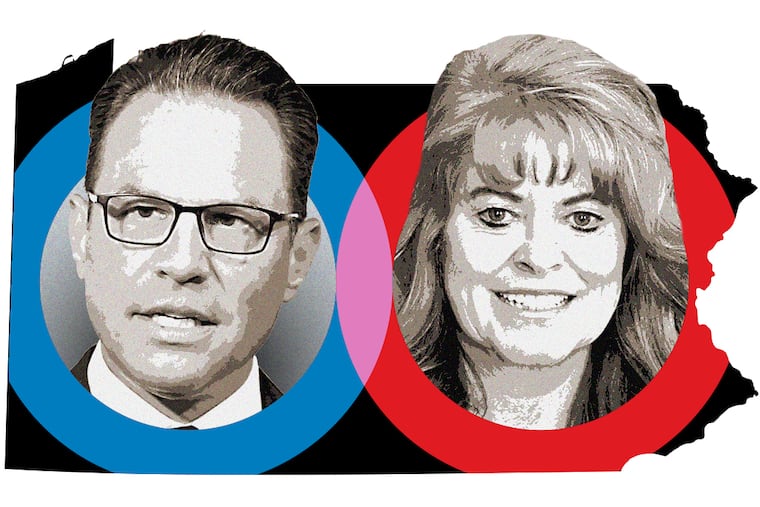
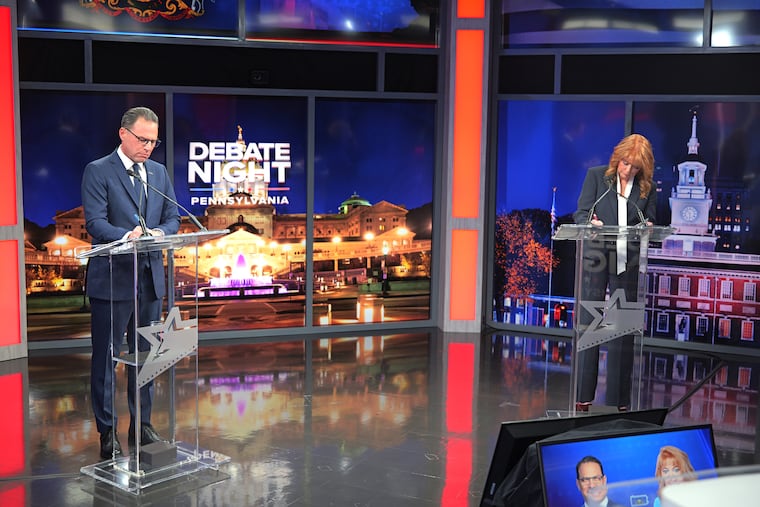
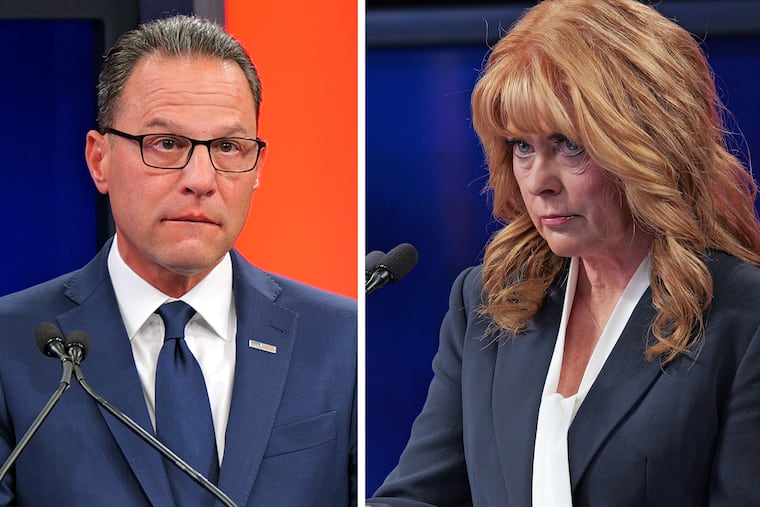
With a little more than two months until Election Day, Democratic Gov. Josh Shapiro has a double-digit lead over his Republican challenger, Stacy Garrity, among likely Pennsylvania voters in the race to lead the critical swing state — an election that could also serve as an audition for the 2028 presidential primary.
Shapiro holds a 16-percentage-point lead over Garrity, the state treasurer, according to a new poll of 760 likely voters conducted from Aug. 17 through 21 by The Inquirer, the New York Times, and Siena University.
The numbers could foreshadow another commanding victory for Shapiro, as he hopes his popularity trickles into other down-ballot races, including four congressional districts that national Democrats think they can flip. Shapiro is also trying to flip the state Senate for the first time in 30 years and deliver a Democratic trifecta in the statehouse.
A majority of Pennsylvania voters — 60% — have a favorable opinion of the governor, compared with Garrity, who is viewed favorably by just 37% in the state.
Shapiro’s popularity also eclipses that of President Donald Trump, according to the poll. Sixty percent of likely Pennsylvania voters approve of the job Shapiro is doing as governor, while 39% approve of Trump, who won the state two years ago.
» READ MORE: Read the full Inquirer/NYT/Siena poll here.
Lora Peluso, 63, a Democrat and retired catering director from Pittsburgh, said Shapiro has been a shield in Pennsylvania against some of Trump’s most harmful policies affecting low-income and older people.
“I think [Shapiro] is trustworthy,” said Peluso, who participated in the poll. “His policies are things that actually benefit people, the average working person, seniors.”
Garrity still unknown by some Republicans
Pennsylvania Republicans this year had hoped to avoid another walloping by Shapiro, who has won three times statewide, with fears that a weak gubernatorial candidate could negatively affect the rest of the Republican ticket. So the state GOP took the unprecedented move of endorsing Garrity in September 2025 — approximately 14 months before the election — to try to raise her profile.
Despite securing Trump’s endorsement, Garrity has struggled to raise money, attract support from national Republicans, or compete with Shapiro’s $13 million in ad buys so far this cycle. Her campaign has spent $679,000 on ad buys thus far, according to media-tracking firm AdImpact, as it seeks to introduce the candidate to voters.
Now, with 70 days until the election, a quarter of likely Republican voters still did not know Garrity or know enough about her to form an opinion of her, according to the poll.
Meanwhile, Shapiro maintains favorable opinions among 27% of Trump’s 2024 supporters, and 35% of registered Republicans approve of the job he is doing as governor, the poll found.
» READ MORE: Will Donald Trump and national Republicans help Stacy Garrity’s campaign from falling flat against Josh Shapiro?
Michael Patterson, a Republican from Trumbauersville, Bucks County, who supported Trump in 2024, said he plans to support Shapiro in November because he likes the job the governor is doing and because he does not know much about Garrity besides what he has seen on social media.
“Honestly, I don’t know much about her,” Patterson, 60, said. “I guess I don’t see advertisements on the TV. Other than Facebook, I really don’t see her. The stuff I see on Facebook is just typical partisan stuff.”
Shapiro, on the other hand, appears more moderate and independent from his party in Patterson’s eyes.
“He’s kinda doing his own thing. I have a lot of respect for that. He’s not playing partisan games,” Patterson said, contrasting Shapiro with Democrats in California and New York.
This attitude shows up among other Republicans, too, said Don Levy, the director of the Siena Research Institute.
“Shapiro is seen as sufficiently middle of the road,” Levy said. “He’s got 35% of Republicans approving of the job that he’s doing as governor. That’s a really impressive number in today’s world.”
Other Republicans like Steven Keenan, 70, of Ridley Township, are all in for Garrity, citing her military experience and support for Trump.
“[Shapiro’s] a big phony. He’s a politician,” Keenan said. “She is, too, but she’s been through the wars. I think she’s earned her place. I think we should give a woman a chance.”
A majority of Pennsylvania voters trust Shapiro over Garrity to handle top issues facing the state, including the economy, cost-of-living increases, the Trump administration, immigration, and doing what is best for ordinary Pennsylvanians.
Tina Hoffert, 68, of Lenhartsville, Berks County, said she has not heard much about Garrity, but plans to vote for her in November because she is unsatisfied with Shapiro’s leadership.
“He’s forever bashing Trump,” Hoffert, a Republican, said. “I’m sorry, I don’t care whether you like him or not, he’s our president. You work with him. You don’t fight him. And if there’s things you don’t like that he’s doing, then you go in there and you have discussions.”
Shapiro’s presidential prospects
If Shapiro is reelected in a landslide victory this November, it becomes even more likely that he jumps into the 2028 presidential race as the governor of a key swing state with 19 electoral votes.
Among those surveyed who said they plan to vote in the Democratic primary in two years, 86% said they would be likely to support him — though the poll did not compare him with other potential primary candidates.
Other prospective candidates include former Vice President Kamala Harris, Govs. Gavin Newsom of California and JB Pritzker of Illinois, U.S. Sens. Mark Kelly of Arizona and Jon Ossoff of Georgia, and U.S. Rep. Alexandria Ocasio-Cortez of New York.
Shapiro has brushed off questions about his ambitions and told a reporter Saturday, in response to whether he would commit to serving a four-year term in office, that “the only thing that I’m focused on — and the only thing anybody should be focused on — is winning in November and being a check on this president’s chaos, cruelty, and corruption.”
Most voters in the poll — 58% — said that if Shapiro decides to run for president, doing so either would not distract from his role as governor or would not keep him from being effective at governing.
“I mean, it would be a distraction, of course, but I think he’s a professional and a hard worker, and he would figure it out. It seems like he hires good people, too,” said Peter Hewitt, 62, of Devon, a Democrat who supports Shapiro’s reelection bid.
Shapiro’s potential candidacy has largely centered on his electability, especially his ability to win the top office in the nation’s premier swing state. He has pitched himself as a Democratic governor more interested in working with Republicans to make meaningful improvements to the state than in picking partisan fights, and voters agree: 58% of respondents said he is neither too far to the left nor to the right.
“He’s done a good job of just being more of a moderate, middle-of-the-road Democrat,” said Andrew Perez, a 58-year-old self-described independent voter in Pittsburgh. He said he appreciated Shapiro’s focus on improving roads and highways and not “just blindly disagreeing” with Trump.
“I think we need a strong presidential candidate who will try to unite the country instead of just keeping it being divisive, so I think that I’d be pretty likely to vote for him [for president],” said Perez, a physician.
Montiese McKenzie, 46, of West Philadelphia, said she is supporting Shapiro for a second term, but is not quite yet sold on a presidential run. She said she has not seen him rise to the level of “fighter” she thinks the Democratic Party needs, and believes as of now, she would be more likely to support someone else in the Democratic primary.
“You see people like Jon Ossoff and JB Pritzker, and they’re not putting up with it. They don’t make it pretty anymore,” McKenzie said. “If I saw some of that in Shapiro, I might be more likely to support him as a presidential candidate. Until then, I’m not sure he has the gumption.”
Shapiro has signed on to dozens of lawsuits against Trump’s administration on a host of issues, from tariffs to gender-affirming care.
But to win the party’s nomination, Shapiro would have to defeat more progressive candidates and make the case for his more centrist approach.
He has already faced criticism from some progressive voters over his previous support for school vouchers, and his early embrace of data centers, which he reversed last week by implementing what he called some of the nation’s “strictest guardrails.” Shapiro, Pennsylvania’s third Jewish governor, has also faced a perception from some progressives that he has been too supportive of Israel during its war with Hamas, despite his vocal opposition to the country’s leader, Prime Minister Benjamin Netanyahu.
Nearly half, 47%, of respondents said he has been just “about right on support of Israel,” with 14% saying he has been too supportive and 19% saying he has been not supportive enough.
Should Shapiro launch a presidential campaign, Hewitt wants to see him “come out on the right side.”
Hewitt, who emphasized his support for Jewish people in his community, said he considers the Israeli government’s actions toward Palestinian people in Gaza to be genocidal. More than 73,000 Palestinian people have been killed in Gaza since the war began nearly three years ago, and multiple international institutions have said Israel’s actions violate human rights.
“I don’t think it’s really that big of a deal for governors per se. He’s not going to vote on national policy as the governor of Pennsylvania,” Hewitt said. But he added: “He does have a voice, and if he’s thinking about a next step beyond Pennsylvania, then he will have to come out in regard to that issue.”

The New York Times/Philadelphia Inquirer/Siena University poll of Pennsylvania was funded by a grant from The Lenfest Institute for Journalism. The poll was designed and conducted independently from the institute.
- Most of Pa.’s likely voters disapprove of Donald Trump and his policies, new poll shows
- Josh Shapiro has a 16-point lead in the governor’s race — and most Pa. Democrats would support him for president
- Pa. Democrats say John Fetterman is siding with Donald Trump too much, new poll shows
-
6 in 10 Pennsylvania voters oppose data center development, new poll finds
-
Pope Leo XIV is popular with Pa. Democrats after feud with Trump. But Republicans are split.
-
Young Pa. voters are frustrated with Trump as they grapple with ‘the cost of continuing to exist’
-
Pa. voters are more critical of Trump’s handling of the economy than they were a month ago
-
John Fetterman’s favorability dips as voters see him more as a Republican than a Democrat
-
1 in 4 Pa. GOP voters don’t know who Stacy Garrity is as Josh Shapiro widens lead in governor’s race
-
New poll shows RFK Jr. is unpopular among Pa. voters amid feud with Shapiro over measles
-
Pa. Democrats have mostly positive view of socialism as progressive candidates secure wins