An eclipse and planet show are due Wednesday, but meteors may be the stars in Philly’s skies
And August ends with a once-in-a-blue-moon “Blue Moon.”
A partial eclipse will occur Wednesday, along with a planetary alignment that doesn’t happen all that often.
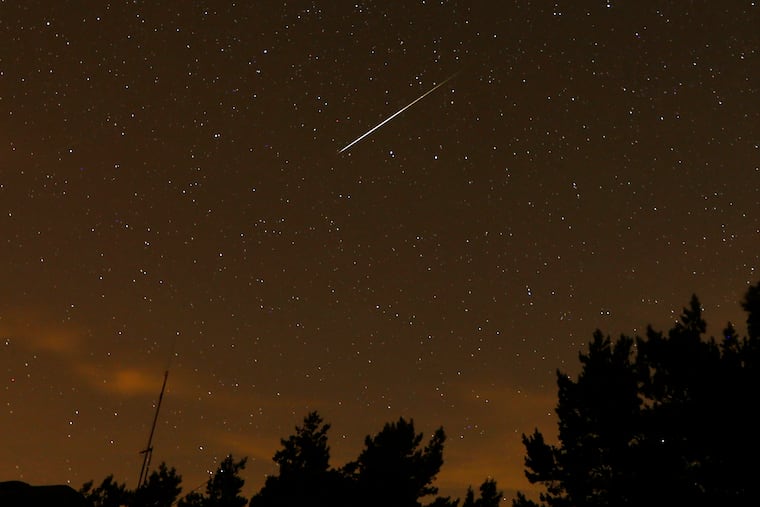
For star power, however, the annual Perseids meteor shower, which will be peaking late Wednesday night and early Thursday, may outshine them both as the moon gets out of the way to prepare for its big night at the end of the month.
The Perseids should put on quite a decent show this year for those who have access to reasonably dark skies and do not mind staying up a little late.
These things can produce 50 to 100 meteors an hour under ultra-dark sky conditions, but you won’t see that many above light-polluted Philly.
Above the darkness-challenged Philadelphia Museum of Art, you might be able to catch 10 an hour, said Bill Cook, NASA’s meteoroid guru at the Marshall Space Flight Center in Huntsville, Ala.
The potential spoiler in all this would be the state of the skies, which are expected to be sunny Wednesday. But just how cloud-free they will be at night is not clear just yet, said Patrick O’Hara, meteorologist with the National Weather Service in Mount Holly.
The weather service is calling for mostly clear skies late Wednesday night, but some clouds may roll in after midnight, and it says the forecast contains “a frustrating level of uncertainty.”
About the eclipse
The eclipse has been generating media attention, and it is going to be a spectacular show — if you happen to be in Greenland or Iceland or northern Spain, places that will experience the haunting magic of totality, which will occur around 1:45 p.m. Philly time.
Locally?
“Philly just isn’t in the right place for any good eclipse viewing this time around,” said Teddy Kareta, assistant professor of astrophysics and planetary science at Villanova University.
Only about 8% of the sun will be blocked out at Philly’s latitude, said Dwight Dulsky, with the Bucks-Mont Astronomical Association.
Said Kareta, “That’s a small enough change that … I don’t think I’d even notice.”
Dulsky said the Bucks-Mont group “will be doing some safe solar viewing” of the eclipse in the marina parking lot of Nockamixon State Park, in Upper Bucks County.
If you’re jonesing for a totality experience, NASA will be showing the whole thing live on YouTube.
The parade of planets
Early risers (or late stay-uppers) on Wednesday can admire a planet parade in the western sky, or at least some of its participants.
Four planets — Jupiter, Mercury, Mars, and Saturn — will be lined up and visible to the unaided eye, said Kareta, though Jupiter and Mercury may be elusive, since they will be close to the horizon.
The line may be slightly less orderly on the 13th, but may not look much different from the perspective of the average earthling, Kareta added.
If you miss the planet show, Kareta advises that these things may be special but are not exactly rare. A similar alignment occurred “about a year ago,” he said.
“As an astronomer,” he said, “I find these planetary alignments more fun and beautiful than I find them super interesting.”
The Perseids are about to peak
Several hours after the moon gets in the sun’s way Wednesday, it will be fortuitously out of the way for the annual Perseid meteor showers.
As many as 50 to 100 meteors per hour may appear at their absolute peak, which this year would be in the early morning hours of Thursday.
You would not find that absolutely dark sky anywhere around the city, but NASA’s Cook estimates that about 20 an hour might be visible over, say, Malvern. Similar numbers may appear in the open spaces of Valley Forge National Historical Park.
Elsewhere in the great Philadelphia city-state, French Creek State Park, bordering Chester and Berks Counties, is a favorite among local sky watchers, and the prime viewing area is open all night.
At least a few watch parties are planned, including one by the Bucks-Mont group from 8 to 11 p.m. at the Nockamixon park, Dulsky said.
Also, the McKaig Nature Center in Upper Merion Township, Montgomery County, will be taking a busload of meteor-gazers to a clearing overlooking the McKaig Woods.
The Perseids are so named because they appear to radiate from the constellation Perseus, but they show up all over the sky. They are the most popular among the 30 or so showers visible in the night sky annually.
The Geminids, in December, outnumber the Perseids, but people prefer warmth with their meteor-watching. Plus, NASA reports that the Perseids are by far number one for those spectacular fireballs.
The meteors are the result of debris from the comet Swift-Tuttle, one of the larger meteor-producing comets, having a diameter of about 15 miles.
The earth encounters Swift-Tuttle detritus every year around this time, and those cosmic pebbles become bright streaks as they enter Earth’s atmosphere at 130,000 mph. If they’re big enough, they explode into fireballs.
Cook says that while the moonless skies offer the ideal background, this will not be an especially prolific year for the Perseids. He said the 2028 harvest will be more abundant, when the earth passes through “a denser stream” of the comet’s sheddings.
That once-in-a-blue-moon event
The moon will be returning later in the month, on Aug. 31, as the second full moon of August, thus a “blue moon.” Like those planetary alignments, it is something to expect once in a blue moon.