A treasure trove of jewelry awaits at the Woodmere Art Museum’s underground galleries
The Jewelry Vault is a permanent exhibition space dedicated to the art of jewelry making and includes the work of artisans like Theophilus Annor, Doug Bucci, Henri David, and Mary McFadden.
Each time Theophilus Annor descends the stairs nestled underneath Frances M. Maguire Hall’s grand first-floor banister and into Woodmere’s Jewelry Vault, he’s humbled and proud.
The 26-year-old metalsmith, 3D printer wiz, and graduate of Temple University’s Tyler School of Art and Architecture has a significant amount of bling on permanent display in the vault, which comprises the Woodmere Art Museum’s three underground galleries dedicated to baubles fashioned by Philadelphia’s most celebrated jewelry artisans.
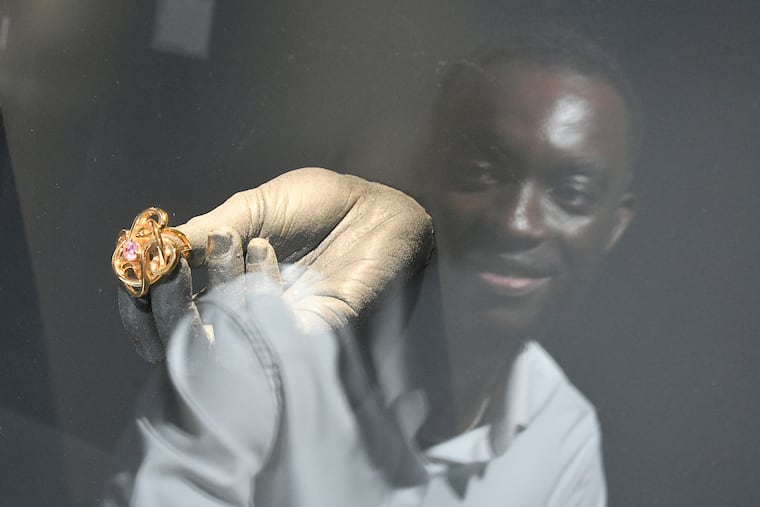
Holding On is a gold-plated brass ring Annor, one of the youngest artists featured in the vault, fashioned into the Ghanaian Adinkra symbol for loyalty. It sits in the vault’s center display case with its rose gold gemstone sparkling in conversation with more than a dozen other pieces from artisans Richard Reinhardt, Wesley Emmons, Henri David, and Doug Bucci, Annor’s teacher and mentor at Tyler.
Each ring in the showcase is delicately planted between the middle finger and thumb of a silicone hand Annor cast from an alginate mold of his own. The lines in the 14 gray palms and shape of each nail bed clutching the trinkets mirror Annor’s lithe ebony hands. The young artist’s hands literally uphold the masterpieces of the artists who came before him.
“Of that I’m so honored,” he said, sitting on a bench on Maguire Hall’s porch. Above him is one of five window grills he designed with Philadelphia blacksmith John Rais.
Rais created the decorative wrought iron while Annor scaled another Adinkra symbol up to life-size with a bronze, metallic finish.
He made the ornamentation on a 3D printer, and it took several days to print each of them.
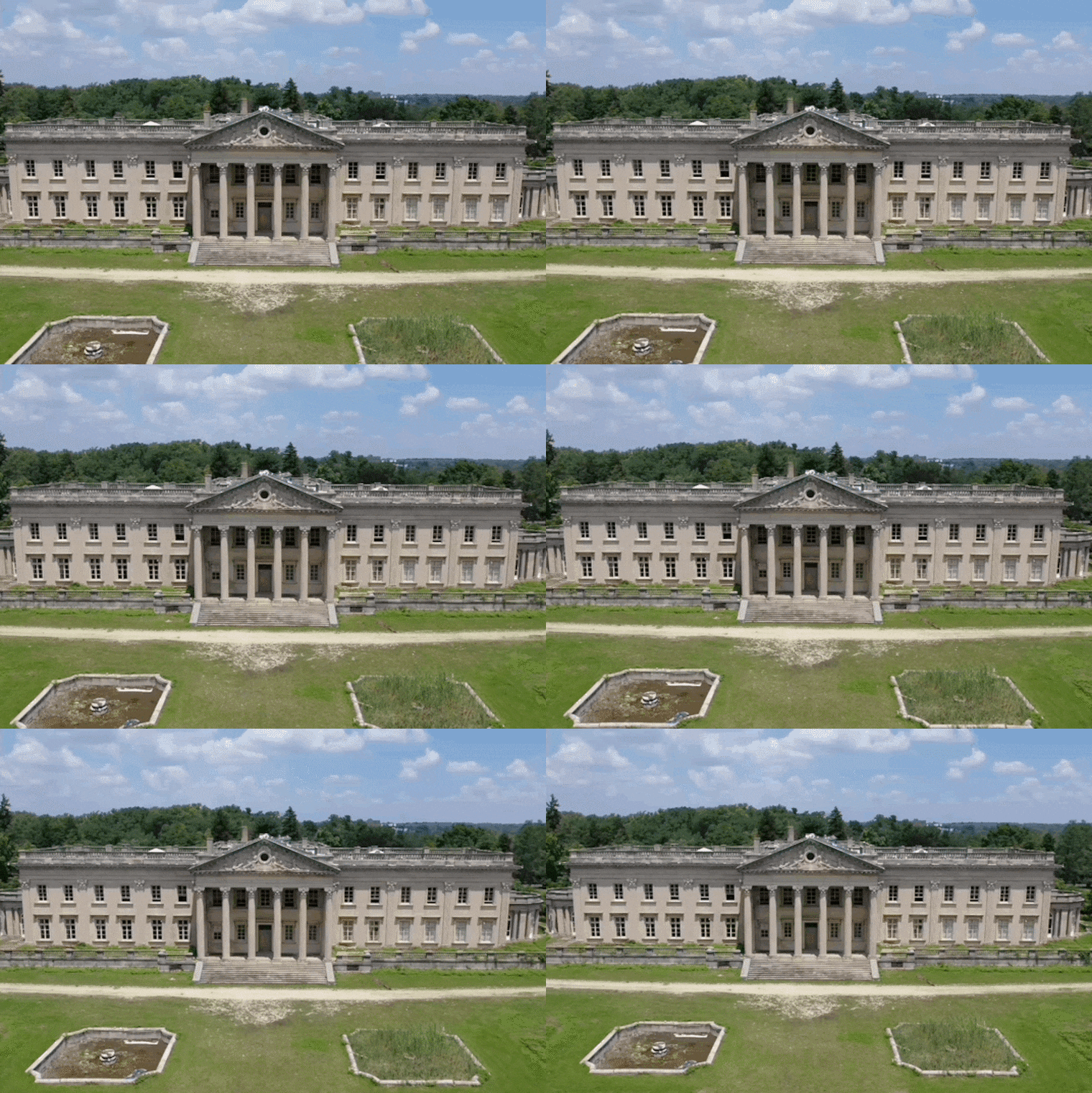
Woodmere purchased its four-story Victorian mansion home from the Sisters of St. Joseph in 2021. In 2022, the Maguire Foundation gave the museum $10 million in honor of its late matriarch, Frances M. Maguire. Through a capital campaign, Woodmere’s executive director William R. Valerio raised a total of $28 million to purchase, renovate, and create an endowment for Maguire Hall.
Last October, the 14-gallery space opened, Annor’s touch dispersed throughout, “reminding visitors of the diversity of Philadelphia artists on display here at Woodmere,” Valerio said.
“My work is next to that of so many amazing artists,” Annor said. “And I’m so excited to be a part of the legacy.”
As part of Maguire Hall and the vault’s first birthday, Woodmere will host a jewelry trunk show on Oct. 22.
The 1,000-square-foot vault was conceived to serve as a showcase of Philadelphia artisans and pay homage to the city’s history of jewelry arts. It’s less about engagement rings and more about engagement with the community of Philadelphia artists and their patrons.
To the right of the entrance, a vitrine beams with exquisite Gilded Age accessories: a J.E. Caldwell sapphire-and-diamond ring twinkles next to a Bailey, Banks & Biddle topaz brooch.
These brands were featured in the 1876 Centennial as part of its jewelry arts exhibition, which catapulted their popularity. And within the year, Philadelphians’ interest in the jewelry arts led to the opening of the University of the Arts, home of one of the country’s first jewelry arts programs. The university helped Philadelphia become an industry leader in the jewelry arts during the 20th century, Valerio said.
Of course, many of the vault’s showpieces celebrate the beauty and drama of all that is jewel-encrusted.
A Henri David installation gives enchanted forest vibes, taking up the entire back wall of the first gallery. A cloak sewn together from thousands of iridescent feathers from the tails of French roosters is centered next to faux greenery. David’s nature-inspired frippery glistens: a 14-carat yellow-and-gold stingray brooch, a diamond-and-pearl dragonfly brooch, and a druzy agate flower brooch with a pretty black fresh freshwater pearl affixed to its center.
Jewelry innovation is a focus of the vault, too.
Across from the ring case is Bucci’s insightful Shroud, a continuous sheet of polylactic acid and cubic zirconia installed into the floor. But Shroud is more than a thin layer of ivory glitz under a glass case that resembles a tomb. It’s a 3D-print installation generated from 30 days of Bucci’s blood glucose data. Bucci is a Type 1 diabetic who wears an around-the-clock insulin monitor. Each day is a vertical slice of Bucci’s metabolic history, brilliant evidence of his lived experience.
“The funny thing is that we were really just figuring out what to do with the hole in the ground,” Bucci said. “What we came up with was inspired by beauty, inspired by architecture, and the unseen. It’s like the game of Operation where you have that look inside.”
Islet — Bucci’s most well-known work that includes a necklace, a ring, and a bracelet — also resides in the vault. Each one of the links in the necklace is a honeycomb-patterned tube that is printed as one piece and interlinked, creating an unbroken chain. Bucci was the first jewelry artisan to manipulate a 3D printer to do that.
Islet shares gallery space with a purple polyester resin and sterling silver torque, or metal collar, by Stanley Lechtzin, who founded Tyler’s jewelry program in 1962 and served as its head through 2018.
Lechtzin is considered the grandfather of computer-aided design in the jewelry industry, the first to use a 3D printer to design and produce jewelry. He also developed electroforming, a process that makes big, chunky jewelry light. (It’s why bamboo door-knocker earrings look heavy but are actually light.)
“Lechtzin is truly an innovator in the design field,” Bucci said. “He is one of my educators, mentors, and heroes. So for my work to stand along his and with my students’ is one of the most important moments of my career.”
The vault houses the ostentatious and the kitschy. Brooches made from found art and resin by Maximal Art’s John Wind and Hilary Jay are placed next to brooches, cuffs, pendants, and pleated gowns by the late fashion and accessories designer Mary McFadden.
McFadden — who died two years ago at 84 — made an undisclosed donation to the vault and gave Woodmere several pieces of clothing and jewelry to exhibit. One of the vault’s galleries is named for her.
The vault’s permanent exhibit comes full circle, ending with a glass cabinet filled with hair adornments. It’s called the Crown Case. In this glass cabinet is a laurel crown symbolizing power, sanctity, and celebration designed by McFadden, a wedding tiara by Reinhardt, and a knotted red-and-yellow hair piece by Annor.
The piece, Annor said, explores the historical significance of knots used in Ghana as ladders during the African slave trade.
“I am from Ghana, but a lot of my thoughts and experiences as a jewelry maker are here in Philly,” Annor said. “At Woodmere I’m able to blend traditional and contemporary art and honor my heritage.”
The Woodmere Art Museum’s Frances M. Maguire Hall is located at 9001 Germantown Ave. The Jewelry Trunk Show will be held Oct. 22 from 1 to 5 p.m. at Charles Knox Smith Hall at 9201 Germantown Ave.