As measles cases grow in Pennsylvania, some parents are speeding up vaccinations and avoiding Lancaster County
The measles outbreak has some Philadelphia-area parents opting to vaccinate their children early and delay daycare while avoiding Lancaster County and those who have traveled there.
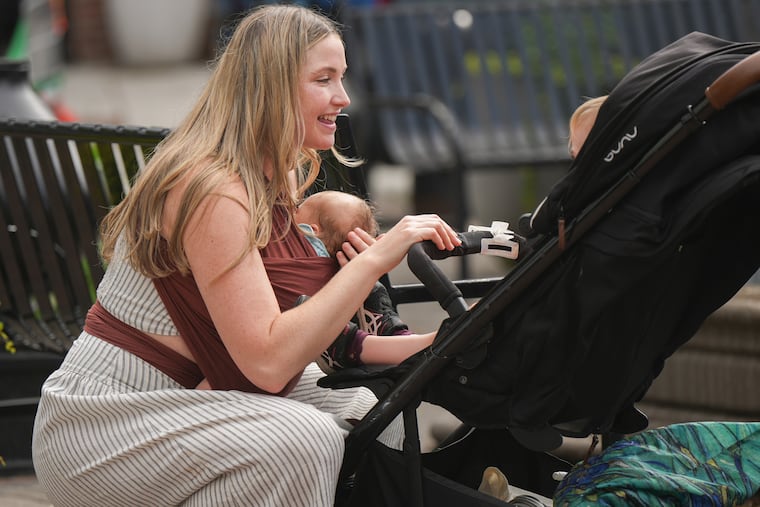
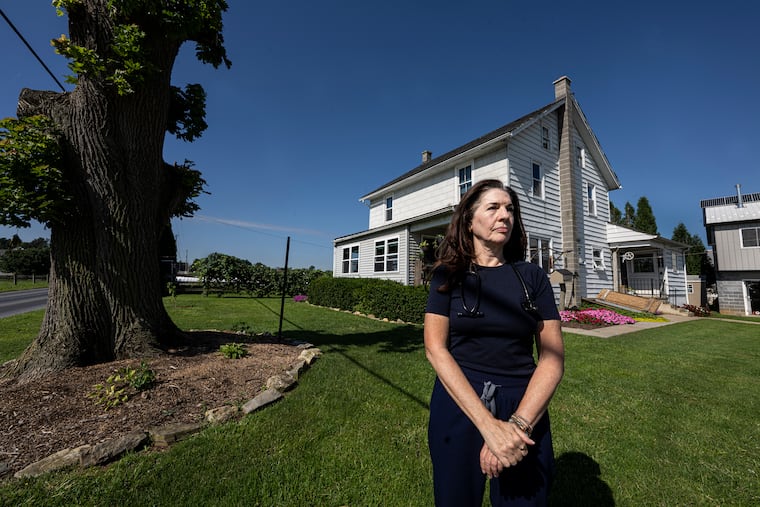
Leah Santos still wears a mask during her daily Regional Rail commute into Philly.
The 35-year-old nurse from Springfield, Delaware County, never stopped implementing COVID-19-era precautions. And she’s just as careful with her one-year-old son.
So when Santos learned in May about the growing measles outbreak in nearby Lancaster County, she started asking a new question of friends and family who regularly make excursions around the region for shopping and dining: Have you been to Lancaster lately?
“I have a child to protect at all costs. So I’m making sure I’m not in contact with anyone who’s been traveling out to Lancaster,” Santos said.
A spreading measles outbreak in Pennsylvania has sickened 767 people already this year, and hospitalized 45 children under age 18. State officials have announced four deaths related to the outbreak: Two infants in Lancaster County, a 40-year-old in Jefferson County, and an 18-year-old in Mifflin County.
Chester County remains the only Philadelphia-area county with confirmed cases — more than 65 this year, the third-highest in the state.
But in a densely populated region where crossing county lines for work and socializing is the norm, some worried parents are vaccinating babies early, delaying daycare, and weighing the risks of attending crowded festivals with their kids or visiting family in affected areas.
Measles can be more dangerous for some
Young children are especially at risk from the vaccine-preventable disease, which in severe cases can cause pneumonia, blindness, and brain swelling that can lead to brain damage.
None of the Pennsylvania residents who died were vaccinated against a virus so contagious that it will infect nine in 10 unvaccinated people who are exposed.
Measles deaths are rare, and the four deaths confirmed as “measles-associated” by Pennsylvania health officials, sparked a political standoff between Democratic Gov. Josh Shapiro and President Donald Trump’s Health Secretary, Robert F. Kennedy Jr., a longtime anti-vaccine activist.
Experts say that life shouldn’t change much for families whose children are vaccinated and otherwise healthy. But it’s important to take the disease seriously at a time when declining vaccination rates have left communities across the state increasingly vulnerable, including in the Philadelphia region.
Even as countywide immunization levels in the area remain relatively high, hundreds of kindergartens across Philadelphia and four surrounding suburban counties dropped below the “herd immunity” threshold — a vaccination rate of 95% or higher — for the 2025-26 school year, an Inquirer analysis of state data found.
This is the level at which a given population must be fully vaccinated against measles to prevent the spread of disease. In the Philadelphia region last school year, about 40% of kindergartens failed to meet that threshold, up from about a third the year before.
What are the pediatric guidelines to protect against measles?
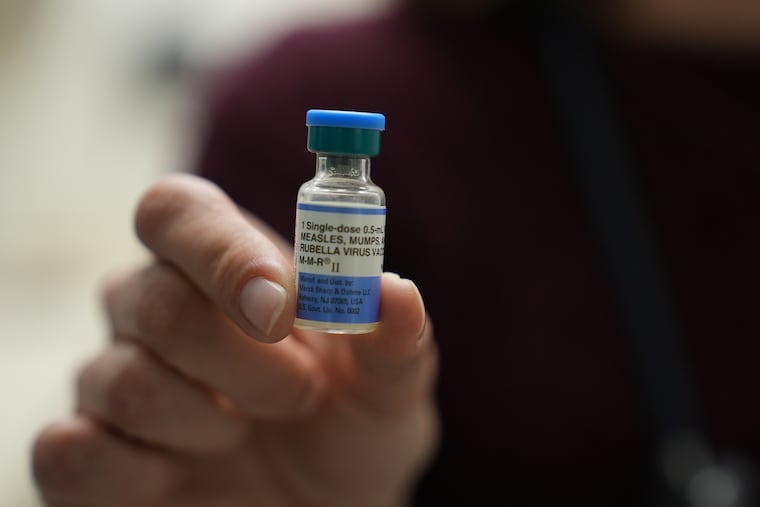
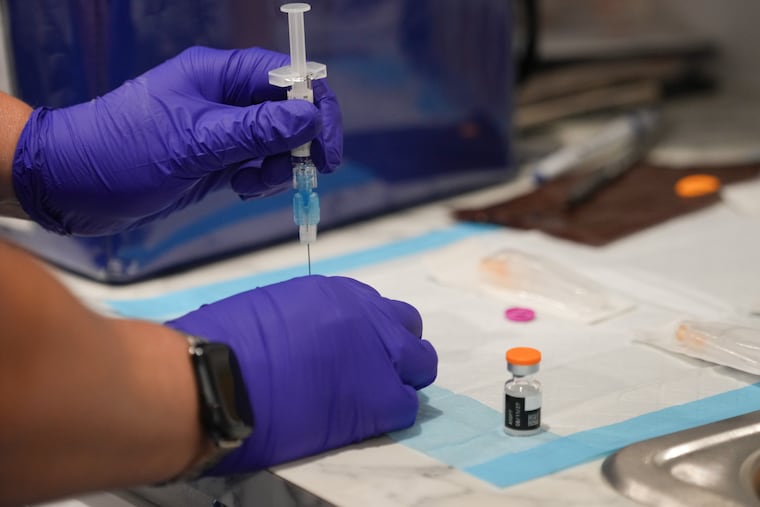
Pediatricians typically recommend a child’s first measles, mumps, and rubella vaccine at one year old, unless the child is likely to travel overseas, and then a second between 4 and 6 years old.
But Pennsylvania health officials are now encouraging a “dose zero” for children as young as six months old in counties affected by the state’s worst outbreak in three decades. Children can then get a second dose at 1 year old and another at 4 to 6 years old. The state is also recommending that children older than 1 who haven’t started their MMR vaccine series get two doses of the vaccine at least 28 days apart.
Santos said her son recently had his first vaccination, and her son’s pediatrician recommended he get his next shot at just 15 months old.
“We have gotten so far from knowing what vaccinations have done for us that we have no idea how terrifying this disease is,” Santos said.
‘One of those things you never think would affect you’
Caitlin Buttery of Kennett Square, in Chester County, recalls her trip, earlier this summer, to Lancaster when she was 9 months pregnant, only to regret it after learning about the measles outbreak.
Now, with a healthy six-week old baby, as well as a 18-month old, she’s avoiding the Lancaster area and also monitoring cases in her own county, where measles is circulating.
She worries about taking her children to public spaces like the YMCA or Kennett Square’s annual Mushroom Festival, which earlier this month drew thousands to the rural town south of West Chester.
“Measles is definitely one of those things you never think would affect you,” she said. “Now, I need to be a lot more cognizant of the chance that it could.”
The 33-year-old said she plans to get her youngest the measles, mumps, and rubella vaccine at six months old.
Public health experts have warned that there are likely far more measles cases circulating in Pennsylvania than have been recorded by the state. And the disease doesn’t confine itself to county or state borders. Across the U.S., more than 3,100 people this year have tested positive for the disease, the CDC said last Thursday.
Amina Lowery lives in Upper Darby, which borders Chester County. No cases have been reported in Delaware County, but health officials there did identify measles in a wastewater sample earlier this summer, meaning someone with the disease used a bathroom connected to the county’s public water supply.
Lowery opted to get her 6-month-old daughter vaccinated early. She also quit her job in the insurance industry to keep her daughter out of daycare, “since we can’t control what other parents decide.” She said the plan now is to enroll her child closer to 2 years old.
She feels safer having her child vaccinated ahead of a family trip later this year to Florida, which is also dealing with a measles outbreak.
“We have the research and documentation to show that vaccines work and are for the greater good. It feels like we are in the midst of societal decline,” Lowery said.
Like Lowery, Shelby Steele of Springfield opted to keep her daughter out of daycare. Her daughter is now nearly two years old, but Steele, a consultant who works from home, isn’t any closer to enrolling her.
“We obviously worry about the socialization aspect of things, but measles is no joke. We’d rather find more creative ways to socialize her safely for now,” Steele said.
Steele and her partner want to have another child if possible. But she said the measles outbreak “and just the current state of things overall” makes them think twice about the risks a child could face.
Steele said she’d like to send her daughter to school, but the outbreak even has her considering homeschooling. “We are having to reconsider a lot of things, schooling being one of them,” she said.
Physicians advising parents to talk to schools and daycare and change behavior as they navigate the outbreak
Pediatrician Katie Lockwood says parents coming to her Children’s Hospital of Philadelphia practice in Montgomery County say they’re changing childcare and vacation plans to avoid measles exposures.
Montgomery County has reported three measles cases this year.
“If you’re fully vaccinated and healthy, I don’t think there’s a change in how you need to operate right now,” Lockwood said.
“But if you have someone in your family who is particularly vulnerable, if they’re immunocompromised, pregnant, or unvaccinated because they’re too young, then you may want to change your behaviors.”
She advises parents to talk to school officials and daycare providers about their vaccination policies, keep sick kids home to avoid spreading illness, and make sure children are up to date on all recommended vaccines.
“It’s awful that now parents are having to make a decision between work and childcare for something that we can prevent safely with vaccination,” she said. “Not everyone has the ability to quit their job or stay home, and they may not have an alternative childcare resource.”
Like many practicing physicians today, most schools and daycares have never had to deal with a measles case. Lockwood recently had several childcare providers refer children with rashes to her practice, worried about measles.
None of the children had the disease, but “I would rather a school or a daycare overreact,” she said, explaining that keeping a child out of school to evaluate a rash that proves harmless prevents “potentially exposing a bunch of kids to measles.”
In Bucks County, pediatrician Toni Richards-Rowley often counsels parents frustrated about having to navigate the outbreak.
She also serves as president of the Pennsylvania chapter of the American Academy of Pediatrics, which has been working to educate doctors about measles and how to recognize it.
In her own practice, Richards-Rowley is also offering “dose zero” shots for children whose parents work or plan travel to affected counties.
“If a parent asks for it, even though there’s not community spread in Bucks yet, we’re not going to turn a family away,” she said.
“Measles doesn’t respect borders. Just because we don’t have an index case doesn’t mean it’s not going to happen. You do have to be fairly vigilant wherever you go.”