‘Do one outrageous thing in the cause of simple justice’: Gloria Steinem’s campaign for equality at the King of Prussia Mall
Originally published on Thursday, May 13, 1982.
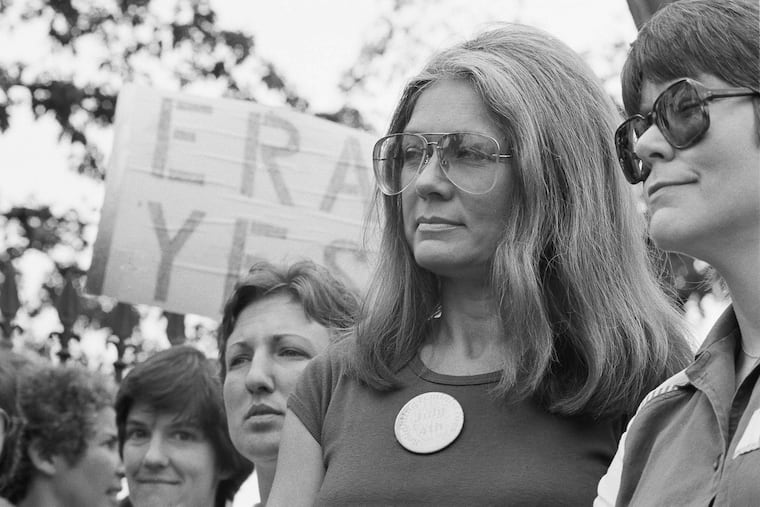
Gloria Steinem — the author, activist, and feminist icon — died on Wednesday, Sept. 2, 2026, at the age of 92.
In 1982, Steinem traveled to Philadelphia to receive an award. During her trip, she met with The Inquirer’s Kathy Hacker, who wrote this profile. Hacker died in January of 2021.
The Equal Rights Amendment was ratified by 38 states well after the original deadline mentioned in this article, and the legal and congressional debate continues. It is not recognized as part of the Constitution.
For a woman who has so often disavowed the label of “celebrity,” the scene probably was a bit discomfiting. First came the makeup man, intent on penciling her eyebrows and sponging suntan-colored goo over an already classically beautiful face.
Then came the television cameras, attached by a tangle of electrical wiring to a perspiring crew from NBC’s “Today” show.
And, finally, there were the fans, a zealous flock of devotees angling for a closer look, perchance a word and — the ultimate coup — an autograph.
If it didn’t quite qualify as a Hollywood-style welcome, the hoopla yesterday was sufficient nonetheless to jolt the modest sensibilities of that most private of public persons, Gloria Steinem.
“Sure, you feel a little foolish — you begin wondering what to do with your teeth,” sighed the premier philosopher-scribe of the women’s movement during a rare respite in a daylong visit to Philadelphia.
As she spoke, an entourage pored over her frenetic schedule, which had her popping up in places as disparate as the Women Organized Against Rape offices in Center City and the furniture department in Bloomingdale’s King of Prussia emporium.
Just as pressing, they debated whether to rush out and buy Steinem a dressier blouse.
In the midst of the hubbub, with a microphone dangling nearby, she shrugged:
“It’s difficult. But if there’s one thing I don’t want to do, it’s let anyone down at a time like this.”
The attention did not necessarily take her by surprise. It was, for starters, Lucretia Mott Day, a major feminist observance called by Womens Way in honor of the l9th-century Quaker who devoted her life to the advocacy of women’s rights and the abolition of slavery.
And so, as the sun was peeking over Manhattan yesterday morning, Steinem climbed out of bed, pulled on a pair of boots, chocolate-brown wool slacks and a matching silk shirt, hopped aboard an Amtrak train and chugged to Philadelphia for the celebration, which culminated last night in the fifth annual Lucretia Mott Award gala at the Bellevue Stratford hotel.
This year, Womens Way chose none other than Steinem as the recipient of its medal. Like Mott herself, she is a fighter — and for a cause that, while certainly not lost, seems painfully far from being won.
As summer begins, the 48-year-old Steinem finds herself in a situation that is, at best, bittersweet. Come June, she and her fellow feminists on the staff of Ms. magazine will be marking the 10th anniversary of the publication, which she helped found and has since served dutifully as editor and writer.
For the occasion, she’ll be throwing a bash at the Armory in New York and then will be jetting off to all corners of the country to appear as a guest on the Merv Griffin, Phil Donahue and “Today” shows (hence, the omnipresent cameras). Another bit of sweetness in Steinem’s life: “She’s Nobody’s Baby,” a documentary on 20th-century women that she and her Ms. colleagues produced for Home Box Office, just received a prestigious Peabody Award.
Chances are, however, that Steinem will not be raising her glass in a toast on June 30. On that day, the deadline for ratification of the Equal Rights Amendment will come . . . and, by the looks of things, go, with approval by three state legislatures still lacking. She is, understandably enough, angry.
But beaten? Never.
“It’s important to say that there’s still a possibility of ratification,” she pointed out. “The odds are slender, I know. But remember, there are only about a dozen aging white men who have to change their minds. It’s still possible.”
Having said that, Steinem voiced what is virtually inevitable: “OK, let’s say it doesn’t get ratified this time around.” The people who worked before, she guaranteed, will continue working. And furthermore, she vowed, they will fight to reintroduce the amendment in Congress before this fall’s elections.
“It isn’t as if the country doesn’t support it, since opinion polls have shown just the opposite to be true,” she said, then added vigorously: “We are going to stay. We are not going away.”
Steinem’s battle cry echoed yesterday afternoon through Bloomingdale’s third-floor furniture department, converted into an auditorium for her lecture and a twin showing of “She’s Nobody’s Baby.” If Bloomie’s seemed at first an odd choice of forums, Steinem assured that suburban department stores are a logical arena.
“Shopping malls,” she smiled, “are what churches once were to Black women in the South. It’s where everybody goes.”
To be sure, a record-breaking crowd of 200 suburban women, children and a smattering of men had gathered there to hear her — and to pick up free samples of shampoo and copies of Ms. magazine’s May issue.
To the assembled throng, Steinem preached organization and demonstrated her caustic “lip.”
“Some of us are having flashes of revelation,” she noted wryly. “It’s dawned on us that we’re becoming the men we wanted to marry.”
Before dashing back to Center City, where Mayor [William] Green was waiting with an official proclamation in hand, Steinem exacted a promise from the crowd.
“You’ve gotta do one thing,” she urged. “Promise me that, within the next 24 hours, you’ll do one outrageous thing in the cause of simple justice. I don’t care what it is. It could be saying, ‘Pick it up yourself.’ If you’re employed outside the home, it could be comparing salaries.”
Her parting words, delivered with a mischievous grin: “Just one outrageous thing.”
Lucretia Mott, no doubt, would have approved.