The ‘Olympics of Math’ is in Philly for the first time ever, drawing crowds
The International Congress of Mathematicians, held this year at the Convention Center, is one of the most prestigious math gatherings in the world.
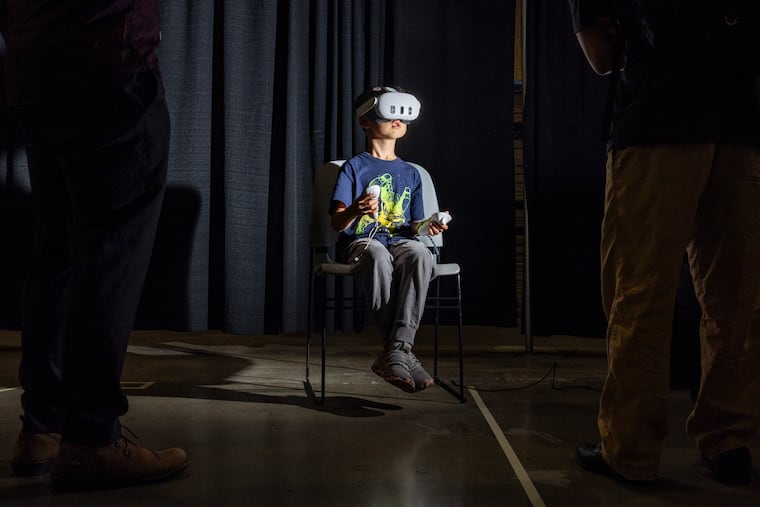
There’s math games and math art. Math theater and math music. Math for the family. Math for the kids. Mathdramatics. Math on stage. Math movies. Math podcasts. Math murals. Math rock stars. Math awards. Math in sports. Math in culture. Philly math.
Ancient math. Existential math! Asking whether, if machines solve the greatest math questions of all time but no human understands how, would it even matter. The beauty of math. The patterns and excitement. Ubiquity and mystery. The undeniable logic and truth. Of Math.
Welcome to the Super Bowl of Math. It’s in Philly, if you didn’t already know. For a limited time only.
“It’s like the Olympics of math every four years,” said Thomas Sumner, a spokesperson for the International Congress of Mathematicians, held this year at the Convention Center, from July 23-30, with public events from July 24-28. “Celebrating the beauty and ubiquity of all things math.”
The International Congress of Mathematicians is a big deal. Among the largest math gatherings in the world, it is where the Nobel Prize of math — the Fields Medal — is awarded. Hosted in rotating nations, like the Olympics, this year marks the first time the prestigious affair has been held in the United States since 1986, when it was hosted in Berkeley, Calif. Previously it had been held in Cambridge, Mass., in 1950, and Chicago in 1893.
Controversy and Awards
It was not without some controversy that the eminent math event returns to America. In March, Tarik Aougab, an associate professor of mathematics and statistics at Haverford College, circulated a petition — eventually signed by more than 2,600 mathematicians — to boycott the nearly 130-year-old conference this year if it was not moved out of the United States.
Petitioners expressed concern that some international colleagues would be unable to get visas to enter the United States due to President Donald Trump’s administration mostly suspending entry for citizens of dozens of countries. Other concerns included fear of U.S. Immigration and Customs Enforcement and reluctance to travel to the United States at a time when the nation is embroiled in a war in the Middle East.
In response the International Mathematical Union, which oversees the conference, assured attendees it was committed to providing a safe and welcoming environment for all participants and had made “additional arrangements to help mitigate risk.”
On Saturday, at the Convention Center, crowds filled the event’s free math festival in the center’s exhibit hall. Sumner said that while some potential attendees did experience travel issues, over 3,000 mathematicians from all over the world made it to Philly .
“This is where they give out the top prizes,” said Sumner, managing editor for the Simons Foundation, one of the largest charitable mathematics organizations in the United States, and the Congress’ main organizing partner. “This is where the most important talks in math are happening.”
Indeed, the Congress’ Philly locale did not come up at all at a jammed-packed news conference Thursday when Sumner introduced the four mathematicians under 40 — including ones from the U.S., Canada, and China — to become Fields Medals recipients. The prizes are accompanied by a $10,600 award and a gold medal with the face of Archimedes, an ancient Greek math whiz. This year represented the first time the winners included more than one Asian mathematician — and also included just the third woman to ever be honored with a Fields: Yu Deng, 37, of the University of Chicago, awarded for her work describing the motion of gases.
“How do we adapt?”
The conference comes as the discipline — like so much else — faces existential questions about its future from AI. On Friday Terence Tao, an Australian American mathematician considered a rock star in the math world — and awarded the Fields in 2006 for his contributions to partial differential equations — offered a crowded keynote address in the hall on “Mathematics in the Age of AI.”
“It’s starting to solve math problems that have been stumping people for decades,” Sumner said of AI. “How do we adapt to this future?”
But on Saturday, the Convention Center floor was filled less with the angst of the future and more with the everyday joys and esoteric wonders of math. Families from all over crowded into the festival — as symposiums and lectures continue through Tuesday.
Math magicians performed magic card tricks while budding mathematicians from the world over struggled through math proofs on portable chalkboards, Good Will Hunting-style. On a stage, a sports analytics panel — with representatives from every Philly sports franchise — discussed how math helps them make their moves.
In a bustling nook, renowned Duke university mathematician Ingrid Daubechies – another math rock star— showcased her world-famous multimedia art installation, Mathemalchemy. The 20-foot-long whimsical math wonderworld features tiny creatures and structures embodying complex mathematical concepts. She had created the installation with 24 other mathematicians and artists to showcase the beauty and creativity of math. Like a little model cat named Arthur who bakes perfectly rounded pi-cookies.
“People are constantly surrounding it.” Daubechies said, as crowds moved in.
At the festival, some mathematicians posed Philly-related probabilities. Like picking a random seat at Lincoln Financial Field that just happens to be in the premium club section (0.16), the likelihood that Kyle Schwarber hits a home run during the next Phillies game (0.36), or getting into the University of Pennsylvania (0.05).
“So it’s harder getting into Penn than it is getting a club seat,” explained Alissa Crans, a professor of mathematics at Loyola Marymount University, working the booth. “Got to have some Philly math fun!”
Others, like Ariana Chin, 26, who studies algebraic combinatorics at UCLA — an area of pure math that uses abstract algebra to solve elusive counting and structural problems — talked about what they love about math, and the hope it can bring, even amid the uncertainty.
“The beauty is the connections,” she said in the quiet of the crowd. “The beauty of mathematics is expanding those connections between things you wouldn’t expect to be connected.”
