A federal judge tossed a Justice Department lawsuit seeking Pennsylvania voters’ private information
The Department of Justice sued more than half of the states to force the release of unredacted voter rolls. Ten federal judges have ruled against the administration so far.
A federal judge on Saturday dismissed a U.S. Department of Justice lawsuit seeking to obtain Pennsylvania’s entire, unredacted, voter-registration database.
President Donald Trump administration’s doesn’t have the legal authority to demand the “highly sensitive” information, wrote Cathy Bissoon, Pittsburgh’s federal court chief judge. And while the Justice Department couldn’t articulate the “basis and purpose” for its request, Bissoon said, the administration has been “say[ing] the quiet parts out loud.”
“Public statements from government officials reveal its intentions: to create a nationwide voter-database, for potential weaponization in future elections; as a ‘fishing expedition,’ hoped to advance unsubstantiated claims of non-citizen voting; and as a tool for immigration enforcement,” the Barack Obama-appointed judge wrote.
The Justice Department sued more than half of the states in the union for their voter-related records. Bissoon’s ruling marks the Trump administration’s 10th defeat in a district court, which the judge notes with a positive spin.
“The administration’s demands have yielded one unexpected benefit, namely, bipartisan agreement,” Bissoon said. “Five of the district judges are Trump appointees.”
The Justice Department did not immediately respond to a request for comment.
“No matter what the Trump Administration tries next, we’re going to stand up to protect Pennsylvanians’ right to privacy — and our fundamental right to vote,“ Gov. Josh Shapiro said in a post on X.
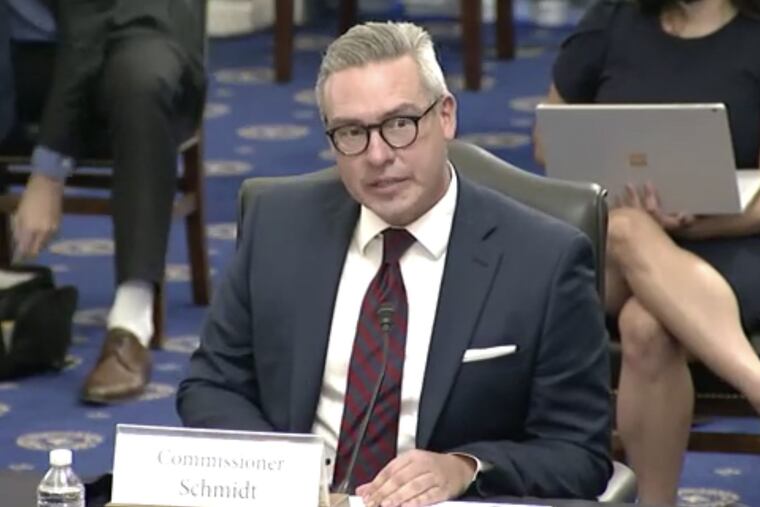
The Trump administration sued in September after Pennsylvania Secretary of State Al Schmidt refused to turn over all voter-registration data — which includes sensitive information such as Social Security numbers — from the November 2022 election through the 2024 presidential election.
Schmidt, who previously served as the lone Republican on Philadelphia’s election board, responded to DOJ’s August request by offering to share the redacted public voter file. There is no precedent to justify turning over the unredacted information, Schmidt argued, and releasing the sensitive files would violate state law.
“This request, and reported efforts to collect broad data on millions of Americans, represent a concerning attempt to expand the federal government’s role in our country’s electoral process,” Schmidt said in his response to the DOJ.
The federal government sued Schmidt, invoking federal voter election law and “ironically,” according to Bissoon, the Civil Rights Act of 1960.
“Every state has a responsibility to ensure that voter registration records are accurate, accessible, and secure — states that don’t fulfill that obligation will see this Department of Justice in court," then-Attorney General Pam Bondi said in a statement announcing the suit.
The Trump administration’s push to obtain the unredacted voter rolls has alarmed multiple civil rights groups, including the American Civil Liberties Union, National Association for the Advancement of Colored People, and the League of Women Voters.
Far from boosting the public’s confidence in election integrity, the request seems like an attempt to undermine it, Lauren Cristella, the president of the Committee of Seventy, a Philly-based civic engagement group, previously told the Inquirer.
“They are insinuating that there’s something wrong,” Cristella said. “Even though there is no credible evidence.”
Others raised privacy concerns over sharing sensitive information of millions of voters nationwide.
The Trump administration’s argument hasn’t found much traction in federal courts throughout the country so far. Bissoon joins district judges in Arizona, California, Maine, Maryland, Massachusetts, Michigan, Rhode Island, Oregon, and Wisconsin in dismissing the lawsuits, according to the Brennan Center for Justice, a legal nonprofit affiliated with New York University.
The U.S. Court of Appeals for the Sixth Circuit last week rejected the Justice Department’s appeal to obtain Michigan’s voter rolls, the first federal appeals panel to do so.
A lawsuit to obtain New Jersey’s unredacted voter rolls is ongoing.
Bissoon opened her opinion by saying limiting the federal government’s power has been among the “bedrock principles of conservative political ideology” and quoting former President Ronald Reagan’s commitment to states’ rights.
“That was then,” the judge said, “this is now.”