2025 was a wild year for fires in New Jersey, nearly all due to human mayhem
Drought may have worsened conditions, but of the 1,322 wildfires that burned 27,229 acres statewide last year, nearly all were caused by humans.
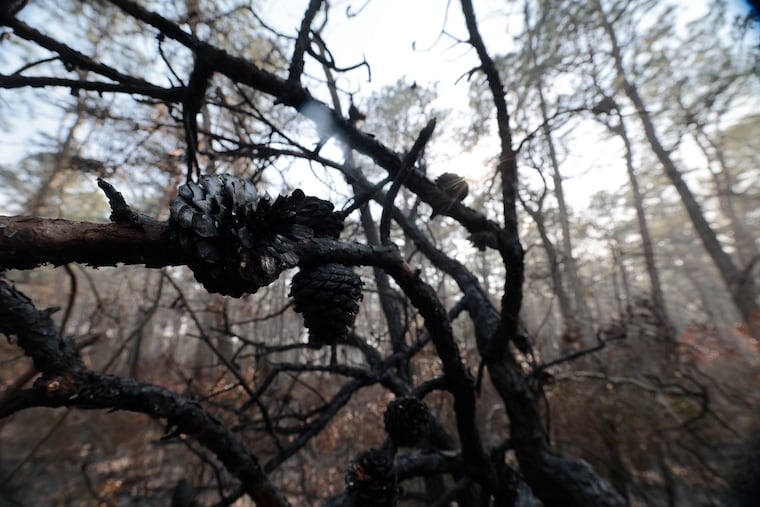
Conditions worsened by a drought last year, which continues in 2026, had a dramatic impact on wildfires in New Jersey, according to the state’s inaugural wildfire report.
However, of 1,322 wildfires that burned 27,229 acres statewide in 2025, nearly all were caused by humans, according to the report. That includes the massive Jones Road Wildfire in Ocean County that took 20 days to contain as the result of a bonfire set by youth.
» READ MORE: N.J.’s biggest fire in more than a decade started in area known for illegal bonfires
The figures represent a 22% increase in the number of wildfires and an eye-popping 116% increase in acreage burned compared with the 20-year average.
To date in 2026, New Jersey has logged 589 wildfires that burned 648.5 acres.
Overall, the New Jersey Forest Fire Service’s first wildfire report details a historic, challenging, and highly destructive 2025 for the state’s wildlands.
That came after a demanding fall fire season in 2024. Severe blazes in 2025 not only stretched firefighting resources but also forced thousands of residents from their homes.
“Our wildland firefighters responded to an increased number of wildfires and spent weeks at a time battling fires, often under challenging weather conditions,” Bill Donnelly Sr., chief of the New Jersey Forest Fire Service, wrote in the report, which was released Thursday.
Enjoyed this story?
Get more South Jersey news on your homepage with one click.
A major wildfire in New Jersey is classified as any blaze reaching or exceeding 100 acres. While the state typically averages 4.75 major fires annually, crews battled nine major wildfires in 2025.
The drought had a big impact as it created tinderboxes in areas such as the Pinelands. Not only did the dryness help spread fires, but it also forced the forest fire service to drastically reduce the amount of acres it intentionally burns in advance.
Firefighters use those prescribed fires, or controlled burns, in strategic areas to reduce dry brush and other vegetation, thus denying future fires fuel.
The drought continues into this June despite some recent heavy downpours. Data from the National Weather Service’s Middle Atlantic River Forecast Center show that Camden County is running a 13-inch rain deficit over the last 12 months.
» READ MORE: South Jersey heads into another summer already parched under the worst rainfall deficit in 20 years
Residents of the state are living amid a prolonged drought warning — the third of four levels of dryness monitored by officials. Parts of South Jersey have been under a drought warning since fall 2024.
But the biggest issue has been people.
Human activity was responsible for an overwhelming 99.6% of New Jersey’s wildfires in 2025, stemming from both accidental and intentional acts, according to the report.
“Whether through accident, carelessness, or even at times intentional acts, human behavior continues to be the primary driver of wildfire activity in our state,” Donnelly said.
Equipment use was the leading cause of fires by volume, sparking 486 individual wildfires that collectively burned 527.5 acres. Lawnmowers, weed trimmers, chain saws, welding tools, grinders, and agricultural harvesting machinery can all create sparks that ignite brush.
However, illegal and improperly managed campfires were responsible for the most devastating destruction, scorching a massive 15,263.75 acres statewide.
The largest incident of the year, the Jones Road Wildfire in Ocean and Lacey Townships, burned 14,949 acres and prompted the evacuation of 7,000 people.
Triggered by an illegal bonfire, the massive blaze threatened more than 1,300 structures and forced the closure of major thoroughfares, including the Garden State Parkway and Route 9. It destroyed a commercial building and triggered power outages affecting 30,000 residents.
Other large incidents included the Mines Spung Wildfire in Burlington County, which consumed 6,610 acres and closed portions of the Batona Trail, and the California Branch Wildfire in Camden County, which burned 2,336 acres.
Firefighters faced increasingly difficult environmental conditions throughout 2025. The report noted a growing trend of prolonged emergency operations, stating that 44% of the major wildfires in 2025 required more than five days to contain due to persistently dry weather.
In response to the escalating wildfire threat, the state’s fiscal year 2026 budget allocated an additional $1 million to the New Jersey Forest Fire Service, funding that is expected to be maintained in future budgets. That allowed the addition of six full-time positions.
The remaining $700,000 was used to buy equipment, including a bulldozer and fire engines, and to expand air base operations. The service is also upgrading its communication network by transitioning to a 700 MHz radio system to improve coordination with local and state agencies.
Additionally, the state opened the new Veterans Fire Tower in Jackson Township.
The $2 million, 133-foot structure replaces the decommissioned Lakewood tower and will serve as a vital vantage point to protect nearly 200,000 homes and more than 516,000 residents across Ocean and Monmouth Counties.