Before the Phillies could sell you a beer, fans were throwing them at the umpires
Friday marks the 65th anniversary of legal suds at long-gone Connie Mack Stadium — and the chaos that made it necessary.
The Phillies tell me they sell more than 40 brands of beer, priced from $6.99 for a 12-ounce can of nonalcoholic beer to $17.69 for a 24-ounce premium can. Beer is everywhere at Citizens Bank Park, including at a humongous walk-through cooler on the main level.
I recently strolled into that cooler and found a lager — at $38.48 for two 19-ounce cans — that paired nicely with chicken fingers and the Fightin’ Phils. OK, so 64 ounces of the exact same beer costs $11.99 at Acme, but you can’t watch the Phils live from Acme, can you?
“Sometimes, things become clichés because they’re true: A cool beer on a warm summer day at the ballpark is among the great joys of fandom,” says the avuncular Glen Macnow, the former Inquirer reporter (and colleague) and sports talk-show host whose What’s Brewing PA beer show appears on the NBC Sports Philadelphia networks.
Macnow — who is, full disclosure, also the part-owner of Conshohocken Brewing Co., which vends two of its brands at the ballpark — adds: “I’ve spent many an afternoon (or evening) with a beer in one hand, a hot dog in the other, juggling both so I can fill out the scorecard balanced on my knees.
“Those are simple and eternal pleasures. Baseball isn’t designed for trendy cocktails in a can; it’s designed for the tradition of leisurely enjoying a cold brew over several innings as you try to convince the guy in the next seat that the manager (whoever he is) is the dumbest one in Phillies history.”
OK, but just in case you don’t care for a brewski, the Phillies also sell about a dozen different trendy cocktails in cans, with prices running from $14.55 to $23.99. These are no bargains, either, but consider the alternative: The Phillies used to not sell booze at all.
Baby boomers like me vividly remember the towering, then-state-of-the-art right field scoreboard at Connie Mack Stadium, topped by a gigantic advertisement for Ballantine Beer (and its three-ring logo, for Purity, Body, and Flavor).
Well, that scoreboard was erected in 1956, five years before beer was sold there.
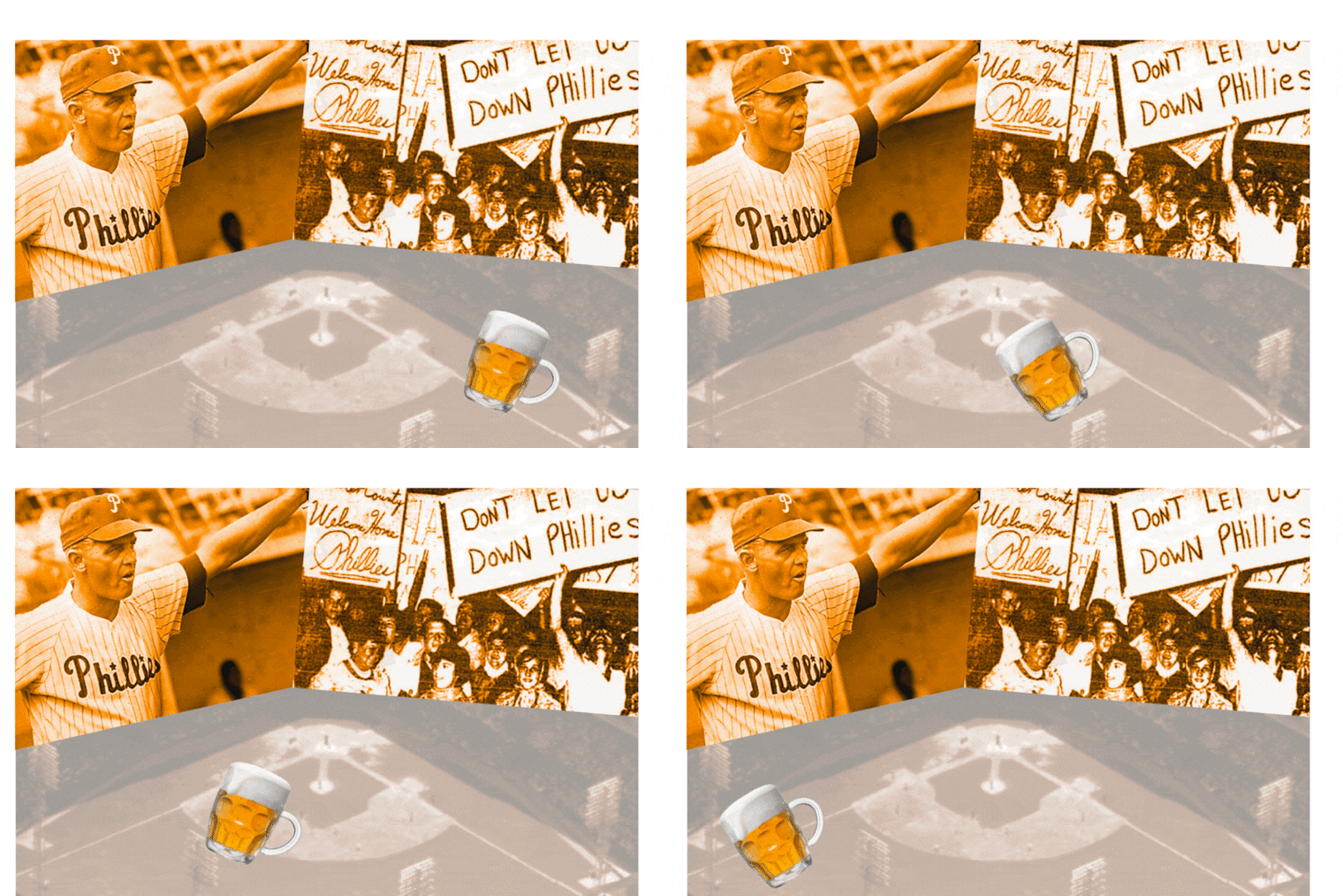
The Phillies first legally sold beer inside Connie Mack Stadium, their musty old park in North Philadelphia, on Aug. 7, 1961, when they put seven local brands of bottled beer on sale for 35 cents, first poured into a paper cup by eight vendors working the aisles.
The paper cup was a vital part of the transaction, because, prior to legal sales, Phillies fans used to sneak in cans of beer, often sold in “cold packs” at nearby bars like Charlie Quinn’s Deep Right Field Cafe at 20th and Lehigh.
Beer cans were heavier in those days, so they tended to become missiles when the umpires missed a call, or if the Phillies stank, which was quite often.
The low point probably came on June 12, 1959, when a twi-night doubleheader against San Francisco was halted after five innings because of rain. The Phillies were no-hit — but even worse, fans were denied rain checks to both games because the first game was official.
As Frank Fitzpatrick, the now-retired Inquirer reporter who attended the game as a 9-year-old, recalled in the paper in 2016: “Suddenly, one empty can fluttered toward the field. A second followed quickly. Soon, it was a dangerous deluge. So many were tossed that cans obscured the tarp, from the mound to the batter’s box.”
That was not good news for Robert R.M. Carpenter, the Phillies owner, who dearly wanted a new ballpark for his team. Plans had been drafted for a 45,000-seat, $8 million stadium in the Torresdale section of Philadelphia, with an adjoining theme park, yacht basin, and bird refuge park adjacent to I-95. Beer sales would bring in some cash for that amazing project.
On June 20, 1961, the Pennsylvania Senate passed a previously approved bill by the state House that would permit the sale of beer every day but Sunday at sporting events at stadiums in the state that seated more than 25,000. (The Pittsburgh Pirates also happened to be looking for a new ballpark.)
But they faced stout foes. After voting against the bill earlier in 1961 that would have enabled the Phillies to sell beer, a Democratic state assemblyman from Philadelphia, Charles Heavey, predicted that the sale of beer would actually “contaminate” youngsters.
So … first the beer had to be poured into a paper cup before drinking, preventing another beer can pileup on the field like the one in 1959. And there would be more than one starting pitcher: Schmidt’s, Esslinger, Old Dutch, Horlacher, Neuwiler and, yep, Ballantine were all included in the original sudsy rotation.
Larry Merchant provided statistics in his Daily News column the next day: A total of 3,739 beers were served to 5,586 who attended that Aug. 7 game, a 3-1 Pittsburgh victory on a Monday, which was also the Phillies’ 10th straight loss. No bottles or cans were thrown on the field, he reported, but fans did pop the cups and try to throw those onto the field — often in vain.
“For serious drinkers, it was about a four-beer game, just two and a half hours long,” Merchant joked. “For serious Phillies fans, it was a six-beer job. They look better that way.”
Merchant made note of signs at the entrances that read, “Bringing in of canned beer or bottled beverages will be a cause for ejection from the park.” Nonetheless, he reported, seven would-be beer smugglers were caught at the gate, their brews returned when they left the park.
Those 1961 Phillies were so lousy that their losing streak grew to 23 games, still a modern record. After the Phillies beat Milwaukee, 7-4, on Aug. 20 in the second game of a doubleheader, their flight home was welcomed by 500 fans at 1 a.m. the next day at the airport.
“They are selling rocks at $1.50 a pail,” Phillies pitcher Frank Sullivan, looking out of the plane, joked to his teammates.
He then wisecracked: “Leave the plane at five-minute intervals. That way, they can’t get us all with one burst.”
In truth, the beer ploy sales did not seem to provide much of a boost to the 1961 Phillies, who lost 107 games and finished last in the National League in home attendance in 1961, averaging only about 7,600 per home game. But a door, or many brewskis, had been cracked.
Beer would not be sold at Sunday home Phillies games until 1972, after the Phillies moved to Veterans Stadium, following the amendment of the ancient Pennsylvania Blue Laws, intended to curtail activities on Sundays (including Phillies and A’s home games until 1934).
» READ MORE: Most Phillies fans want to forget the 1964 season. This Facebook group is dedicated to remembering it.
“My parents didn’t drink, so I always associated the public consumption of alcohol as something dark and troubling,” Fitzpatrick told me recently. “That feeling was confirmed in spades at that 1959 game.
“By 1966, the summer I worked at the ballpark, I felt differently. I was a soda vendor, and beer suddenly was a precious commodity. Now I envied the beer sellers, because they made the most money and had the least amount of walking. Occasionally, rowdy fans would harass young vendors like me, hurling popcorn containers or wadded-up cups at us, [but] it definitely was comforting to know you wouldn’t have to dodge metal cans. On the other hand, in ’66 the smell of spilled beer now permeated the place. I don’t remember that same aroma when fans brought their own.”
Carpenter never did get his Torresdale stadium. After a one-year delay because of construction, however, the Vet opened in 1971 in South Philadelphia. A few fans grumbled about paying 75 cents for a 12-ounce beer served there by a vendor, perhaps because those same items were 40 cents and 60 cents, respectively, at Yankee and Shea Stadiums in New York.
The pricing was actually meant to be sort of a deterrent. Bud Vye, the Connie Mack stadium manager, told The Inquirer, “At these prices, they’ve got to bring a bankroll just to get bombed out.”
But beer stuck around. A 1998 Daily News exposé into how Ogden Entertainment, then the vendor at the Vet, was caught skimming a half million dollars in annual beer sales led to a price reduction. Local brands, kicked to the side by the national brews, were sold again when the Phillies moved to Citizens Bank Park in 2004. (Large premium drafts then sold for $6.)
Cups were eventually discontinued, and most beer at the ballpark is sold in much lighter cans (which, it should be noted, are opened by the cashier, lest someone try to hurl a full can on the field). Dozens of different brands of beer can be spotted at any Phillies game.
“A big part of this is marketing,” Macnow tells me. “Beer at the ballpark is no longer poured into paper cups, so there’s a long-term benefit to seeing people walking around the park holding cans of your beer. Labeling becomes important. Naming beers becomes important.”
And so is the vessel itself. The Phillies continue to sell “beverage bats,” large hollow plastic souvenir baseball bats that can be filled with any beverage. Those are not cheap, either. Phillies fans may be held captive by the prices, but beer and baseball are inseparable.
Dave Caldwell lives in Manayunk and covered sports for The Inquirer from 1986 to 1995.