Letters to the Editor | Nov. 4, 2026
Inquirer readers on allegations of antisemitism in Philadelphia’s public schools and the parallels between President Trump and one of his 19th-century predecessors.

Schools under scrutiny
The Inquirer recently reported on the Philadelphia School District’s effort to fire its social studies curriculum director — Ismael Jimenez — as the result of a report produced by the House Committee on Education and Workforce entitled “Antisemitism in K-12 Schools.”
While the district should be proactive in combating all forms of prejudice — including antisemitism — it is doubtful whether this report will accomplish those objectives.
For example, the report argues that students learning about “environmental justice,” climate activism, and “the impact of bias, injustice, and privilege on a global scale” is unacceptable. The committee also found fault with the district’s recommendation of “a book introducing children to pronouns including ‘ey/em’ and ‘ze/zir.’”
It is understandable why the committee’s Republican majority included this material, whose agenda has nothing to do with antisemitism. What is less comprehensible is why the district would acquiesce to this subcommittee’s demands.
Coleman Poses, Philadelphia
. . .
Ismael Jimenez, the social studies curriculum director of the Philadelphia School District, is being considered for termination. He claims he had no issues with the district until the district’s Jewish Family Association called him out. But the real issue is — why didn’t the Board of Education call him out first?
Public school employees are entitled to freedom of speech outside of classrooms. But inside school classrooms, publicly funded teachers have a responsibility to teach both sides of issues equitably, so students, using critical thinking, can make up their own minds.
This was not happening in the Philadelphia School District, the ninth-largest public school district in the country, thanks to Jimenez and his one-sided social studies curriculum. Jimenez and the teachers who followed his curriculum were promoting only anti-Israel views, while omitting the entire Israeli side of the conflict. This is called indoctrination, not education, and millions of Philadelphia taxpayers were footing the bill.
Teachers’ public media posts are an extension of their classrooms, as students have access to these posts and can read and comment on them. The district has clear policies for teachers’ use of social media, but Jimenez and his like-minded teachers repeatedly violated district policy by posting their extreme anti-Israel views, with no counternarrative.
Jimenez’ single-sided curriculum and inflammatory social media posts were a leading factor in a pair of federal investigations into antisemitism in the district.
The Board of Education should not only terminate Jimenez — it should also apologize to the tax-paying public for allowing Jimenez’s indoctrination-based curriculum to pass for education and for allowing our public schools to become a national disgrace.
Katherine Kaplan, Mount Laurel
. . .
AJ Ernst makes an excellent point in his essay about the need to teach Pennsylvania students how to civically engage. The Academy at Palumbo project Ernst referenced was from my class, which used a teacher-designed curriculum from the Philadelphia School District and support from PhillyBOLT, a community organization.
The school district’s civics curriculum includes government advocacy lessons designed by teachers in partnership with local organizations. These lessons, as Superintendent Tony B. Watlington Sr. rightfully says, are “to teach children how to think and not what to think” by posing real issues in their communities, developing skills of academic research considering multiple perspectives, and engaging directly with the leaders who make policy — critical life skills for Philly students to become civic actors.
However, with the district’s curriculum under politically motivated attack from Washington, the superintendent now says the district is “standardizing its social studies curriculum and will no longer allow staff to write district social studies curricula.”
The district needs to stand up to political bullying, defend its teachers, and stand by its locally created and relevant curriculum. The Pennsylvania General Assembly should also go beyond a civics test and legislate an inquiry-based civic skills project for high school seniors.
Charlie McGeehan, teacher, Philadelphia School District
Time’s up
Last week’s online public meeting focusing on developer KBK Enterprises’ latest attempt to assemble a plan to renovate and repurpose the historic Germantown YWCA building fell far short of instilling confidence among the participants. But this is nothing new — it marks the continuation of more than a decade of raised expectations and dashed hopes.
While KBK’s CEO and president, Keith B. Key, was present at the virtual meeting, offered a project overview, and invited questions, he failed to provide substantive answers to critical queries. Repeatedly, via the chat, he was asked for details on the funding mix — the capital stack, as he called it. Most notably, several people inquired about the terms and amounts of the city’s contribution of loans and grants, but to no avail.
Back in 2024, when KBK first applied for Low-Income Housing Tax Credits from the Pennsylvania Housing Finance Agency (PHFA), its application was rejected. Quoting from the agency’s standard protocols, PHFA wrote that “In accordance with our published 2024 Qualified Allocation Plan, a development must receive AT LEAST 120 points to even be considered for a potential reservation of Low Income Housing Tax Credits.” That KBK submission scored a mere 87 points out of a possible 218, far below the minimum threshold. Once again KBK is seeking tax credits from PHFA, but Key could not explain why this time around, “Things look good,” as he asserted.
In fact, things did not look so good to the 50-plus concerned participants who sat through the 90-minute online meeting. And when asked by one person if the funding commitment letters could be posted, the host responded with, “Perhaps at a more appropriate time.” The time is now, for such letters and much more.
Sydelle Zove, Conshohocken
Dictator envy
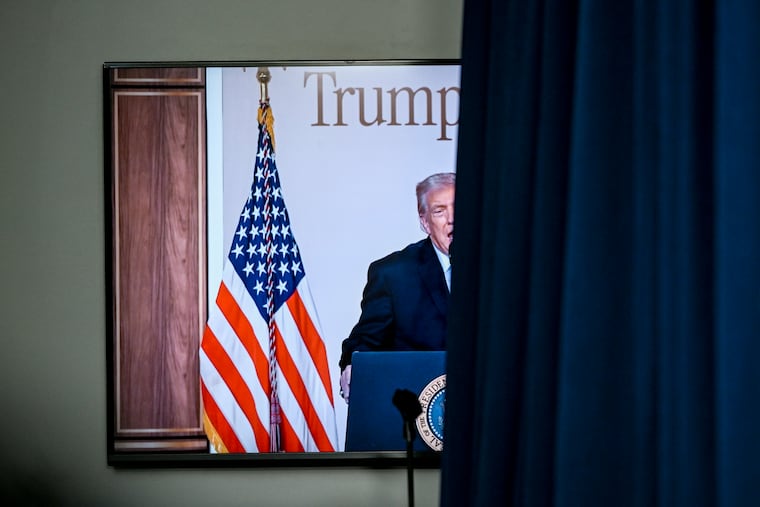
I had a good laugh when I read the historical essay headlined, “Trump could learn from Grover Cleveland about the ‘sixth-year curse.’” Yeah, and my cat “could learn” to play piano. The author mistakenly assumes Donald Trump might actually care about his “governing effectiveness” or persuading Congress to pass legislation that helps ordinary Americans. Trump is only interested in two things: grabbing shady opportunities to enrich himself, and littering Washington, D.C., with garish tributes to himself. For learning about that, Trump looks to foreign dictators like Vladimir Putin, not previous U.S. presidents.
Matt Zencey, West Chester, mzencey@hotmail.com
The writer is a former editor at The Inquirer.
Voter vigilance
Whenever someone complains about election fraud, I always wonder how much they know about it. Over 15 years, I volunteered at polling places in two different states and saw attempts to vote fraudulently. In each case, I filed challenges and the election board handled them properly, preventing fraudulent votes and removing fraudsters from future voting rolls. After the word got out, attempts to vote fraudulently subsided.
It is easy (and correct) to say voting fraud is bad, but instead of blaming one party or complaining that the “system” is corrupt, do what I did: Get to know your voting precinct, learn what the law requires, and volunteer to watch the polls on Election Day.
James Jones, Newark, Del.
About letters to the editor
Letters feature a reader’s written opinion and are submitted in response to an article in The Inquirer or another topical issue. Submissions should be sent to letters@inquirer.com. Limit length to 150 words and include the writer’s home address and day and evening phone number. Letters are published in the Inquirer six days a week on the print opinion pages and online.