RFK Jr.’s slurs against Muslims should remind us to fight bigotry with facts, not name-calling
The health secretary’s false assertions that those who practice Islam don’t produce prize-winning science or literature are easy to refute. Let’s focus on that instead of aiming more barbs at him.

Jonathan Zimmerman teaches history and education at the University of Pennsylvania. His next book, “Schooling Citizens: How Education Can Save Democracy,” will be published in the spring by the American Philosophical Society Press.
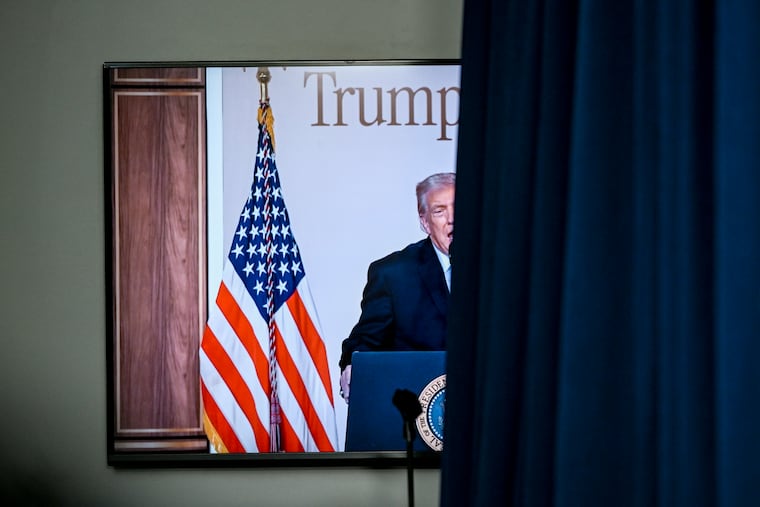
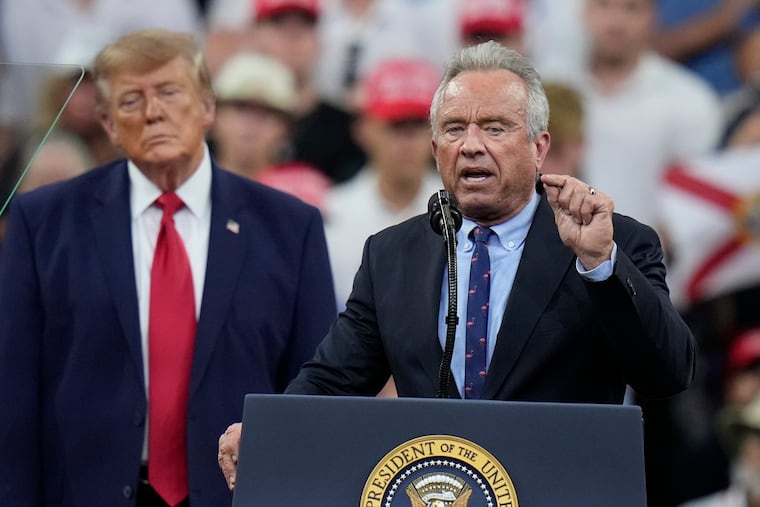
Last week, at a campaign stop in Michigan, Health and Human Services Secretary Robert F. Kennedy Jr. said contemporary Arab Muslims don’t produce prize-winning science or literature.
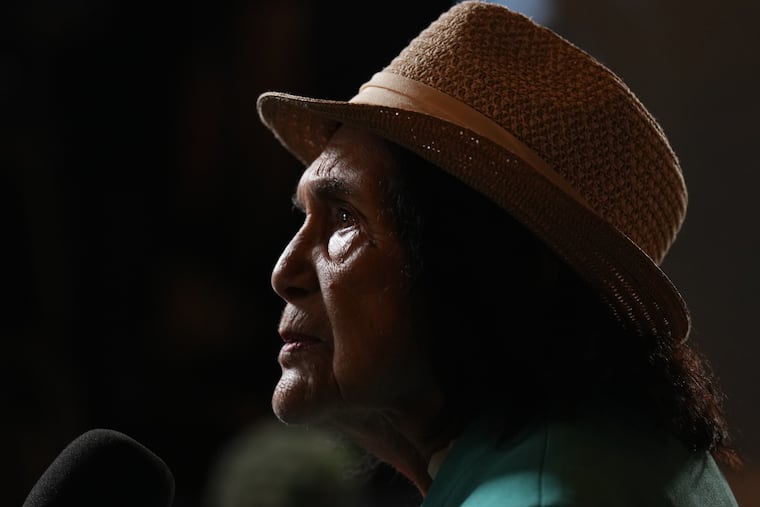
Secretary Kennedy, meet Magid Abou-Gharbia.
A few days before Kennedy’s speech, Abou-Gharbia won America’s oldest science prize: the John Scott Award. Other recipients have included Marie Curie, Thomas Edison, and Jonas Salk.
Abou-Gharbia’s research has led to 145 patents and 10 new drugs, including the antidepressants Effexor and Pristiq. He’s the founding director of the Moulder Center for Drug Discovery Research at Temple, where Abou-Gharbia is developing medicines to treat opioid and cocaine addiction.
And Abou-Gharbia grew up in Egypt. He came to the U.S. in 1974 to pursue his doctoral degree at the University of Pennsylvania.
I’ve been thinking about Abou-Gharbia during the present election season, as Republicans stepped up their anti-Muslim rhetoric.
Kennedy was in Michigan to barnstorm against Senate nominee Abdul El-Sayed, whom President Donald Trump has labeled a “jihadist.”
Sen. Tommy Tuberville (R., Ala.) posted a picture of New York Mayor Zohran Mamdani next to a photo of the 9/11 attacks, along with the caption “the enemy is inside the gates.”
Other GOP politicians have called for bans on Sharia law, and even for the mass expulsion of Muslim citizens.
It’s tempting to just call these attacks racist and Islamophobic, which they surely are. But that’s also guaranteed to stoke yet more anti-Muslim sentiment. When you call people names, they dig in their heels.
The best strategy is to stick to the facts. Across history, bigotry has rested on ignorance. And the only antidote to that is knowledge.
Muslims don’t win high-status prizes? Before Abou-Gharbia, there was the Egyptian diplomat Mohamed ElBaradei, who won the 2005 Nobel Peace Prize for his efforts to limit nuclear weapons. An Egyptian American scientist, Ahmed Zewail, received the 1999 Nobel Prize for chemistry. Egyptian novelist Naguib Mahfouz received the Nobel Prize in literature in 1988.
Secretary Kennedy might not know any of that, and he certainly doesn’t seem to care about it. He’s got his story, and he’s sticking to it.
But we don’t have to play along. When our leaders spread falsehoods about Muslims, we should reply with the truth. It’s our most lethal weapon.
Take Sharia law, a set of guidelines in the Quran — Islam’s major religious text — for living a good life. Over the past two years, state and federal legislators have introduced at least 39 anti-Sharia bills and resolutions. But there is not a single known instance — not one — of a state or municipality adopting or requiring Sharia law.
Does the movement against Sharia reflect anti-Muslim prejudice? Sure. But it’s also deeply ignorant. It imagines Muslims are trying to impose their religious code on other Americans. Again, that’s simply untrue.
Likewise, President Trump’s repeated claim that Muslims in New Jersey cheered after the 9/11 attacks was obviously bigoted. But more than that, it was false. Although some Muslims in other parts of the world celebrated when the World Trade Center towers came down, there is no evidence — none — that Muslims in America did so.
To be sure, people don’t necessarily change their minds when they’re confronted with facts. But they will almost surely tune us out if we simply call them Islamophobes, racists, or fascists.
Carl Rogers, one of the foremost psychologists of the 20th century, noted a “curious paradox” in human beings: When they feel accepted, they’re more likely to change. But if they feel alienated or demeaned, they’ll resist.
When those we disagree with feel accepted, they’re more likely to change.
So we need to proceed gently if we want to win anyone over. That means pointing out the facts, over and over again. And it also means asking people — again, gently — how they would feel if they were judged as harshly as they judged others.
Nearly a decade ago, my Penn colleague Emile Bruneau showed that people who imagined all Muslims as terrorists were more likely to alter their views if they were asked whether white people should be held responsible for the actions of a white mass murderer like Dylan Roof. That works a whole lot better than calling them names.
Emile died of brain cancer in 2020, at the too-young age of 47. A great way to remember him would be to remind ourselves that nobody listens when they feel insulted.
And that includes people who insult Muslims. I won’t excuse or apologize for them, but I want them to change. Don’t you?
Then stop telling them they are evil or subhuman, which is what they say about Muslims. Tell them about Magid Abou-Gharbia instead.
About our columnists
In contrast to news reporters, who operate within an independent, nonpartisan framework, columnists are charged with including their perspectives, opinions, and viewpoints when presenting their reporting. Inquirer columnists include Jenice Armstrong, Will Bunch, Luis F. Carrasco, Paul Davies, Daniel Pearson, Trudy Rubin, and Sabrina Vourvoulias.